
Fichas
1.2 Elasticity
Fichas del conjunto (35)
- 1Price elasticity of demand (PED)A measure of how much the quantity demanded of a product changes when there is a change in price of the product.
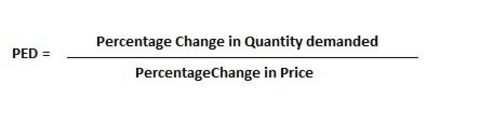
- 2PED formula
- 3PED valueIts always treated as positive although its mathematical value is usually negative.
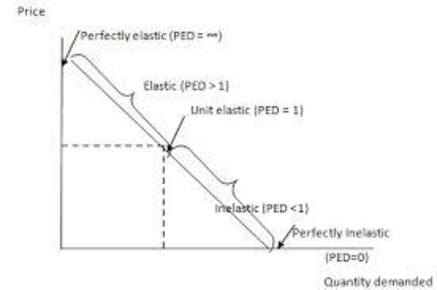
- 4Range of PED values
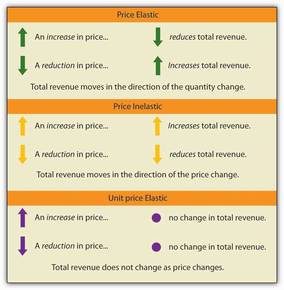
- 5The effects of PED on revenue
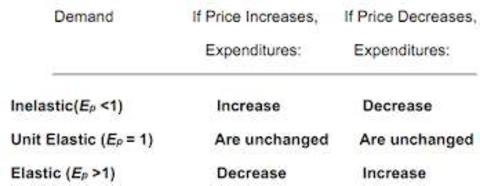
- 6PED values and consumer response
- 7Determinants of PED1. The number and closelessness of substitutes
2. The necessity of the product and how widely the product is defined
3. The time period considered - 8The number and closelessness of substitutes1. The more substitutes=the more elastic the demand for the product
2. The closer the substitutes= the more elastic the demand for the product - 9The necessity of the product and how widely it is defined1. The more essential the product, the more inelastic (eg. food)
2. As the product is defined more widely, the more elastic it becomes eg. Meat-> chicken -> wings, fillets, nuggets, patties ->brands - 10Time period consideredPED tends to be more inelastic in the short term and then becomes more elastic the longer the time period it is measured.
- 11PED on a demand curve
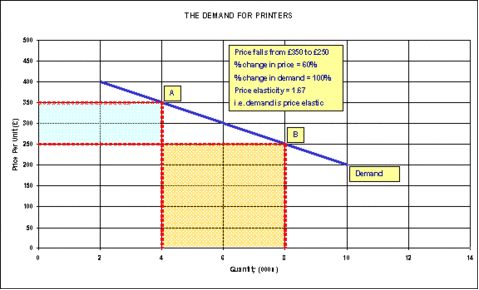
- 12Why does PED vary along a straight line?
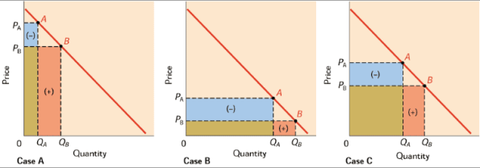
- 13Role of PED for firm decision making regarding price changes and their effect on total revenue
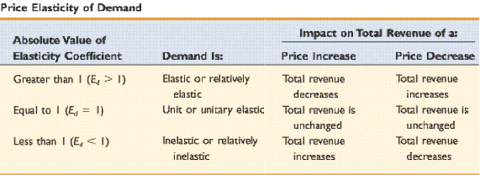
- 14PED for primary commodities vs. PED for manufactured productsPrimary commodities have a relatively low PED compared to manufactured goods because
they are necessities and have little substitutes. This results in large fluctuations in primary
commodity prices over short periods of time.
For example, a small decrease in the supply of primary commodities will result in large
increases in the price of primary commodities, but a small increase in the price of
manufactured goods. - 15PED and government policies (Taxation)Governments aim to raise revenue and discourage/encourage consumption. The lower the
price elasticity of demand for the taxed good, the greater the government tax revenue. - 16Cross price elasticity of demandA measure of how much the demand of a good changes when there is a
change in price of another good, ceteris paribus. - 17XED formula
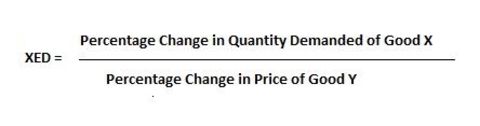
- 18XED values (Complementary goods vs. Close substitutes)
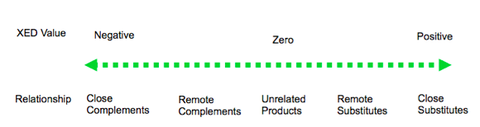
- 19Why does the absolute value of XED depend on the closeness of the relationship between two goods?Assuming Xboxs and PS3s are close substitute goods.
Absolute value of XED depends on the closeness of the relationship between two goods because if the price of Xbox rises a bit, everyone would switch over to the PS3 and the sales of PS3 may skyrocket. Thus if a small change in price increases/decrease the sales of another product by a significant amount, the absolute value of XED would be high. - 20What are the implications of XED for business if prices of complements/substitutes change?CED helps to increase the rival consciousness of a firm and plan pricing policies. If a firm
has a product that has a high positive CED in relation to his rival’s product, the firm has to
respond quickly to change in the price of the rival’s product.
Firms can make their goods less substitutable from its rivals so that it is less affected by
the pricing policies of the rival firms, through advertising and adding different features to
his product to increase product differentiation. (e.g. membership scheme, longer
warranty, delivery services)
If a firm has a product that has a negative CED in relation to his rival’s product, the firm
partner with such firms and link marketing plans to the pricing policy of the other firm.
(e.g. package complementary goods together, display same area, stock up goods) - 21Income elasticity of Demand (YED)The measure of how a change in the overall income level in an economy changes in the demand of a specific product.
- 22YED equation

- 23YED values -Normal goods (positive) -Inferior goods (negative)
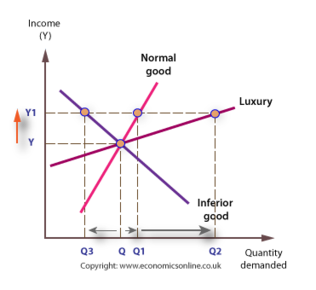
- 24Necessity goods vs. luxury goods
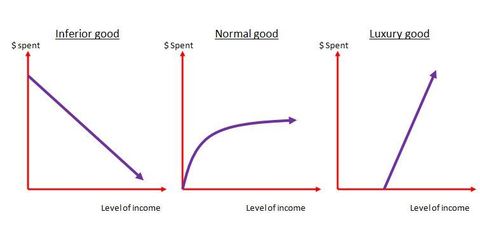
- 25YED implications for producers and the economyIf incomes are rising, during economic booms, firms could produce goods that are more
income elastic, add more features to their products to make it more luxurious, or
advertise their products as premium goods.
If incomes are falling, during economic downturn, firms could produce goods that are
more income inelastic, reduce features from their products to make it more essential, or
advertise their products as “value for money” to the budget conscious.
Firms can segment his market into different income groups and produce the appropriate
range of products to suit consumers of different income groups. - 26Price elasticity of Supply (PES)A measure of how much the quantity supplied of a product changes when there is a
change in the commodity’s own price, ceteris paribus. - 27PED equation
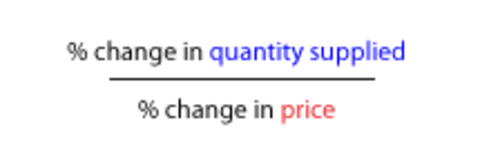
- 28PES values
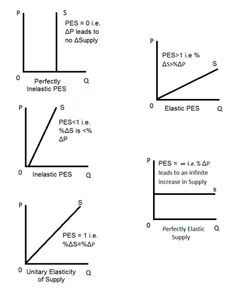
- 29Determinants of PES1. Time period considered
2. Factor mobility
3. Number of firms
4. Stocks and spare capacity
5. Length of production period - 30Time perioda. Longer time period, more elastic
b. Short time period, more inelastic
c. Take time to change quantity supplied (react to price changes) - 31Factor mobilitya. Quicker resources can be shifted, more elastic
b. Ease and speed firms can shift resources from one industry to another - 32Number of firmsa. Greater number of firms, more elastic
- 33Stocks and Spare Capacitya. More ease in storing goods, more elastic
b. More spare capacity, more elastic - 34Length of Production Perioda. Shorter length of production period, more elastic
- 35PES of primary commodities vs. manufactured productsThe PES for primary commodities is relatively low because a change in price cannot lead to a proportionately large increase in quantity supplied.
The PES for manufactured products is relatively high because it is easier to increase or decrease quantity supplied in response to a change in price.
Información
- Descripción
- International Baccalaureate (Microeconomics ) Economics Fichas sobre 1.2 Elasticity , creado por ntokozoyende el 13/04/2014.
- Creado por
- ntokozoyende
- Visitas
- 912
- Valoración