
Fichas
SL Flashcards
Fichas del conjunto (79)
- 1Name some theoretical models that distinguish between managers and leadersBuchanan and Huczinski
Mintzberg's managers roles
Hollingsworth's leader versus manager
Watson's use of McKinsey's 7 S framework
Covey's Transactional vs Transformational - 2Buchanan and Huczinski's of Leaders vs Managers has four categories, what are they?1. Create an agenda
2. Develop People
3. Execution
4. Outcomes - 3Mintzberg identifies ten roles of a manager, one of which is leader. How does he categorise the roles?Interpersonal, Informational, Decisional
- 4Identify some of the contrasting roles of managers and leaders, according to Hollingsworth's modelAdministrates vs Innovates
Maintains vs develops
Systems/ structure vs people
Controls people vs trusts people
Bottom line vs Horizon
Does things right vs does the right thing - 5Identify McKinsey's 7 S's, and categorise them according to WatsonSuperordinate goals (L)
Structure (M)
Skills (L)
Staffing (L)
Strategy (M)
Systems (M)
Style (L) - 6What are the power bases of a leader, according to French and Raven?Richard Cromwell Likes Riding Elephants!
Referent
Co-ercive
Legitimate
Reward
Expert - 7Stogdill identified 12 Traits of a Leader. Name them.Drive
Focus
Vigour and Persistence
Originality
Initiative
Self Confidence
Personal Identity
Accepts consequences
Absorbs stress
Tolerates delay
Influences Others
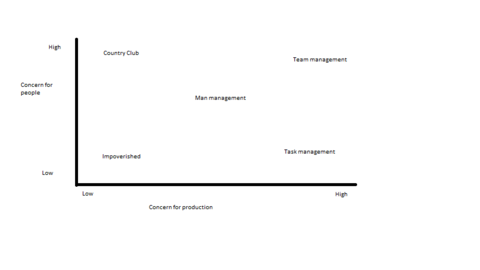
Structures situations - 8Identify at least 8 different Leadership theoriesBlake and Moulton
Fielder's Contingency (Least preferred co-worker)
Hershey & Blanchard Situational Leadership
Tannenbaum and Schmidt
Adair's Action Centred Leadership
Covey's Transformational vs Transactional
Path-Goal theory
Charismatic Leadership
Servant/ Team Leadership
Distributed Leadership
Characteristics - 9Explain Blake & Moulton's model of team leadership
- 10What is Fielder's contingency theory?A load of rubbish!
Least preferred co-worker. No one gets it. - 11Who devised "Situational Leadership" and what is it?Hershey and Blanchard
R1: Unable and unwilling
R2: Unable but willing
R3: Able but unwilling
R4: Able and Willing - 12Whose team leadership model plots authority versus freedom?Tannenbaum and Schmidt
Movement on the X-Axis: Tell, Sell, Suggest, Request - 13What are the three elements of Adair's Action Centred Leadership model, and how does it work?Task, Team and Individual
A leader must focus on the different areas at different times, depending on the situation - 14What are the differences between a transformational and a transactional leader?Transactional leaders tend to focus on the day to day, short term tactical issues. A transformational leader focuses on the strategic and transcends the day to day.
There is a need for both types of leader. - 15What is path-goal theory?Leader behaviour is effective to the extent that followers can see it as an instrument to future satisfaction.
Leaders set a path for followers to achieve their goals - 16Explain charismatic leadership, and current thinking on it.Leaders should be strong role models, dominant personalities, articulate goals and have high expectations.
After high-profile scandals, there is also the need for leaders to have gravitas. - 17What is servant/ team leadership?A leader is the servant of their team
They take their direction from the team because they recognise the skills and expertise within it. - 18What is distributed leadership?Leaders emerge from within the organisation, and possibly at any level. The "best person for the job" leads the task.
LEO - 19Identify some characteristics of a leaderCommunicator
Problem-solver
People manager
Motivator
Decision-maker - 20How has public sector leadership been defined?Structure,
Craft,
Institution - 21Pfeffer identified 11 ways to exercise power in strategy, name them1. Mete out resources
2. Shape behaviour through reward
3. Advance on multiple fronts
4. Make the first move
5. Co-opt antagonists
6. Remove rivals, if possible
7. Don't draw unnecessary fire
8. Use the personal touch
9. Persist
10. Make important relationships work
11. Make the vision compelling - 22What are Kotter's 8 steps to lead change1. Establish a sense of urgency
2. Create the guiding coalition
3. Develop the change vision
4. Communicate the change vision
5. Empower broad based action
6. Generate short term wins
7. Never let up
8. Incorporate change into the culture - 23CIPFA identified 14 roles of a Finance Director, over and above "Head Accountant". Name themDirector
Financial Manager
E-Commerce manager
Quality manager
Strategist
Treasury Manager
Risk manager
A Professional
Planner
Internal Auditor
Resources Manager
Relationship manager
Corporate finance manager
Information Manager - 24Identify six types of engagement.Information giving
Information gathering
Consultation
Involvement
Participation
Empowerment - 25Collaborative Leadership is also known as the 8 I's for successful We's. List the 8 I's.Individual excellence
Importance
Interdependence
Institutionalisation
Integrity
Integration
Information
Investment - 26List the seven dimensions of an innovative organisationRisk taking
Reward
Relationships
Resources
Knowledge
Goals
Tools - 27Define sustainability and explain the spectrum of sustainability in the Public ServicesSustainability is all people in the world satisfying their basic needs and enjoying a better quality of life without compromising the quality of life of future generations.
The spectrum is:
At risk
Compliance led
Incremental
Strategic
Systemic - 28What is ethical leadership?Ethical leadership is about:
Being transparent and accountable
Behaving honestly
Promoting public value
Supporting sustainability
POPIC! - 29Explain Quinn's model of Cultural congruence4 types:
Clan: A cohesive unit. The leader is a parent figure
Adhocracy: A creative adaptable organisation. The leader is an innovator
Hierarchy: An organisation based on structure. The leader is an organiser/ administrator
Market: A competitive organisation. The leader is achievement-oriented - 30Explain Miles and Snow's Organisational Types4 types of organisation:
Defender: High expertise with a narrow product focus
Prospector: An organisation continually looking for new markets
Analyser: An organisation with a distinct set of products, but willing to look at new opportunities
Reactor: An organisation that frequently changes but is not effective - 31What is the difference between Human Resource Management and Strategic Human Resource Management?HRM is the coherent approach to managing people.
SHRM is the planned way to do this to support the strategic goals of the organisation, by creating and implementing fitting policies and procedures - 32What are the three elements of motivation?Arousal: The recognition that something in our lives is missing
Direction: The path we choose to get that item
Intensity: The vigour we apply to get there - 33What type of theory is Herzberg's two factor theory? Explain itIt is a job based theory of motivation.
There are two factors, "hygiene" and "motivator".
Hygiene factors are hard things like pay and conditions
Motivator are soft things like job enrichment, job satisfaction. - 34What are the three needs-based theories of motivation?Maslow's Hierarchy of needs
McGregor's theory X and theory Y
McLellands N-Ach theory - 35What is Maslow's Hierarchy of needs?It is the theory that people need to satisfy one need before moving onto the next.
The needs are physiological, security, social, esteem, self-actualisation - 36What is McGregor's X and Y?It is the theory that managers can recognise two type of worker, and motivate them differently:
Theory X workers are lazy and need to be motivated with sticks
Theory Y workers are motivated by softer things, like carrots - 37What is McLelland's theory on motivation?McLelland thought that there were three type of people, motivated by different things:
N-Achievement: Motivated by achieving
N-Affiliation: Motivated by social relationships
N-Authority: Motivated to gain authority - 38What are the four cognitive process theories of motivation?Adam's equity theory
Vroom's expectancy theory
Goal setting theory
The psychological contract - 39What is Adam's equity theory?The theory that people are motivated by being treated equitably. Eg if they understand that someone has worked their way up an organisation, they may be motivated to do the same
- 40What is Vroom's Expectancy Theory?Vroom's expectancy theory is the theory that motivation is an equation, made up of three elements:
Expectancy: The thing that is wanted
Instrumentality: How hard you need to work
Valency: How likely it is you'll achieve it - 41What is goal setting theory?The theory that people are motivated if they are set realistic and achievable goals, and there is reward for doing so.
SMART - 42What is the psychological contract?It is an unwritten contract between employed and employer, whereby one guarantees security, pay and job satisfaction and the other guarantees they will work hard and meet expectations
- 43Describe the 5 elements of a high performing team (not Tuckman)Job design
Interdependence
Composition of team
Context of the team
Processes - 44Explain Tuckman's model of High Performing TeamsForming
Storming
Norming
Performing
Mourning - 45Explain Cog's ladder of High Performing TeamsPolite stage
Why we are here stage
Power stage
Co-operation stage
Esprit stage - 46What are the team roles Belbin identified?Plant
Resource Investigator
Chair
Shaper
Monitor Evaluator
Company Worker
Completer Finisher
Specialist
Team worker - 47Identify the two types of conflictAffective conflict: Conflict between parties due to the behaviour of one or both
Substantive conflict: Conflict between two parties based on issues - 48Identify 6 causes of conflictActivity incongruent with need
Resources in short supply
Exclusive preferences re joint actions
Parties are interdependent
One's behaviour is incompatible
One holds exclusive views - 49Explain McCobby and Scudder's model of conflict managementAnticipate potential conflict sources
Prevent conflict by creating strategies
Identify sources of conflict
Manage the conflict
Resolve - without blame - 50Who devised transactional analysis and what is it?Berne.
The PAC model
Parent-Adult-Child
Mature relationships should be Adult to adult. - 51What ways of resolving conflict does the TKI questionnaire examine?Avoid
Accommodate
Compromise
Competition
Collaborate - 52What is a competency and how can it help resolve conflict?A competency is a skill. It can help resolve conflict by making sure everyone is clear on the expectation of them.
- 53What are the two steps in appropriate delegation?1) What will success look like?
2) What skills and qualifications are needed to do the task right? - 54What is performance management?Performance management is managerial work needed to ensure that the organisation's aims (its vision and mission) and objectives are accomplished.
- 55What three elements are required for performance management to work in the public services?1) An understanding of how performance affects strategy
2) Decision makers must know how their policies will work operationally
3) The organisation must be motivated to improve. - 56Give some examples of performance improvement techniquesBechmarking
Lean thinking (improving the value stream)
Total Quality Management - 57What is a network?A network is any relationship between two or more bodies for common benefit, in an informal manner
- 58What is a partnership?Partnerships are formalised networks, often with a separate body formed to administrate the organisation
- 59What is the purpose of organisations being structured?To ensure effective communication and control across an organisation
- 60What are Mintzberg's organisational types?Entrepreneur (simple, flat)
Machine (hierarchical)
Professional (one person with power)
Divisional (hub and spoke)
Innovative (project based)
Missionary (Campaigning eg charity)
Political (relies on alliances) - 61What are Handy's cultural types?Role (power from position in organisation)
Power (small groups of power)
Task (ability to get job done)
Person (eg GP, Lawyer) - 62Explain Johnson's cultural webParadigm
Stories
Control
Rituals and routine
Organisational structure
Power
Symbols - 63What are the six elements of the Localism Act?Diversify the supply of public services
Open up Government to public scrutiny
Lift the burden of bureaucracy
Increase local control of public finances
Empower communities
Strengthen accountability to local people - 64What is "Double Devolution"?1) Devolve from CG to LG
2) Devolve from LG to lowest level - 65What is the difference between change management and organisational development?OD is a planned intervention to improve effectiveness
Change management is the organised transition from one thing to another - 66What are the four classifications of change according to Balogen and Hope-Hailey?1) Adaptation: Small steps to realign
2) Reconstruction: Many realignments
3) Evolution: Step by step change to alter the paradigm
4) Revolution: Big bang change to alter the paradigm - 67What are the seven steps for implementing change?C Current State
F Future state required
C Change Needed
A Analyse the change needed
T Transition required
M Manage the Transition
E Evaluate the process - 68What element form the change Kaleidoscope and what is it used forThe change Kaleidoscope is a method of analysing change and its implementation
P Power
C Capacity
C Capability
P Preservation
R Readiness
D Diversity
S Scope
T Time - 69What is the TROPICS test?The TROPICS test is a method of analysing the change required
T Timescale
R Resources
O Objectives
P Perceptions
I Interest
C Control
S Source - 70What are the stages of Kurt Lewin's change life cycle?Unfreeze
Move
Refreeze - 71Identify Kubler-Ross's stages of reaction to changeD Denial
A Anger
B Bargaining
D Depression
A Acceptance - 72Identify 6 "change interventions"E Education
C Coercion
A Agreement
M Manipulations
P Participation
S Support - 73What is Force Field Analysis and What can it be used for?Force Field analysis is a method of measuring the factors involved in a change.
There are positive and negative forces. They are depicted with arrows, the size of the arrow determines the strength of the force. - 74What is a "change agent"?A change agent is someone who will lead or be a catalyst for change.
They can be internal or external - 75What are the advantages and disadvantages of external change agents?ADV:
New skills, not in organisation already
new perspectives
no baggage
Can be skill transfer
can be "mr nasty"
DISADV:
Cost
No buy in
Resentment
No history in the organisation - 76What are the five competency areas of a change agent?Objective setting
Role allocation
Communicator
Negotiator
Managing up - 77Name some methods of consulting the publicCitizen juries
Community advisory groups
Consultation documents
Public meetings
Road shows
Surveys and interviews
Workshops and focus groups - 78What factors might influence choice of media?A Audience
B Budget
C Channel
L Length of interaction
I Importance of message
E Evaluation of success - 79What are the three types of stakeholders when it comes to consultation?Champions (supporters)
Blockers (Opposers)
Floaters (Unclear on position)
Información
- Descripción
- Fichas sobre SL Flashcards, creado por Adam Cook el 26/05/2014.
- Creado por
- Adam Cook
- Visitas
- 57
- Valoración