
Fichas
Working Memory
Fichas del conjunto (20)
- 1Short term memory-In the late 1800s, William James distinguished between primary and secondary memory.
Evidence?
-The magic number 7: Miller (1956) concluded that our information processing capacity ranges from 5 to 9 items (7 +/- 2)
-BUT: Cowan (2001)-
A single, central capacity limit averaging about four chunks is implicated along with other, noncapacity-limited sources
-LTM has MUCH larger capacity.
Double dissociation: Immediate memory recall is worse when the items are phonemically similar (e.g. car, cat, hat, ham…) than when they are semantically similar (e.g. big, huge, large, enormous…). HOWEVER… the inverse is true for longer retention intervals (Baddeley, 1966). - 2Primacy and RecencyWhen subjects are instructed to free recall a list of items…
-Primacy effect: they tend to remember best the items in the beginning of the list
-Recency effect: they tend to remember best the items near the end of the list - 3Postman & Phillips (1965)-shown that when recall is delayed for a few seconds, during which rehearsal is prevented with a counting task, the recency effect disappears; whereas primacy is virtually unaffected by this manipulation.
- 4The serial position curve: Glanxer and Cunitz (1966)-Glanzer & Cunitz (1966) examined the serial position curve using three groups of subjects.
G1: Immediate free recall
G2: Counting backwards for 10 secs
G3: Counting backwards for 30 secs
-The longer the wait for the free recall, the fewer the items recalled from the end of the list.
So, the recency effect appears to be based on STM. Evidence against a unitary view of memory. - 5The serial position curve: Baddeley and Warrington (1970)-Baddeley and Warrington (1970) employed free recall and the serial position curve to compare the performances of healthy subjects and amnesic patients.
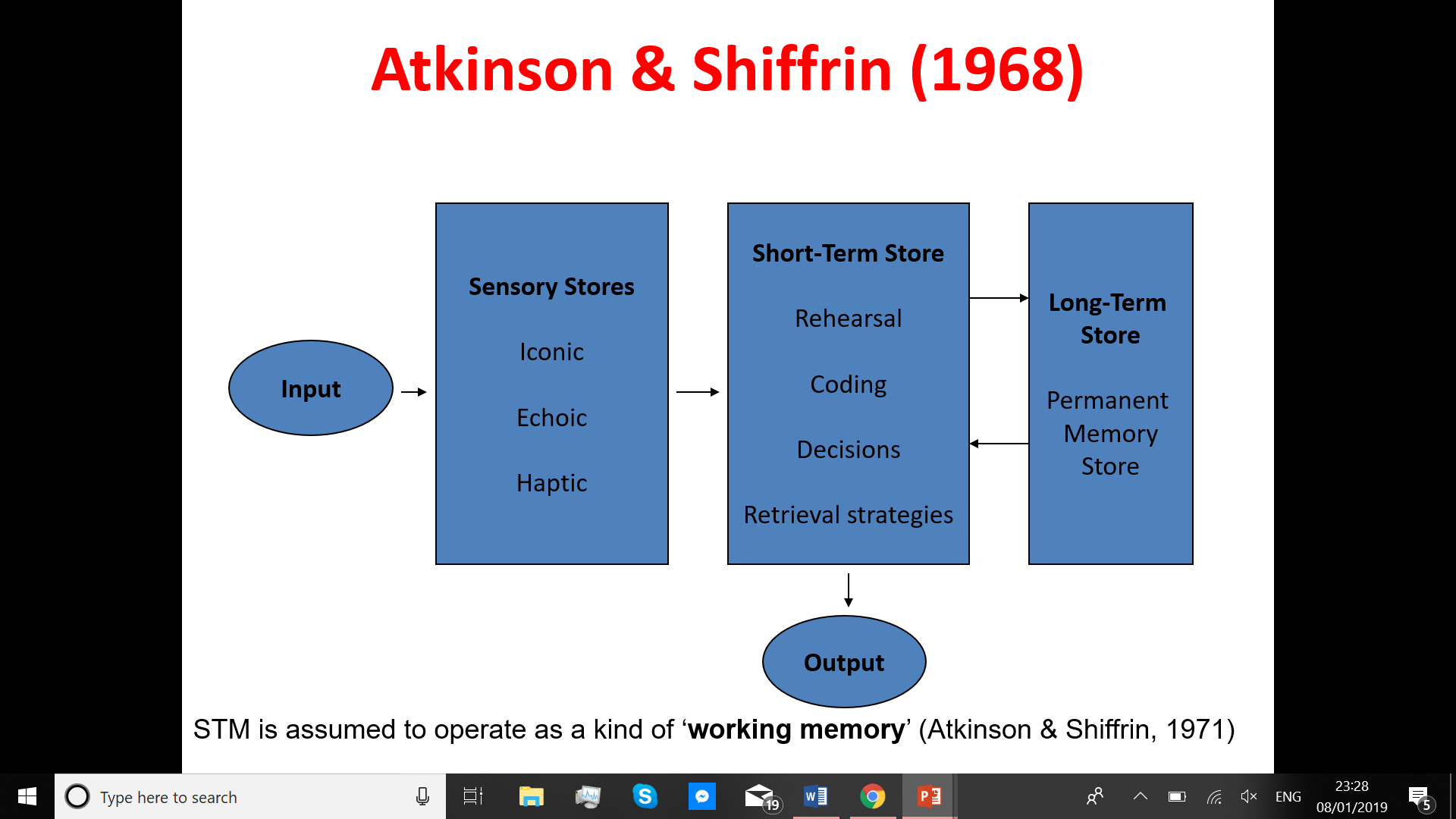
-Amnesics performed normally on the digit span task (STM task) and showed a normal recency effect at free recall (STM component). However, their free recall of early items (primacy effect) was impaired compared to controls’. - 6Atkinson & Shiffrin (1968): assumptions-Information is transferred to and from LTM through STM only.
-The longer an item is held in STM, the greater the probability it will be transferred to LTM.
-STM is unitary. - 7Flowchart
- 8Shallice & Warrington (1970): KF-KF sustained a severe head injury resulting in a left hemisphere lesion next to the Sylvian fissure.
-According to several tests, KF’s cognitive functions were near normal, but his digit span was very low (1 to 2 items rather than 7).
-KF’s auditory STM performance was impaired with all types of material (digits, words and even worse with letter strings). - 9Shallice & Warrington (1970): KF EVIDENCE-Strong evidence for the STM LTM distinction:
-Amnesic patients like HM (Milner, 1966) have intact STM and impaired LTM.
--Single Dissociation
--Alternatively: STM tasks are easier than LTM tasks.
-However, KF’s case provides a Double Dissociation
-On the other hand, KF provides evidence AGAINST the Atkinson and Shiffrin Model:
-His LTM was unimpaired (info was assumed to go into LTM only via STM).
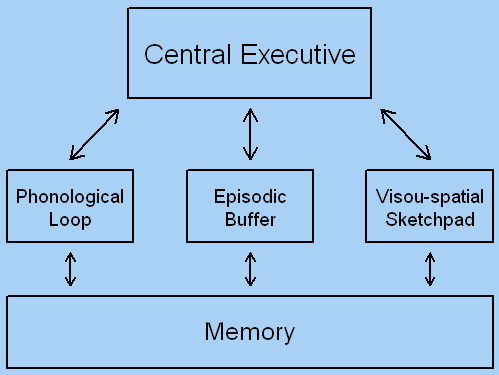
Other cognitive functions assumed to rely on ‘Working STM’ were also intact! - 10Baddeley and Hitch (1974) Intro-Dual task experiments have been most illuminating.
-If working memory is involved in reasoning, language comprehension and similar cognitive tasks, such tasks should be disrupted by irrelevant STM loads.
-Indeed! But the disruption was not ‘catastrophic’ suggesting different components.
-Similarly, phonetic similarity (shown to disrupt STM) disrupted reasoning and comprehension, but again not severely.
-Findings consistent with KF’s condition. - 11Baddeley and Hitch (1974)
- 12Phonological loop components-Inner ear
-Phonological store: Keeps speech-based information for 1 to 2 seconds.
-Subvocalization: 1. Translates visual information into speech-based information and transfers it to the phonological store 2. Refreshes information already in the Phonological store preventing it from decaying. - 13The Phonological Loop-Baddeley et al. (1975):
-Participants saw lists of 10 words. Each list comprised of words with one, two, three, four or five syllables.
-Recall fell as the length of the words increased.
-Also, reading rate was related to amount of recall (the faster the reader, the higher the recall).
-Articulatory suppression (e.g. “the the the the”)
-Eliminates the word length effect and the similarity effect by occupying the subvocalization process.
-Evidence for a subvocalization process of rehearsing verbal material to prevent their decay from the phonological store. - 14Continued-Irrelevant speech effect: Recalling visually presented consonants is more difficult if irrelevant speech is played in the background.
-That is because speech has direct access to the phonological loop.
--So: Non-speech items should not have the same effect…
-Indeed, they don’t (Salame’ & Baddeley, 1982)
-Additionally, articulatory suppression disrupts the irrelevant speech effect!
-HOWEVER: If the irrelevant non-speech sounds vary over time, they are disruptive (Macken & Jones, 1995). - 15Visuospatial sketchpad- (inner eye) deals with visual and spatial information.
- Visual information refers to what things look like.
- It is likely that the visuospatial sketchpad plays an important role in helping us keep track of where we are in relation to other objects as we move through our environment (Baddeley, 1997). - 16Baddeley & Lieberman, (1980)-Subjects used the method of loci OR simple rote rehearsal to memorize words.
-Half of the subjects from each group had to do a concurrent tracking task (track a moving sound) which is a spatial task (non-visual).
-The tracking task disrupted memory performance when the method of loci was used, but not when rote rehearsal was used.
-A visual (non-spatial) task of detecting brightness changes had no disruptive effect. - 17Continued-Double dissociation between the visual and the spatial aspects of the visuo-spatial sketch pad with neuropsychological evidence:
-Patients have shown isolated impairment with spatial tasks but not visual tasks while other patients have shown the inverse pattern (Farah, 1988). - 18The Central Executive-“The most important but least understood component of working memory” (Baddeley, 2003:835)
-Baddeley (1986, 1996): A system for attentional control
Focusing, dividing, switching attention, and accessing information in LTM.
-A common task thought to tax the central executive is random generation (inhibitory control is required to avoid stereotyped sequences). - 19Baddeley (2000)-The model was refined and the Episodic Buffer was added.
-Largely to solve the ‘binding problem’.
-A limited capacity store supporting the CE, and storing info from the other slave systems and LTM (in ‘bound’ form). - 20Cowen’s (1995, 2001) Embedded process model-LTM is partitioned in three ways:
1. The larger portion with low activation. 2. A subset currently activated because of specific cognitive activity and perceptual input
3. The focus of attention and awareness.
Información
- Descripción
- Cog Exam Fichas sobre Working Memory, creado por Veton Vishka2 el 08/01/2019.
- Creado por
- Veton Vishka2
- Visitas
- 1
- Valoración