
Fichas
FINC306
Fichas del conjunto (80)
- 1What are the difference between forwards and futures contracts?Futures : standardised, publicly traded, have marked to market (settled daily), low credit risk because of clearing house and margin requirements, usually used for speculation closed out prior to maturity and high liquidity.
Fowards : Customized to customer needs, Privately traded over-the- counter (OTC), Only possess one settlement date, High counterparty/credit risk (may default on their obiligation), Usually used for hedging.
physical delivery or cash settlement and low liquidity. - 2What are the different exercise styles?European-style: can be exercised only at expiration date – Bermudan-style: can be exercised during specified periods – American-style: can be exercised at any time before expiration
- 3What are the uses of derivatives?Risk management. Derivatives can be used by companies and other users to reduce risks
• Speculation. Derivatives can serve as investment vehicles, which give you exposure not accessible through normal securities
• Reduce transaction costs. Sometimes derivatives provide a less costly way to undertake a particular financial position
. Regulatory arbitrage. It is sometimes possible to circumvent regulatory restrictions, taxes, and accounting rules by trading derivatives - 4What is an in the money and at the money options?In the money option is one that if exercised immediately a positive payoff while at the money has a zero payoff.
- 5What is a derivative ? and what forms do they take?A financial instrument that has a value
determined by the price of something else (i.e.,
the underlying).
– A contract/an agreement between two parties.
come in forms of options, swaps, forwards and futures. - 6What are forms of underlying assets?The most common underlying assets include
stocks, bonds, commodities, currencies, interest
rates and market indexes. - 7What are the strategies used to sell insurance?– Covered writing (option overwriting or selling a covered call) is writing an option when there is a corresponding long position in the underlying asset is called covered writing
– Naked writing is writing an option when the writer does not have a position in the asset - 8What are the 4 different measures of market size and what do they represent?Market value- The market value is the sum of the market value of all
the claims that could be traded, without regard to whether they have
traded
– Notional Value. Notional value measure the scale of a position, usually
with reference to some underlying asset
– Trading Volume. This measure counts the number of financial claims
that change hands: the liquidity
– Open Interest. Open interest measures the total number of contracts
for which counterparties have a future obligation to perform. - 9What does a forward contract specify?The features and quantity of the asset to be delivered
– The delivery logistics, such as time, date, and place
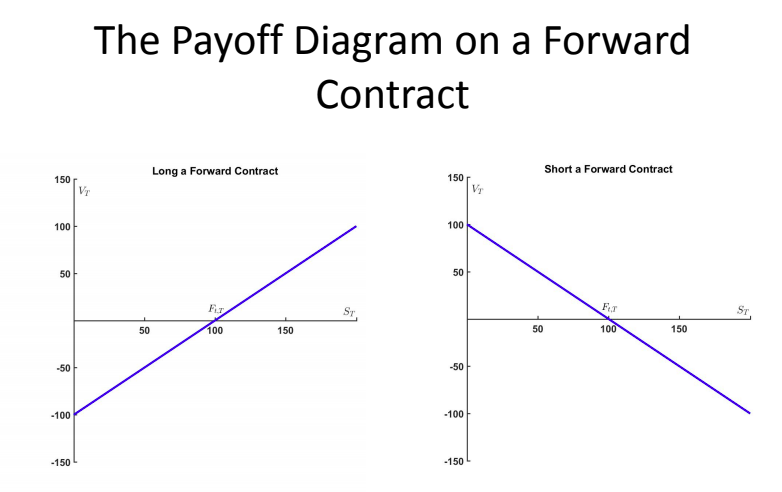
– The price the buyer will pay at the time of delivery - 10What do the payoff diagrams look like for forwards?
- 11What do the payoff diagrams look like for calls?
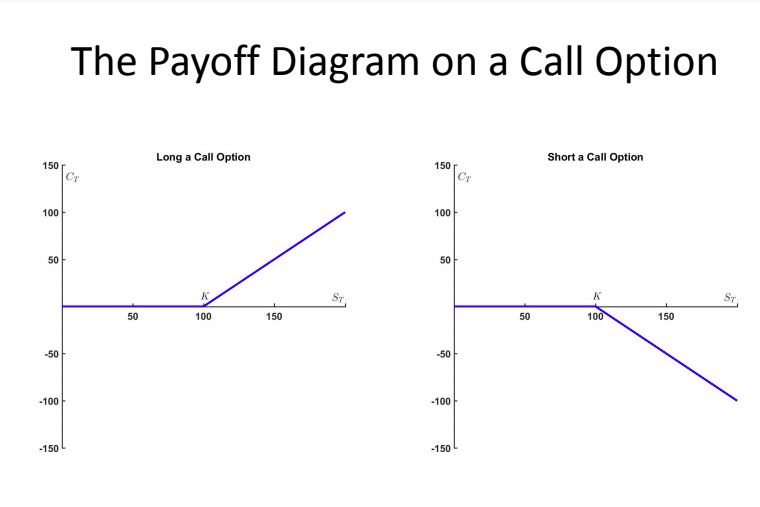
- 12What do the payoff diagrams for puts look like?
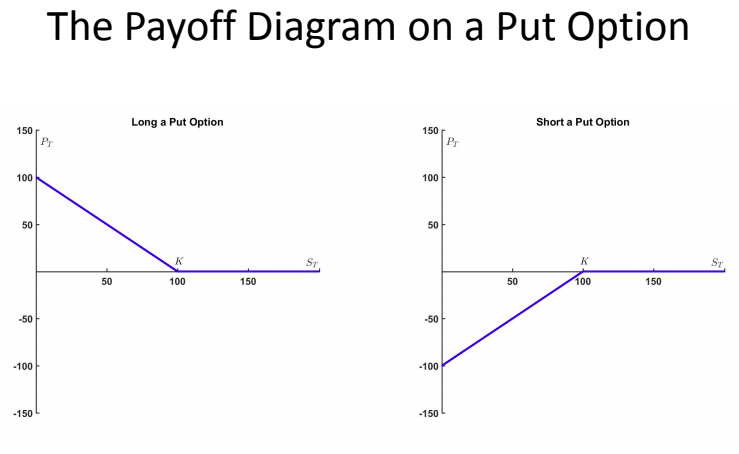
- 13How do floors and caps?Floors is insuring a long position by also buying a put. Caps are insuring a short position by buying a call.
- 14What is a synthetic forward long contract?It is buying a call and selling a put on the same underlying stock with the same strike price. (Ct(k)-Pt(k))
- 15What is replication and static or dynamic?Replication means creating a portfolio with
the same payoff as a targeted derivative by
using existing securities and/or other
derivatives. static is where the units of replicating derivatives will not change while dynamic is where they do. - 16What is equation for put-call parity?Ct(k)-Pt(k) = St-k
LHS - long a call and short a put
RHS - long a stock and short a bond - 17What is a straddle?Buying a call and put with same strike price
Ct(k) + Pt(k)
diagram is a 'V" shape on the strike price. - 18What is a strangle?Buying a put and call with different strike price ( call > put)
Payoff = Ct(k) + Pt(k)
Diagram looks a 'V' shape but with flat top between strike prices for a long and reverse for short. - 19What is a bull spread?A bull spread is a position in which one buys a call and sells an otherwise identical call with a higher strike price. Payoff function is Ct(k1) - Ct(k2) where k1
- 20What is a bear spread?A bear spread is a position in which one sells a put and buys an otherwise identical put with a higher strike price. payoff of
-Pt(k1) + Pt(k2) where k2>k1.
Payoff diagram looks like flat line until k1 and then downward slope until 0 at k2. - 21What is a butterfly spread?A butterfly spread is a position in which one sells multiple calls (puts) with different strike price. Can be asymmetric or symmetric (going up in specific price increments)
- 22What is the formula for margin balance?previous margin* interest + multiplier* (x-F) for long and for put is (F-x) for short.
- 23How to work out how much money needed to top up account to keep active?New initial margin - Margin account balance
- 24What does it mean to be bullish and bearish?bullish means thinks stocks will go up so buy call, while bearish means think stock will go down so buy a put
- 25What is the theorem implied by no arbitrage?That if two portfolios have the same payoff at a certain date in the future then they must have the same payoff at any time before the future date.
- 26What are the assumptions of a perfect market?No bid-ask spread
• No transaction cost
• Borrowing and lending rates are the same. - 27When calculating value of forward at t what can Ste^(-&(T-t)) be equal to?Ke^(r(T-t))
- 28What are the largest futures and largest options exchanges in the world?Futures is CME group
and options is CBOE both chicago based. - 29What is the role of the clearing house?Matches buy and sell orders, keeps track of members obligations and payments, After matching the trades then becomes the counter party.
- 30What is the interest rate parity equation and what is the relationship?FoT = Soe^T(rd-rf) is the relationship between forward price and current exchange rates.
- 31What are forward rate agreements? What is and is not true about them?FRAs are OTC contracts that guarantee
a borrowing or lending rate on a given
notional principal amount.
True - is is an agreement to trade at a future uncertain interest rate.
Is a forward contract written on future uncertain interest rate.
False - interest rate is determined at beginning at future period - 32What is the slope difference rule?The number of call
options for each strike is equal to the
difference of the slope of the payoff function
at that strike, i.e., slope at RHS minus the
slope at LHS. - 33What is a swap and what does it provide a way of doing?A swap is an agreement between two parties to exchange one or multiple payments, on one or more dates, determined by the difference between two prices
• A swap provides a way of hedging a stream of risky payments
• A single-payment swap is the same as a cash-settled forward contract - 34How to prove the FRA settlement equation RtFr(T1,T2) = Rt(T1,T2)? That is forward rate agreement rate is equal to the forward rate.For rtFRA greater than construct portfolio with short an FRA, long 1 zero coupon bond T1 and short a number of zero coupon bond maturing at T2. For proving less than just do opposite.
- 35What is a covered call?Writing a call option is covered by a long position
in the underlying asset: −cT + St
– Goal: to insure against a increase in the price
of the call option - 36What is a covered put?Writing a put option is covered with a short
position in the underlying asset: −pT − St
– Goal: to insure against an increase in the price of
the put option - 37What is the relationships between forwards and swaps?Swaps are nothing more than forward contracts coupled with borrowing
and lending money - 38In a swap agreement who bears what risk?The dealer bears the credit risk of both buyer and seller, while the price risk is beared by buyer and seller.
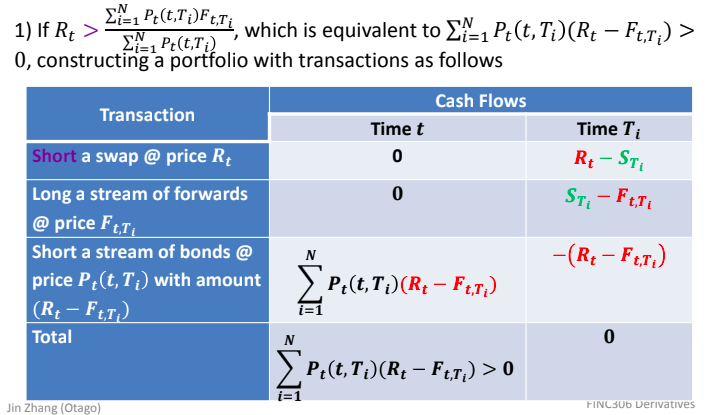
- 39What is the technique for proving the swap rate equation? then for less than? LSSThen for
- 40What is the forward rate settlement equation at time of borrowing and end of borrowing?(fr (T,T1)-fra(T,T1)/4)/(1+fr(T,T1)/4)*NP at start of borrowing and at end of borrowing is ((frT,T1)-fra(t,T1))/4 * NP
- 41What can a swap be regarded as ?Swaps can be regarded as a portfolio of forward contracts plus a portfolio of bonds.
- 42How to derive value of a swap contract? and for less than? (Rt-Ro) LSS
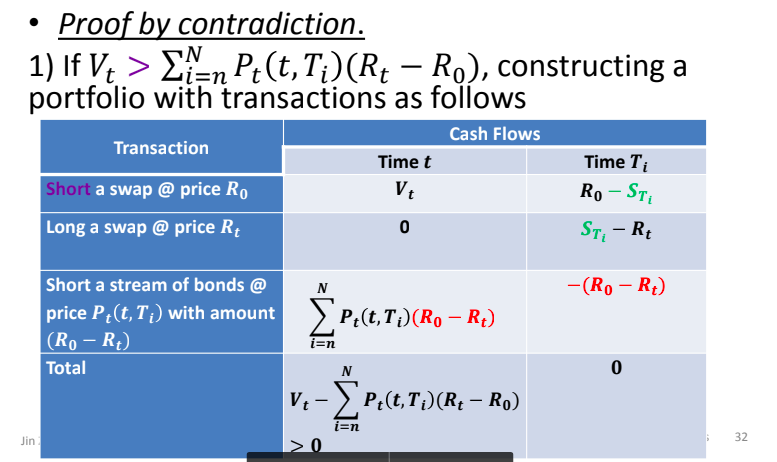
- 43Which derivatives have the largest market size?Interest rate contracts are the largest, than foreign exchange contracts then equity linked contracts.
- 44What is the relationship between OTC derivatives and primary securities?There are much more OTC derivative contracts available than there are primary securities.
- 45What is the difference between synthetic forward and actual forward?The forward contract has a zero premium: 0 = Pv(ST − Ft,T), while
the synthetic forward requires that we pay the net option premium:
ct(K) − pt(K) - 46What can a strangle be used for in relation to a straddle?A strangle can be used to reduce the high
premium cost, associated with a straddle? - 47What is the market value of a swap when its entered into and after its stuck?The market value of a swap is zero at inception
• Once the swap is struck, however, its market value will generally no
longer be zero - 48What is true for the yield curve?Is called the term structure of yield.
Yield curve is yield as a function of time to maturity.
Yield curve provides discount rates over different times to maturity.
NOT TRUE : it is a curve of future interest rates. - 49What are the steps in proving the identity of the blacks scholes identity?rewrite with N'(d2)/N'(d1) = Ste^-&(T-t)/ke^-r(T-t). Next rewrite N'(d1) and d2 using N'(x) = n(x). Then use that (d1^2-d2^2)/2 = ln(st/k) + (r-&)(T-t) and plug into equation. Next using log identity of e^ln, will get st/k * e^(r-&)(T-t) and thus has been proved.
- 50What will you when & = 0 and when & >r>0 for american call and when r>&.When & = 0 you will never exercise american and when drawing none of the 3 lines will cross LB, ct, Vtc. When &>r you will exercise early at some critical price Sc. And same for if r>& except this happens at much higher Sc.
- 51For american puts what do you do if r = 0?If r = 0 you will never exercise early and the three graphs will never intersect. They all have intercept at K when st = 0.
- 52For when & = 0 what will you do for an american put?LB will intersect at Ke^-r(T-t) american intersect at K. At some Sc you will exercise early.
- 53when are the monotonicity properties of puts and calls violated?Monotonicity property of calls is violated
. ie dCt/dK > 0, ie call option price should decrease as the strike price increases. If not then would buy a bull spread.
For puts it is when dPt/dK < 0 then buy a bear spread. - 54What does the binomial option pricing model allow us to do?The binomial option pricing model enables us to determine the price of an option, given the characteristics of the stock or other underlying asset.
often referred to as the “Cox-
Ross-Rubinstein (CRR) pricing model” - 55For 1 period tree what is the no arbitrage condition? And if this is violated how would you make money?d < e^(r-&)h < u
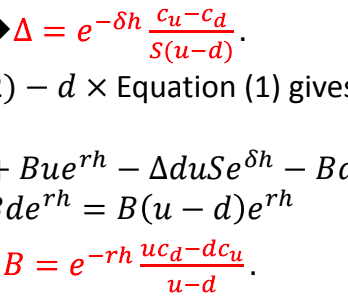
Condition is violated if u>d>e^(r-&)h, you can borrow money from bond market to buy stock then even in worst case stock is worth enough to pay off bond. Or if e^(r-&)h>u>d you can short a stock and invest money in the bond market, and even in worst case is enough to pay off the stock sold. - 56What are Delta and B formulas?
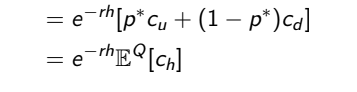
- 57What is formula for call price using p*?
- 58What are u and d?
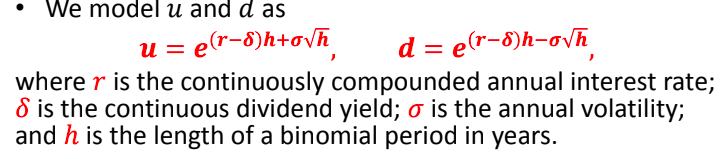
- 59What is the lognormal distribution?(r-&)h +or- sigma*sqrt(h).
So as n >>> infinity, h>>0 and the sum of random variables is normally distributed. - 60How to derive delta and B?Delta = dPt/dSt or dCt/dSt for both there will be e^-&(T-t) and then factor out the rest for partial derivate dd1/dSt and realise that this is the BS identity which equals zero. For B compare to the equation for Pt or Ct.
- 61What is (d1^2-d2^2)/2?
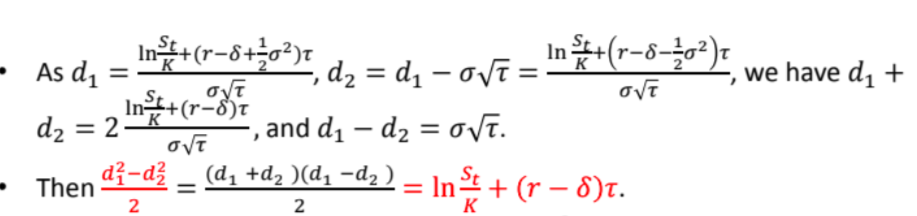
- 62What is the annualised expected return equation?

- 63When can you not use a model free replicating strategy for options and can you?You can use a model free strategy when dCt/dSt is 0 or constant however once its not you have to rely on a model for the underlying stock price process.
- 64When is the convexity property violated, which is the same for puts and calls?Is violated if gradient from from Ct(k1) to Ct(k2) is greater than gradient from Ct(k2) to Ct(k3) then property is violated and you should buy a butterfly spread. As gradient should always be increasing. Other notation is double derivate d^2Ct/dK^2 < 0
- 65What is the techniqe for proving V+ and V-?V+ is short, long borrow and use Ste^-& as Ke^-r
V- is long short, save. - 66What are three commodity futures?Agricultural:NZ, Energy and metals.
- 67What does No arbitrage principal state?That you cannot make profit in financial markets without taking any risk.
- 68What is not true about the forward rate? What is not true about current value Vt?That it is the interest rate over a future period.
That current value of a forward is always 0. - 69What is true and not true for market value for swap?It can be negative and positive, MV swap is zero when entered and thus not always positive and it will generally not be zero once stuck.
- 70How can the swap rate be written when you have St and dividend yield &?
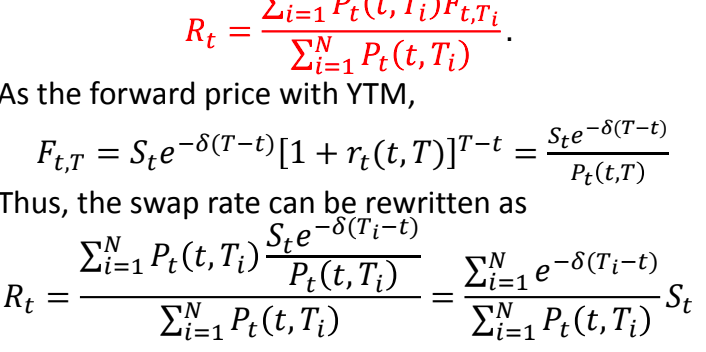
- 71What is the market value of a swap?The market value of the swap is the difference in
the PV of payments between the original and
new swap rates - 72What is technique for deriving value of swap at t? then how to prove it?Portfolio A - Long a swap at Ro
Portfolio B - Long new swap at Rt and long a stream of zero coupon bonds amount (Rt-Ro).
Technique for proving is for greater than, Short S Ro, Long S Rt, short stream bonds. For less than Long, short short. - 73How to prove monotonicity for puts,calls and how to prove convexity?Monotonicity show that limit as ^k >> 0 than ct/kt is less than zero for Pt is greater than zero. Then for butterfly spread show gradient is greater than before gradient2 - gradient 1 and limit ^k>>0 is greater than 0.
- 74Trading technique for arbitrage when call price is outside of bounds?Technique is for C(k1), C(k2) C(k3), you will buy (k3-k2) amount of C(k1) and (k2-k1) amount of c(k3) then sell the amount of C(k2) that balances it out
- 75BS model is the what version of binomial tree?Black-Scholes Model is the limit version of the Binomial Tree Model where
the period goes to infinity! - 76What is the forward rate rt(T1,T2)?

- 77What are the two equations for settlement of a forward contract at T1 and at T2?
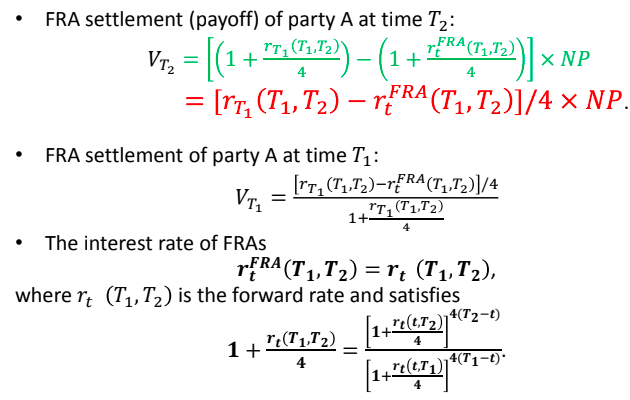
- 78What is the terminal value equation?
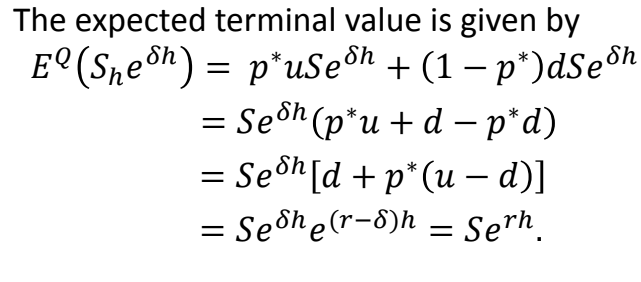
- 79What are two properties of continuously compounded returns?The logarithmic function computes returns from prices
The exponential function computes prices from returns
Continuously compounded returns are additive. - 80When and who cam with BS formula?1969, a mathematical physicist Fischer
Black and a financial economist Myron Scholes
approached option pricing problem by
modelling stock price as a log-normal
distribution as follows, with mean of 0 and variance of1.
Información
- Descripción
- Fichas sobre FINC306, creado por toby riley el 23/07/2019.
- Creado por
- toby riley
- Visitas
- 19
- Valoración