
Fichas
CISCO CCNA
Fichas del conjunto (54)
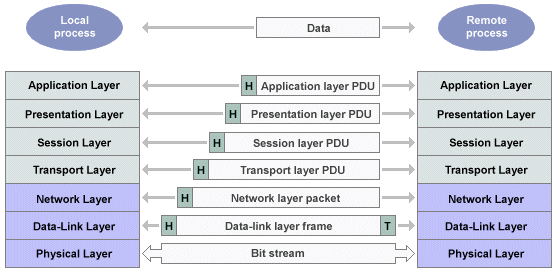
- 1PDUA generic term referring to the header defined by some layer of a networking model, and the data encapsulated by the header (and possibly trailer) of that layer, but specifically not including any lower-layer headers and trailers
- 2Same-Layer interactionThe communication between two networking devices for the purposes of the functions defined at a particular layer of a networking model, with that communication happening by using a header defined by that layer of the model. The two devices set values in the header, send the header and encapsulated data, with the receiving devices interpreting the header to decide what action to take.
- 3SegmentInt TCP, a term used to describe a TCP header and its encapsulated data (also called an L4PDU). also in TCP, the process of accepting a large chunk of data from the application layer and breaking it into smaller pieces that fit into TCP segments. In Ethernet, a segment is either a single Ethernet cable or asingle collision domain(no matter how many cables are used).
- 4EthernetA series of LAN standards defined by the IEEE, originally invented by Xerox Corporation adn developed jointly by Xerox, Intel, and Digital Equipment Corporation.
- 5IEEEInstitute of Electrical and Electronic Engineers. A professional organization that develops communications andnetwork standards, among other activities.
- 6Wired LANa local-area network (LAN ) that physically transmits bits using cables, often the wires inside cables. A term for local-area networks that use cables, emphasizing the fact that the LAN transmits data using wires (in cables) instead of wireless radio waves. See also wirelss LAN
- 7Wirless LANa local-area network (LAN) that physically transmits bits using radio waves. The name "wireless" compares these LANs to more traditonal "wired"LANs, which area LANs that use cables (which often have copper wires inside).
- 8Ethernet frameA term referring to an Ethernet data-link header and trailer, plus the data encapsulated between the header and trailer.
- 910BASE-TThe 10-Mbps baseband Ethernet specification using two pairs of twisted-pir cabling (Categories 3, 4 or 5): one pair transmits data and the other receives data. 10BASE-T, which is part of the IEEE 802.3 specification, has a distance limit of approximatly 100m (328 feet) per segment.
- 10100BASE-TA name for the IEEE Fast Ethernet standard that uses two-pair copper cabling, a speed of 100 Mbps, and a maximum cable length of 100 meters.
- 111000BASE-TA name for the IEEE Gigabit Ethernet standard that uses four-pair copper cabling, a speed of 1000 Mbps (1Gbps), and a maximum cable length of 100 meters.
- 12Fast EthernetThe common name for all the IEEE standards that send data at 100 megabits per second.
- 13Gigabit EthernetThe common name for all the IEEE standards that send data at 1 gigabit per second.
- 14Ehernet linkA generic term for any physical link between tow Ethernet nodes, no matter what type of cabling is used.
- 15RJ-45A popular type of cabling connector used for Ethernet cabling. It is similar to the RJ-11 connector used for telephone wiring in homes in the United States. RJ-45 allows the connection of eights wires.
- 16Ethernet portA genric term for the opening on the side of any Ethernet node, typically in an Ehternet NIC or LAN switch, into which an Ethernet cable can be connected.
- 17Network interface card (NIC)A computer cared, sometimes an expansion card and sometimes integrated into the motherboard of the computer, that provides the electronics and other functions to connect to a computer network. Today, most NICs are specifically Ethernet NICs, and most have an RJ-45 port, the most common type of Ethernet port.
- 18Straight-through cableIn Ethernet, a cable that connects the wire on pin 1 on one end of the cable to pin 1 on the other end of the cable, pin 2 on one end to pin 2 on the oter end , and son on.
- 19Crossover cableAn Ethernet cable that swaps the pair used for transmission on one device to a pair used for receiving on the device on the opposite end of the cable. In 10BASE-T and 100BASE-TX networks, this cable swaps the pair at pins 1,2 to pins 3,6 on the other end of the cable, and the pair at pins 3,6 to pins 1,2 as well.
- 20Ethernet addressA 48-bit (6-byte) binary number, usually written as a 12-digit hexadecimal number, used to identify Ehternet nodes in an Ethernet network. Ethernet frame headers list a destination and source address field, used by the Ethernet devices to deliver Ethernet frames to the correct destination.
- 21MAC addressA standardized data-link layer address that is required for every device that connects to a LAN. Ethernet MAC address are 6 bytes long and are controlled by the IEEE. Also known as a hardware address, a MAC layer address, and a physical address.
- 22Unicast addressGenerally, any address in networking that represents a single device or interface, instead of a group of addresses (as would ber represented by a multicast or broadcast address).
- 23Broadcast addressGenerally, any address that represents all devices, and can be used to send one message to all devices. In Ethernet, the MAC address of all binary 1s, or FFFF.FFFF.FFFF in hex. For IPv4, see subnet broadcast address.
- 24Frame Check SequenceA field in many dat-link trailers used as part of the errordetection process.
- 25TransceiverA term formed from the words transmitter and receiver. The hardware used to both send (transmit) energy over some communications medium (e.g., wires in a cable), as well as to process received energy signals to interpret as a series of 1s and 0s.
- 26Multimode fiberA type of fiber cable that works well with transmitters like LEDs that emit multiple angles of light into the core of the cable; to accommmodate the multiple angles of incident, the cable has a larger core in comparison to single-mode fiber cables.
- 27Single-mode fiberA type of fiber cable that works well with transmitters like lasers that emit a single angle of light into the core of the cable, allowing for a smaller core in comparison to mulltimode fiber cables.
- 28elctromagnetic Interfrence (EMI)The name of the effect in which electricity passes through one cable as normal, inducing a mangetic field otside the conductor. That magnetic field, if it passes through another conductor, like a nearby cable, induces new electrical current in the second cable, interfering with the use of electricity to transmit data on the second cable.
- 29coreIn fiber-optic cabling, the center cylinder of the cable, made of fiberglass, through which lighit passes.
- 30claddingIn fiber-optic cabling, the second layer of the cable, surrounding the core of the cable, with the property of reflecting light back into the core.
- 31Fiber-optic cableA type of cabling that uses glass fiber as a medium through which to transmit light.
- 32Leased lineA serial communications circuit between two pints, provided by some service provider, typically a telephone company (telco). Becasue the telco does not sell a physical cable between the two endpoints, instea charging a monthly fee for the ability to send bits between the two sites, the service is considered to be a leased service.
- 33Wide-area network (WAN)A part of alarger network that implements mostly OSI Layer 1 and 2 technology, connects sites that typically sit far apart, and uses a business model in which a consumer (individual or business) must lease the WAN from a service provider (often a telco).
- 34TelcoA common abbreviation for telephone company.
- 35Serial interfaceA type of interface on a router, used to connect to some types of WAN liks, particularly leased lines and Frame Relay access links.
- 36HDLCHigh-Level Data Link Control. A bit-oriented synchonous data-link layer portocol developed by the International Organization for Standardiztion (ISO).
- 37Ethernet over MPLSA term referring specifically to how a service provider can create an Ethernet WAN sevice using anMPLS network.More generally, a term referring to Ethernet WAN services.
- 38Ethernet Line Service (E-Line)A specific carrier/metro Ethernet service defined by MEF (MEF.net) that provides appoint-to-point topology between two customer devices, much as if the two devices were connected using an Ethernet crossover cable.
- 39Default router/default gatewayOn an IP host, the IP address fo some router to which the host sends packets when the packt's destination adress is on a subnet other than the local subnet.
- 40Routing tableA list of routes in a router, with each route listing the destination subnet and mask, the router interface out which to forward packets destined to that subnet, and as needed, the next-hop router's IP address.
- 41IP networkSee classful IP network
- 42IP subnetSubdivisions of a Class A,B, or C network, as configured by a newtork administrator. Subnets allow a single Class A, B, or C network to be sued instead of multiple networks, and still allow for a large number of groups of IP addresses, as is required for efficient IP routing.
- 43IP packetAn IP header, followed by the data encapsulated afeter the IP header, but specifically not including any headres and trailers for layers below the network layer.
- 44Routing protocolA set of messages and processes with which routers can exchange information about routes to rach subnets in a particular network. Examples of routing protocols include Enhanced Interior Gateway Routing Protocol (EIGRP). Open Shrtest Path First (OSPF), and Routing Infromation Protocol (RIP).
- 45Dotted-decimal notation (DDN)The format used for IP version 4 addresses, in which four decimal values are used, separated by periods (dots).
- 46IP address (IP version 4)In IP version 4 (IPv4), a 32-bit address assigned to hosts using TCP/IP. Each address consists of a network number, an optional subnetwork number, and a host number. The network and subnetwork numbers together are sued for routing, and the host number is used to address an individual host within the network or subnetwork.
- 47Unicast IP addressAn IP address that represents a signle interface. In IPv4 these addresses come from the Class A, B, and C ranges.
- 48SubnettingThe process of subdividing a Class A, B, or C network into smaller gropus called subnets.
- 49HostnameThe alphanumeric name of an IP host.
- 50DNSDomain Name System. An application layer protocol used throughout the Internet for translating hostnames into their associated IP addresses.
- 51ARPAddress Resolution Protocol. An Internet protocol used to map an IP address to a MAC address. Defined in RFC 826.
- 52PingAn Internet Control Message Protocol (ICMP) echo message and its reply; ping often is used inIP networks to test the reachability of a network device.
- 53Command-line interface (CLI)An interface that enables the user to interact with the oprating system by entering commands and optional arguments.
- 54TelnetThe standard terminal-emulation application layer protocol in the TCP/IP protocol stack. Telnet is used for remote terminal connection, enabling users to log in to remote systems and use resorces as if they were connected to a local system. Telnet is defined in RFC 854.
Información
- Descripción
- Recuso para la certificacion CCNA en el examen ICND1 (En ingles).
- Creado por
- hola hola
- Visitas
- 135
- Etiquetas
- Valoración