
Fichas
FINC306final
Fichas del conjunto (17)
- 1What put-call parity used to derive the lower bonds of put and call?Ct-Pt = Ste^-&(T-t) - Ke^-r(T-t)
When setting equal to ct, pt becomes zero and vice versa to get respective lower bounds. - 2What is the formula for the american put and call?early exercise payoff Vtc = (st-k,0) so
UCt = max (Vtc, ct)
Upt = max (Vtp,pt) - 3What will you when & = 0 and when & >r>0 for american call and when r>&.When & = 0 you will never exercise american and when drawing none of the 3 lines will cross LB, ct, Vtc. When &>r you will exercise early at some critical price Sc. And same for if r>& except this happens at much higher Sc.
- 4For american puts what do you do if r = 0?If r = 0 you will never exercise early and the three graphs will never intersect. They all have intercept at K when st = 0.
- 5For when & = 0 what will you do for an american put?LB will intersect at Ke^-r(T-t) american intersect at K. At some Sc you will exercise early.
- 6when are the convexity properties of puts and calls violated?Convexity property of calls is violated
when gradient from k1 to k2 is less than gradient from k2 to k3.
For puts it is when gradient from k1 to k2 is greater than k2 to k3. - 7What does the binomial option pricing model allow us to do?The binomial option pricing model enables us to determine the price of an option, given the characteristics of the stock or other underlying asset.
often referred to as the “Cox-
Ross-Rubinstein (CRR) pricing model” - 8For 1 period tree what is the no arbitrage condition? And if this is violated how would you make money?d < e^(r-&)h < u
Condition is violated if u>d>e^(r-&)h, you can borrow money from bond market to buy stock then even in worst case stock is worth enough to pay off bond. Or if e^(r-&)h>u>d you can short a stock and invest money in the bond market, and even in worst case is enough to pay off the stock sold. - 9Using that c = ^S+B find cu and cd then rearange to get forumlas for ^ and B^ = e^-&h*(cu-cd)/(S(u-d))
B = e^-rh(ucd-dcu)/(u-d) - 10What is formula for p* the risk neutral probability? and the annualised expected return?(e^(r-&)h-d)/(u-d)
ln((E(Sh)e^&h)/S)
where E(Sh) = expected stock price and S equals current stock price.
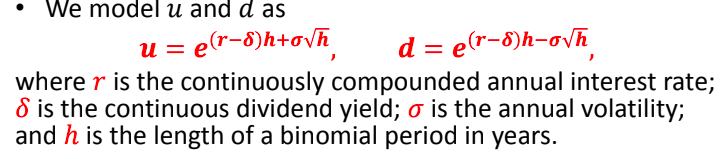
For call it is just ln(Ec/c) expected call price over current. - 11What are formulas for u and d?
- 12What is definition of binomial option pricing model?The binomial option pricing model assumes that the
price of the underlying asset follows a binomial distribution–that is,
the asset price in each period can move only up or down by a specific
amount. - 13How many Decimal places to use for P* and option prices?P* must be 5 dp and option prices must be at least 3 dp
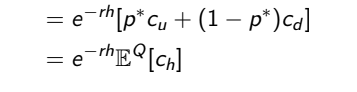
- 14What is the risk neutral probability formula?
- 15What is the lognormal distribution?(r-&)h +or- sigma*sqrt(h).
So as n >>> infinity, h>>0 and the sum of random variables is normally distributed. - 16To find lower and upper bound of call price?Set gradients equal to each-other and solve for unknown
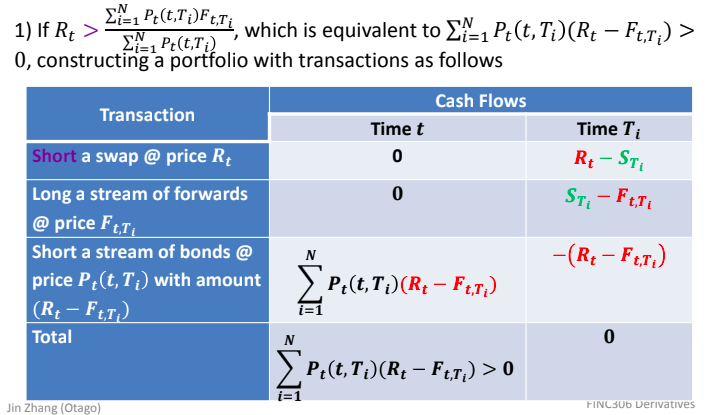
- 17When proving swap rate through no arbitrage what can Rt > swap formula be rewritten as?
Información
- Descripción
- Fichas sobre FINC306final, creado por toby riley el 10/10/2019.
- Creado por
- toby riley
- Visitas
- 13
- Valoración