
Fichas
4.9

Fichas del conjunto (65)
- 1Serial CommunicationSends each bit one after the other along one wire. Cheaper, Reliable, Slower
- 2Parallel communicationSends bits across multiple wires. Faster, less reliable over longer distances
- 3SynchronousUses an external clock to signal when to send and receive a bit. Fast and reliable as the transmitted data does not need additional signals
- 4AsynchronousThe sender and receiver use their own clock and and relies on timing signals within the transmission to synchronize their clocks
- 5Baud RateNumber of signal changes per second the medium can handle without losing data
- 6BitrateHow many bits can be transmitted per second
- 7BandwidthThe range of frequencies (Hz) Directly proportional to the bitrate. If you increase the bandwidth then bitrate will increase by the same amount
- 8LatencyThe time between the first bit being sent and the last bit being received
- 9ProtocolA set of rules and regulations regarding communication
- 10What topology do networks use?They physically use a start topology but act as if they use a bus topology. All computers on the network can see all other computers (like a bus topology) and have bus network protocols
- 11Client server modelSome computers act as the client which they request things (like File servers, web servers, print servers) from the computers which act as servers (who provide). The internet and most commercial networks are Client-Server
- 12Peer-PeerAll computers act as equals, sending and requesting data from each other
- 13Wi-Fi definitionWireless local area network based on international standards
- 14Wireless access pointUsed to manage connections and broadcast the signal to all computers on the network
- 15wireless network adapterIs used to receive and transmit data to the wireless access point
- 16SSIDAll wi-fi transmissions wills have an SSID (Service Set Identifier) attached. SSID identifies the wireless access point which is managing the network. If two networks overlap then they will ignore data without the correct SSID
- 17WPAWPA (Wi-fi protected access) and WPA2 is an encryption standard. It uses a private key and only computers with the correct key can decrypt/encrypt the data
-Very effective if a strong password for the key is used - 18Hidden SSIDThe SSID of the network is not broadcasted, making it more difficult to know if the network is there, however its weak security as the SSID is still included in all data transmissions and can be easily intercepted
- 19MAC FilteringOnly devices with the correct MAC address can join the network. Weak security as MAC addresses can be spoofed
- 20CollisionsA collision occurs when two signals are sent at the same time and corrupt each other. High chance of collisions on wireless networks and bus topologies
- 21CSMA/CACarrier Sense Multiple Access with Collisions Avoidance
-a protocol that avoids collisions and deals with them when they do occur - 22CSMA/CA Protocol-Detects if a transmission is already happening in the channel
-If there is, wait and try again
-If not, send a packet of data and wait for acknowledgement of receipt
-If acknowledgement is received, the transmission was successful
-If no acknowledgement is received, wait a random amount of time and try again - 23RTS/CTS(Request to send/Clear to send) An extension to CSMA/CA to further reduce collisions
- 24CSMA/CA WITH RTS/CTS-If channel is clear then RTS is sent
-If a CTS signal is received, the transmission starts - 25The Interneta network of interconnected networks (in a mesh topology). The networks are connected through routers and gateways
- 26RouterRegulates traffic between networks of the same type. The internet and most LANs use the TCP/IP protocol so routers are used to connect
- 27GatwewayRegulates traffic between networks of different types and protocols. A non-TCP/IP network would need a gateway to
connect to the Internet - 28Packet SwitchingA packet is made up of:
-The payload (the main data being sent)
-The packet number (for re-assembly)
-The receivers IP Address
-The senders IP Address
-Error checking/correcting data
-Packets can all take different routes and need to be reassembled when they arrive - 29Routing-Each node assigns a weight to each connecting node, reflecting the speed of the connection
-These weights are updated regularly to account for traffic changes
-When a packet is ready to be sent it goes through the lowest weighted route - 30IdentificationEach node is assigned a unique IP address
- 31DNSDomain name system stores nodes' IP Addresses and their Domain name. These are regularly updated and shared with other DNS.
- 32Internet registriesEnsure there is no duplication of IP addresses or Domain names
- 33WormMalware that copies itself through a network exploiting software and hardware vunerabilities
- 34TrojanMalware that presents itself as something else, allowing it to spread
- 35VirusMalware that embeds itself within a legitimate program, and spreads by infecting other programs on the system
- 36FirewallSoftware or hardware device that scans packets as they enter or exit the network.
- 37Packet FilteringA firewall will inspect each packet and will block or accept it based on the IP address of the sender and receiver
- 38Stateful inspectionMonitors the state of active connections and uses it to decide which packets are allowed
- 39Proxy ServerReceives the request for information from the network and makes the same request itself to the application making sure they never make direct contact
- 40EncryptionAlters the data so that the private key is needed to read the data. Symmetric encryption is when the same key is used to encrypt and decrypt the data.
- 41Asymmetric decryptionSeparate encrypt and decrypt keys. One party sends their public key to the other to encrypt the message, then decrypts it with their private key
- 42What is TCP/IPA group of protocols that govern communication over the internet
- 43Application layer-Selects appropriate protocol for communication (e.g. HTTP or FTP)
-Allows interaction with the user through
applications such as a web browser - 44Transport Layer-Establishes communication between client and destination
-Deals with errors by the RTS
-Communication split into packets
-Packet numbering applied
-Port number for client and destination assigned - 45Network LayerIP addresses of sender and receiver are supplied
-Route through mesh network is created - 46Link Layer-Receives packets from network layer and adds MAC address s (identifier for physical hardware)
-Moves packets between two hosts
-Deals with physical connections/cabling/drivers - 47File transfer protocolUsed to transfer binary and text files between a client and server. An FTP client connects to an FTP server and this allows the management of files
- 48HyperText Transfer ProtocolUsed for sending hypertext documents from a webserver to a client
- 49HyperText Transfer protocol secureHTTP but with public key encryption
- 50Post Office Protocol v3Used to download emails from a mail server. The emails are held on a mail server until they are downloaded
- 51Simple mail transfer protocolUsed to transfer emails between mail servers
- 52Secure SHellAllows network services to be encrypted on an unsecure network
-Creates an encrypted TCP connection to remote ports and sends commands using application level protocols
-Regularly used for remote administration, allowing users to
securely log on to a remote server and execute commands - 53IPv4Used for IP Addresses, uses 32 bits
- 54IPv6Uses 128 bits but a lot of systems are not updated to use IPv6 so IPv4 is still dominant
- 55What is non routable IP Addresses for?To reduce the amount of IP Addresses that are needed.
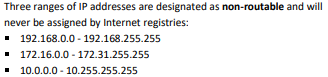
- 56SubnetsAre used to subdivide networks. Part of the IP address identifies the subnet and some identifies the host
- 57Subnet masksUsed to decide how much of the IP address is used to identify the subnet and how much is for the host
- 58DHCP ServersUsed to assign an IP Address to a computer when they join the network. Addresses have a time limit and must be refreshed if the computer is still using that IP Address. This frees up ID addresses that are no longer used
- 59Thin client systemsThe server does most of the processing. Allows complex operations to be done by computers that are not powerful enough to complete them
- 60Thick client systemsOnly requests services that are necessary from the client and most of the processing is done by the client. e.g. an online game, requests data from server but game is running locally
- 61Web socket protocolAllows a full time connection between web browser and server over TCP. There is a constant connection allowing them to send data anytime
- 62web CRUD applicationsWeb applications which provide tools to create retrieve update and delete data
- 63REST (Representational State Transfer)REST API (Application Programming Interface) runs on server, responds to HTTP protocol commands and sends appropriate SQL commands to the database
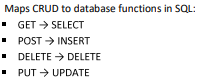
- 64XMLExtensible mark-up language
-Uses tags to categorise data
-Easy for humans to work with - 65JSONUses Java script notation
-Uses less space
-Fast for websites to parse
Información
- Descripción
- Fichas sobre 4.9, creado por Alex Smith el 27/11/2020.
- Creado por
- Alex Smith
- Visitas
- 8
- Valoración