
Fichas
3. Integumentary System
Fichas del conjunto (31)
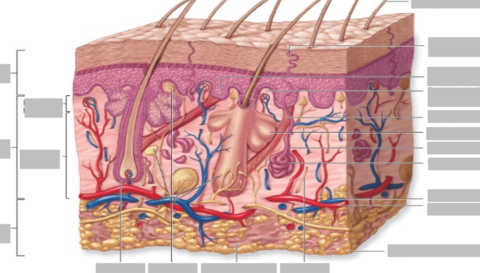
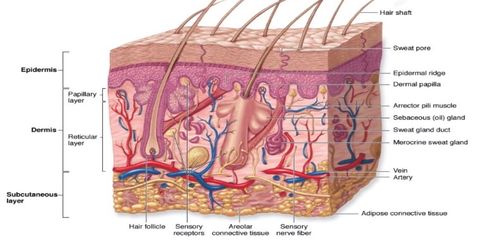
- 1List the 11 structures of skin.Epidermis, Dermis, Subcutaneous, Hair Follicle, Sweat Glands, Sebaceous glands, Blood vessels, nerves, collagen, elastin, arrector pili muscle
- 2List the 3 layers of the skin What are the two main layers?- Epidermis - Outer layer
- Dermis - Beneath Epidermis
Hypo Dermis - Beneath the Dermis - 3What is Epidermis• 5 layers (strata)
• Epithelial tissue (stratified squamous)
• Avascular
• Keratinocytes (produce keratin)
• In a health skin, all layers are completely replaced every 25 - 40 days - 4What are the layers of Epidermis From superficial to deepCorneum
Lucidum
Granulosum
Spinosum
Basale - 5—
- 6Epidermis - Stratum Corneum• Accounts for approx 75% of epidermal thickness : 20-30 cells thick
• Made entirely of keratin
• Cells overlap like tiles on a roof. Surface cells flake off.
• Keratin provides a tough protective coating
• Protects deeper layers from external environment
• Protect against water loss - 7Epidermis – Stratum Lucidum• Only present where the skin is thick and hairless e.g. soles of the feet
• Thought to assist in the transmission of water through the skin.
• Only a few cells thick. - 8Epidermis – Stratum Granulosum• Represents the change from living cells to dead keratinised cells. Cells lose their organelles and become flattened.
• Varies in thickness. Usually 3 – 5 cells thick. - 9Epidermis – Stratum Spinosum• Often termed the ‘prickle cell layer’ due to the cells having projections on their outer surface to encourage a close cellular structure.
• Minimal cell division is possible. - 10Squamous Cell Carcinoma homeostatic imbalance• Arises from Stratum Spinosum
• If not treated will spread to other sites - usually lymph nodes
• Raised, red & scaley. May form concave ulcers
• Common on scalp,ears, lip, back of hand. - 11Epidermis - Stratum Basale• In contact with the dermis below
• 10-25% of cells are melanocytes MELANIN
• Receives nourishment from dermal blood supply
• Constant cell reproduction takes place (mitosis). Old cells push upwards away from nutrient supply.
• Tactile disks are present to detect light touch - 12Basal Cell Carcinoma homeostatic imbalance• Least malignant
• Most Common
• Arises from the Basal
Layer of the epidermis.
• Begin as a shiny nodule that later develops a depressed centre and raised edge. - 13Malignant Melanoma homeostatic imbalance• Rarest, but most deadly skin cancer.
• Metastasizes rapidly to lymph and blood vessels.
• Cancer of melanocytes, so appears usually as a dark area of skin. May be raised or flat and can change in shape and colour. - 14Dermis• Underliestheepidermis.
• Varies in thickness e.g.thicker on palms and soles, thin on eyelids and lips.
• Two regions-Papillary and Reticular. - 15Papillary Layer• Area under the epidermis
• Makes up 20% of dermal thickness
• Made up of loose areolar, collagen and
elastic connective tissue.
• Uneven surface that ‘dovetails’ into basal
layer above.
• Made up of ‘Dermal Papillae’ - finger-like
projections containing capillaries and nerves.
• Give characteristic lines to palms, soles and fingertips that enhance gripping and friction. - 16Reticular layer• Deeper layer – 80% of dermal thickness.
• Dense irregular connective tissue
• Contains, sweat glands, sebaceous glands, hair follicles, blood vessels and nerves.
• Collagen and elastin found here.
• Collagen gives strength to skin. Helps attract & bind water, therefore assists in maintaining hydration.
• Elastin fibres allow skin to stretch and recoil. - 17Subcutaneous Layer or Hypo DermisLies beneath the dermis
Anchors the skin to underlying structures.
Adipose tissue cushions and insulates.
Contains nerve endings that sense deep pressure and high frequency vibration. - 18Appendages of the skin Sebaceous glands• Most are connected to the hair follicles
• Secrete oily substance called sebum - acts as a lubricant
for skin and an antibacterial agent.
• More active in puberty - 19Two Sweat Glands (sudoriferous)Merocrine/Eccrine
Apocrine - 20Merocrine/Eccrine• Most common
• Open onto skin surface
via a duct
• Sweathasahighwater content.
• Primaryfunction–to cool the body - 21Apocrine• Duct empties its contents into a hair follicle
• Functions mainly at puberty
• Generally found in axilla and groin.
• Decomposes to form body odour. - 22Arrector Pili Muscle• Involuntary smooth muscle attached to hair follicle at one end and epidermis at the other.
• Contracts in response to fear, cold and touch.
• Gives skin its characteristic ‘goose bumps’. - 23Functions of the skin• Sensation
• Heat Regulation
• Absorption
• Protection/Immunity
• Excretion
• Synthesis of Vitamin D - 24Sensation• Receptors in the dermis detect sensations
• Touch, pain, heat, cold, vibration, texture and pressure.
• Lay at varying depths in the dermis. - 25Heat Regulation- thermo regulationTemperature is regulated by blood vessels in the dermis
• Vasodilation
• Vasoconstriction - 26Vasodilationhigh temp causes blood vessels to dilate, releasing more heat - skin becomes pink. Sweat glands activated
- 27Vasoconstrictionlow temp, vessels constrict maintaining temp to body core, skin becomes pale
- 28AbsorptionTopically applied products such as drugs,
chemicals and some skin care products, have the ability to be absorbed into the skin layers if they are lipid soluble. - 29Protection/Immunity• Keratinocytes, sebum, mucous
• Intact skin prevents entry of foreign substances.
• Secretions from the skin form the ‘acid mantle’ which aids in creating a healthy environment.
• Pigment melanin protects from ultra violet ray damage.
• Adipose tissue provides protection of underlying structures. - 30Excretion• Skin excretes waste via the sweat glands.
• Water, salts, urea, uric acid and ammonia are eliminated from the body in this way. - 31Synthesis of Vitamin D• On exposure to UV light a substance in the skin called 7 dehydrocholesterol is converted to Vit D in the liver and kidneys.
• Vit D required for absorption of calcium & phosphorus
Información
- Descripción
- 5 HAP 1 Fichas sobre 3. Integumentary System, creado por Jonathan Cash el 28/07/2015.
- Creado por
- Jonathan Cash
- Visitas
- 10
- Etiquetas
- Valoración