
Fichas
Sin título
Fichas del conjunto (43)
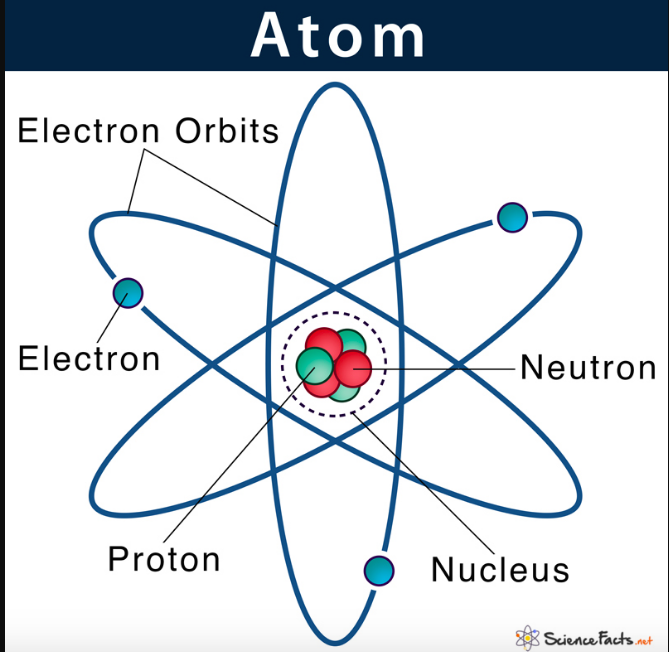
- 1—The nucleus has a radius of 1×10^(−14) and the mass of the atom is concentrated in the nucleus.
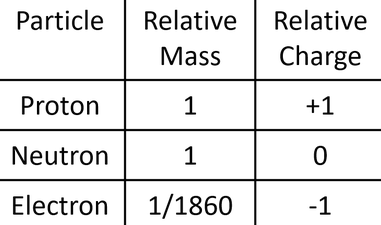
- 2Atoms usually have no charge overall. This is because they usually have the same number of electrons as protons. The atomic number tells someone the number of protons and the relative atomic mass tells someone the total number of protons and neutrons together.
- 3ElementsElements consist of atoms with the same atomic number. The number of protons defines what element it is.
Isotopes have the same number just extra neutrons. They are the same element just more/fewer neutrons. - 4Relative atomic mass (formula)Relative atomic mass (Ar) =
the sum of ( isotope abundance x isotopes mass number)
÷
the sum of an abundance of all the isotopes - 5CompoundsCompounds are substances formed from two or more elements, the atoms of each are in fixed proportions through the compound and they're held together by chemical bonds.
- 6CompoundsA formula shows what atoms are in a compound:
- Carbon Dioxide - CO2
- Ammonia - NH3
- Water - H20
- vetc. - 7MixturesThere's no chemical bond between the different parts of a mixture. They can either be elements or compounds.
The chemical properties of a substance aren't affected by it being part of a mixture. - 8Chromatography1. Draw a line near the bottom of a sheet of filter paper. (with a pencil)
2. Add a spot of ink to the line and place the sheet in a beaker of solvent.
3. If needed add ethanol.
4. make sure the ink isn't touching the solvent.
5. place a lid on top - 9Chromatography 26. The solvent seeps up the paper, carrying the ink with it
7. Each different dye in the ink will move up the paper at different rates, so the dye will spread out
8. If any of the dyes in the ink are insoluble they'll stay on the baseline - 10Chromatography9. When the solvent has nearly reached the top of the paper, take the paper out of the beaker and leave it to dry.
10. The end result is a pattern of spots called a chromotatogram. - 11FilterationFilteration can be used if your product is an insoluble solid that needs to be separated from a liquid reaction mixture.
It can be used in purification as well. - 12Evaporation1. pour the solution into an evaporating dish.
2. slowly heat the solution.
3. Keep heating the evaporating dish until all you have left are dry crystals - 13Crystallisation1. pour the solution into an evaporating dish and gently heat the solution
2. once some of the solvents have evaporated, or when you start to see crystals form, remove them and let them cool. - 14Crystallisation 23. The salt should start to form crystals as It becomes insoluble
4. filter the crystals and leave them in a warm place to dry. - 15Filteration and CrystallisationThey can be used to separate rock salt.
1) Grinding
- Grind the mixture to make sure the salt crystals are small, so they will dissolve easily.
2) Dissolving
- Put the mixture in water and stir. The salt will dissolve, but the sand won't - 16Filtration and Crystallisation 23) Filtering
- Filter the mixture. The grains of sand won't fit through the tiny holes in the filter paper, so they collect on the paper instead. The salt passes through the filter paper as it's part of the solution
4) Evaporation
- Evaporate the water to form dry crystals. - 17Simple distillation ( CAN ONLY BE USED FOR SOLUTIONS WITH SIMILAR BOILING POINTS )1. Simple distillation is used for separating a liquid from a solution
2. The solution is heated.
3. The vapour is then cooled, condenses and is collected.
4. The rest of the solution is left behind in the flask - 18Fractional Distillation1. You put your mixture in a flask and stick your fractional distillation column on top. Then heat it
2. They all have different boiling points
3. The liquid with the LBP with evaporating first - 19Fractional distillation 24. Liquids with a higher BP might also start to evaporate. But the column will be cooler toward the top so they will only go halfway before condensing, running back to the flask
5. When the first liquid has been collected, you can raise the temperature - 20Group 1 Elements (Alkali Metals)They all one electron in the outer shell which makes them very reactive and gives them similar properties.
The alkali metals are soft and have low density
They readily form 1+ ions. Its so easy to lose their outer electron when forming ionic compounds - 21Group 1 elements (2)The trends for the alkali metals as you go down group 1 are :
- Increasing reactivity - Because the electron gets further away its electrons are more easilylost
- Lower melting and boiling points
- Higher relative atomic mass. - 22Group 1 elements (3)In water, group 1 elements react vigorously.
Li, Na and K float, move and fizz furiously.
They produce hydrogen. They also form hydroxides that dissolve in the water to give alkaline solutions.
They react vigorously when heated with chlorine gas to form white salts called metal chlorides - 23Group 1 elements (4)The group 1 elements can react with oxygen to form a metal oxide.
Li2O = Lithium oxide
Na2O and Na2O2 = sodium oxide and sodium sodium peroxide
K2O2 and KO2 = potassium peroxide and potassium superoxide. - 24Group 7 elements (Halogens)Halogens are all non-metals with coloured vapour:
Fluorine is a very reactive, poisonous yellow gas. Chlorine is a fairly reactive, poisonous dense green gas. Bromine is a dense, poisonous, red-brown volatile liquid. Iodine is a dark grey crystalline solid of a purple vapour. - 25Group 7 elements (2)As you go down: they become less reactive, as it's harder to gain electrons that are far away from the nucleus.
they have higher melting and boiling points
And they have higher relative atomic masses.
They all have 7 electrons in the outer shell. - 26Group 7 elements (3)Halogens can share bonds, via covalent bonding, with other non-metals. The compounds that form when halogens react with non-metals all have simple molecular structures.
They form 1- ions called halides when bonding with metals
More reactive halogens will displace less reactive ones. - 27Group 0 elements (Noble gases)They have a full outer shell. They are inert (not reactive)
They exist as monatomic gases - single atoms not bonded to each other.
They're non-flammable and colourless at room temperature.
The boiling points increase as you go down along with the relative atomic mass. - 28Group 0 elementsThe increase in boiling point is due to an increase in the number of electrons in each atom leading to greater intermolecular forces between them.
- 29IonsWhen atoms lose or gain electrons, ions form. For example, a sodium atom will form sodium at one plus ion plus one electron. We know this because if we look at a diagram of a sodium atom, it has one electron in its outermost shell that it needs to lose in order to become stable.
- 30Ions 2An ion is a charged particle. When metals lose electrons they form positive ions and when non-metals gain electrons, they form negative electrons.
- 31Relative Atomic MassPercentage mass of an element in a compound = (Ar x number of atoms of that element) ÷ Mr of the compound x 100
- 32MolesA mole is Avogadro's number, which is6.02 x 10^23
Number of moles = mass in g ÷ Mr - 33Conservation of massIn a chemical reaction, all mass is conserved
If the mass seems to change, there's usually a gas involved - 34Calculating the mass of a product formed in a reaction1. write out the balanced equation
2. work out the Mr of the reactant and product you want
3. Find out how many moles there are of the substance you know the mass of
4. Use the balance equation to work out how many moles they'll be of the other substance - 35Calculating the mass of a product formed in a reaction 25. use the number if moles to calculate the mass
Example:
Calculate the mass of aluminium oxide formed when 135g of aluminium is burned in air - 36Calculating the mass of a product formed in a reaction (Example)1) 4 Al + 3 O2 -> 2 Al2O3
2) Al : 27 Al2O3 : (2x27) + (3x16) = 102
3) Moles = mass ÷ Mr = 135 ÷ 27 = 5
4) 4 moles of Al react to produce 2 moles of AL2O3 - half the number of moles are produced. So 5 moles of Al will react to produce 2.5 moles of Al2O3
5) mass = moles x Mr = 2.5 x 102 = 255g - 37ConcentrationConcentration is a measure of how crowded things are.
It can be measured in g/dm^3
concentration (g/dm^2) = mass of solution (g) ÷ volume of solvent (dm^3) - 38Acids and basesThe pH scale is a measure of how acidic or alkaline a solution is.
You can measure the pH of a solution using an indicator or a pH probe
Neutralisation:
acid (H+) + base(OH-) -> salt + water (H2O) - 39Reaction of acidsMetal oxides and Metal Hydroxides are bases:
Acid + Metal Oxide -> Salt + Water
Acid + Metal Hydroxide -> Salt + Water
Acids and Metal Carbonates produces Carbon Dioxide:
Acid + Metal Carbonate-> Salt + H2O + C2O - 40Making soluble salts using an insoluble base (PRACTICAL)Choose the appropriate acid and insoluble bases, such as an insoluble metal oxide, hydroxide, or carbonate. Also, using a Bunsen burner, remove acid, then switch off the Bunsen burner. Gradually add the insoluble base to the acid until no more reacts.
- 41Making soluble salts using an insoluble base 2 (PRACTICAL)Do you know when all of the acids have been neutralised because any excess solid will just drop to the bottom of the flask after staring? Then, to get the salt solution, filter off the excess solid.
- 42Making soluble salts using an insoluble base 3 (PRACTICAL)To obtain fuel, solid crystals of the soul, gradually heat the solution with a water bath or an electric heater until some of the water has evaporated, then turn off the heat and allow the solution to fall. Soul crystals should form, which can then be filtered and dried out of the solution. This is referred to as crystallisation.
- 43The reactivtey series
Información
- Descripción
- Fichas sobre Sin título, creado por Awa Mamadou el 30/05/2021.
- Creado por
- Awa Mamadou · may 2021
- Actualizado
- 4 jun 2021
- Visitas
- 0
- Valoración