
Fichas
Practical 3 - Topic 11
Fichas del conjunto (63)
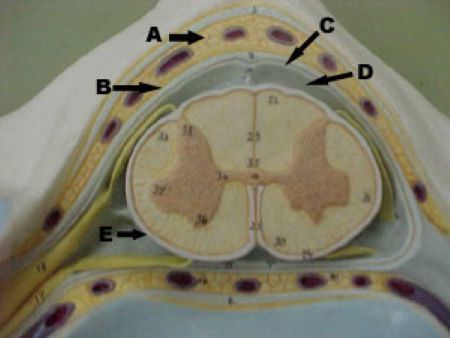
- 1Identify the structure and function of A on the Transverse section of the Spinal Cord.Epidural space
Function = cushions and protects spinal cord (contains adipose tissue) - 2Identify the structure and function of B of the Meninges.Dura mater
Function = outermost protective layer of spinal cord, attaches to Crista galli of the Ethmoid bone - 3Identify the structure and function of C of the Meninges.Arachnoid mater
Function = middle protective layer of spinal cord - 4Identify the structure and function of D.Subarachnoid space (not a meninge)
Function = space within protective layers filled with CSF (cerebrospinal fluid) - 5Identify the structure and function of E of the Meninges.Pia mater
Function = innermost protective layer of spinal cord - 6Identify the structure and function of A.Dura mater
Function = outermost protective layer of spinal cord, attaches to Crista galli of the Ethmoid bone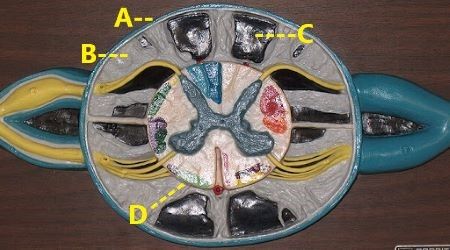
- 7Identify the structure and function of B.Arachnoid mater
Function = middle protective layer of spinal cord - 8Identify the structure and function of C.Subarachnoid space (not a meninge)
Function = space within protective layers filled with CSF (cerebrospinal fluid) - 9Identify the structure and function of D.Pia mater
Function = innermost protective layer of spinal cord - 10Identify the structure and function of A in the gray matter of Spinal cord.Posterior (Dorsal) horns
Function = contain Association neuron cell bodies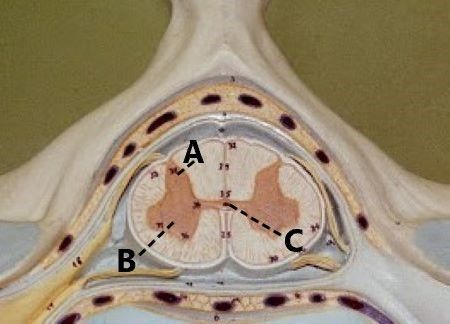
- 11Identify the structure and function of B in the gray matter of Spinal cord.Anterior (Ventral) horns
Function = contain Motor neuron cell bodies - 12Identify the structure and function of C in the gray matter of Spinal cord.Central canal
Function = interior tube in spinal cord filled with CSF - 13Identify the structure and function of A in the gray matter of Spinal cord.Posterior (Dorsal) horns
Function = contain Association neuron cell bodies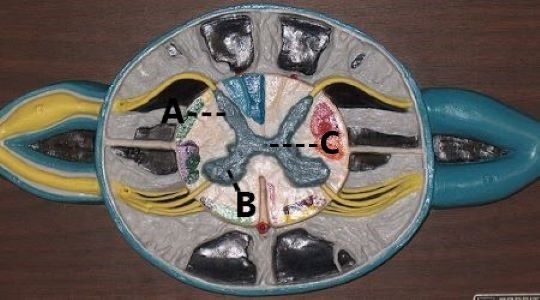
- 14Identify the structure and function of B in the gray matter of Spinal cord.Anterior (Ventral) horns
Function = contain Motor neuron cell bodies - 15Identify the structure and function of C in the gray matter of Spinal cord.Central canal
Function = contains CSF - 16Identify the structure and function of A in the white matter of Spinal cord (myelinated axons).Ascending tract
Function = carries sensory stimuli up to brain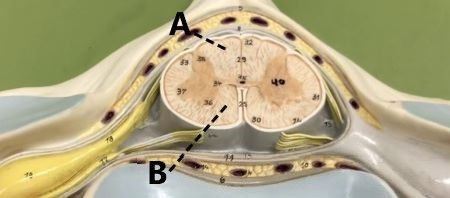
- 17Identify the structure and function of B in the white matter of Spinal cord (myelinated axons).Descending tract
Function = carries motor stimuli down from brain - 18Identify the structure and function of A in the white matter of Spinal cord (myelinated axons).Ascending tract
Function = carries sensory stimuli up to brain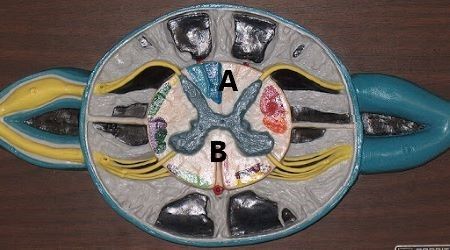
- 19Identify the structure and function of B in the white matter of Spinal cord (myelinated axons).Descending tract
Function = carries motor stimuli down from brain - 20Identify structure A and its function on the spinal cord.Posterior (Dorsal) Root Ganglion
Function = contains Sensory neuron cell bodies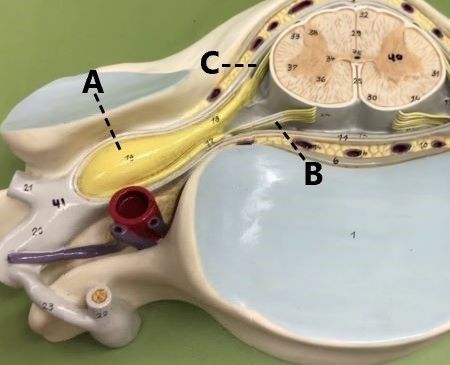
- 21Identify structure B and its function on the spinal cord.Anterior (Ventral) roots - myelinated axons
Function = carries motor stimulation away from spinal cord - 22Identify structure C and its function on the spinal cord.Posterior (Dorsal) roots - myelinated axons
Function = carries sensory stimulation to spinal cord - 23Identify structure A and its function on the spinal cord.Posterior (Dorsal) root ganglion
Function = Contains Sensory neuron cell bodies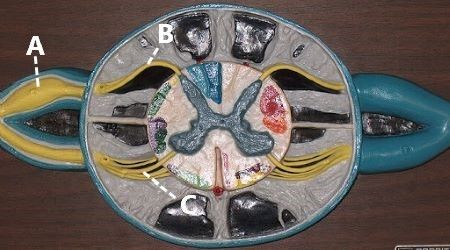
- 24Identify structure B and its function on the spinal cord.Posterior (Dorsal) roots - myelinated axons
Function = Carries sensory stimulation into spinal cord - 25Identify structure C and its function on the spinal cord.Anterior (Ventral) roots - myelinated axons
Function = carries motor stimulation away from spinal cord - 26Identify structure A and its function on the Peripheral nerve cross section.Epineurium
Function = protects entire nerve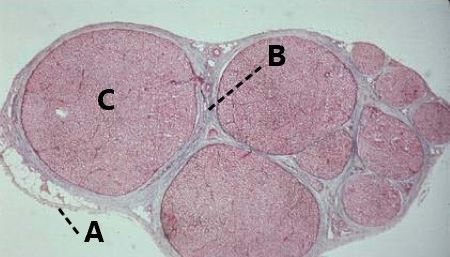
- 27Identify structure B and its function on the Peripheral nerve cross section.Perineurium
Function = protects nerve fascicle (bundle of axons) - 28Identify structure C and its function on the Peripheral nerve cross section.Endoneurium
Function = protects single axon in 1 neuron (superficial to myelin sheath) - 29Identify structure A and its function on the Peripheral nerve cross section.Endoneurium
Function = protects individual axon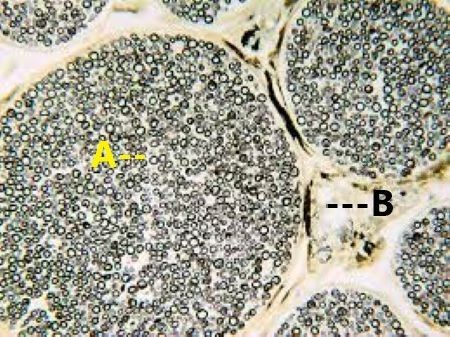
- 30Identify structure B and its function on the Peripheral nerve cross section.Perineurium
Function = protects fascicles (bundles of myelinated axons) - 31Identify the Reflex arc component and its function at A.Receptor
Function = detects stimulus (change in environment)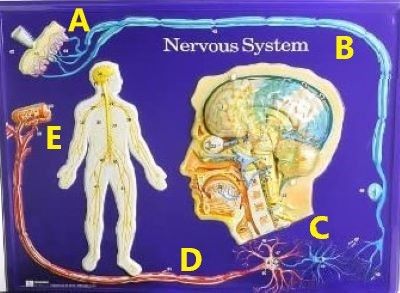
- 32Identify the Reflex arc component and its function at B.Sensory neuron
Function = transmits sensory information from Receptors to Central Nervous System (CNS) - 33Identify the Reflex arc component and its function at C.Association neuron (Interneuron)
Function = Integration and Processing center
Location = Posterior (Dorsal) Horns of Spinal cord - 34Identify the Reflex arc component and its function at D.Motor neuron
Function = transmits motor information from CNS to Effector - 35Identify the Reflex arc component and its function at E.Effector
Function = Muscle or gland that responds to stimulus - 36Identify the Reflex arc component and its function at A.Receptor
Function = detects stimulus (change in environment)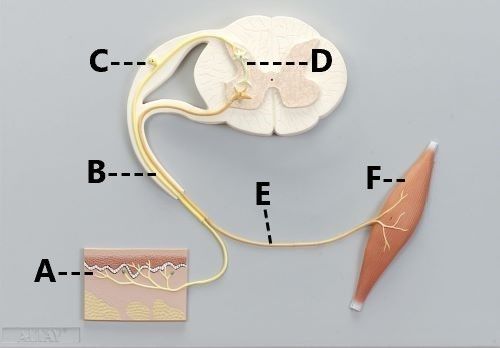
- 37Identify the Reflex arc component and its function at B.Sensory neuron
Function = transmits sensory information from Receptors to Central Nervous System (CNS) - 38Identify the Reflex arc component and its location at C.Sensory neuron cell bodies
Location - Posterior (Dorsal) Root ganglion - 39Identify the Reflex arc component and its function at D.Association neuron (Interneuron)
Function = Integration and Processing center
Location = Posterior (Dorsal) Horns of Spinal cord - 40Identify the Reflex arc component and its function at E.Motor neuron
Function = transmits motor information from CNS to Effector - 41Identify the Reflex arc component and its function at F.Effector
Function = Muscle or gland that responds to stimulus - 42Types of Effectors:Somatic Effector - Skeletal muscle
Autonomic Effector - Smooth muscle, Cardiac muscle, Glands - 43Somatic reflex examples:Pain withdrawal (Flexor reflex), Knee jerk (Patellar reflex), Babinski reflex
- 44Autonomic reflex examples:Heart rate, Respiratory rate, BP, Peristalsis
- 45Name the nerve at A and its innervation area, sensory function, brain structure, and motor function.Olfactory nerve (I)
Innervation area - A = Nose
(Nasal cavity/Sinuses)
Sensory Function = Smell
Brain structure = Olfactory/Temporal
Motor Function = None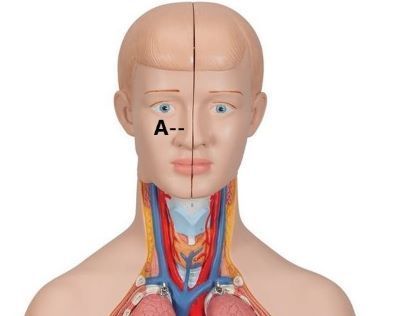
- 46Name the nerve at A and its innervation area, sensory function, brain structure, and motor function.Optic (II)
Innervation = A - Eye
(Retina for vision only)
Sensory Function = Vision
Brain structure = Visual/Occipital
Motor Function = none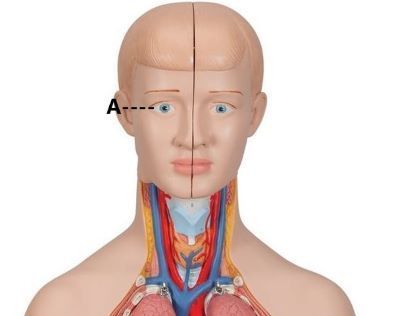
- 47Name the nerves and their innervation area, sensory function, brain structure, and motor function.Oculomotor (III), Trochlear (IV), Abducens (VI) nerves
Innervation for eye muscles (A, B, C, D, E)
Sensory Function = Proprioception
(awareness of movement)
Brain Structure = Primary
Somatosensory/Parietal
Motor Function = eyeball movement
(look up, roll eyes)
Brain Structure = Primary motor/Frontal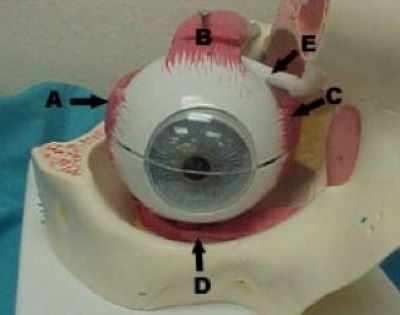
- 48Name the nerve at A and its innervation area, sensory function, brain structure, and motor function.Trigeminal (V)
Innervation = Face
Sensory Function = Facial sensations (touch, pain, temperature)
Brain structure = Primary Somatosensory/Parietal
Innervation = Temporalis (A) and Masseter muscle
Motor Function = Chewing
Brain structure = Primary Motor/Frontal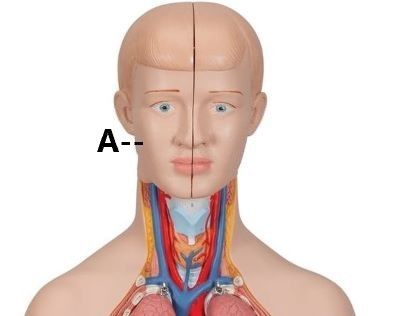
- 49Name the nerve at B and its innervation area, sensory function, brain structure, and motor function.Trigeminal (V)
Innervation = Face
Sensory Function = Facial sensations (touch, pain, temperature)
Brain structure = Primary Somatosensory/Parietal
Innervation = Temporalis and Masseter muscle (B)
Motor Function = Chewing
Brain structure = Primary Motor/Frontal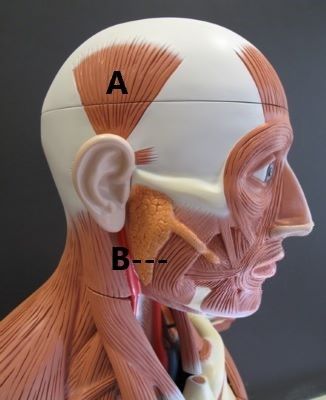
- 50Name the nerve at C and its innervation area, sensory function, brain structure, and motor function.Facial nerve (VII)
Innervation = Tongue - Taste buds
Sensory Function = Taste
Brain Structure = Gustatory/Parietal Additional cranial nerves for taste = Glossopharyngeal (IX), Vagus (X)
Innervation = Facial muscles and Salivary glands (A)
Motor Function = Facial expressions (blinking, smiling, kissing); Saliva and tear secretion
Brain Structure = Primary Motor/Frontal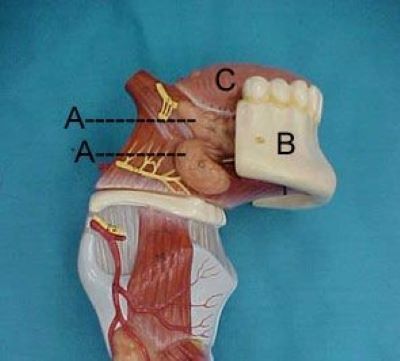
- 51Name the nerve at A, B, & C and their innervation area, sensory function, brain structure, and motor function.Facial nerve (VII)
Innervation = Tongue - Taste buds
Sensory Function = Taste
Brain Structure = Gustatory/Parietal Additional cranial nerves for taste = Glossopharyngeal (IX), Vagus (X)
Innervation = Facial muscles (A, B, & C) and Salivary glands
Motor Function = Facial expressions (blinking, smiling, kissing); Saliva and tear secretion
Brain Structure = Primary Motor/Frontal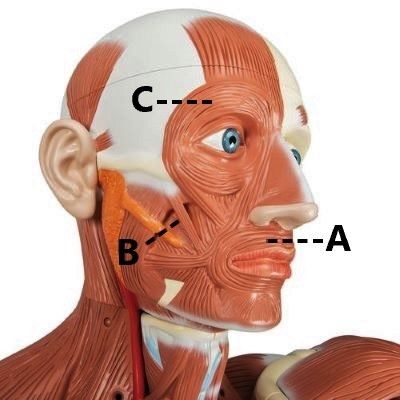
- 52Name the nerve at A and its innervation area, sensory function, brain structure, and motor functionVestibulocochlear (VIII)
Innervation = Inner Ear receptors
Sensory Function = Hearing and Equilibrium (Balance)
Brain Structure = Auditory/Temporal
(Hearing), Cerebellum
(Equilibrium/Balance)
Motor Function = Minimal with hair cells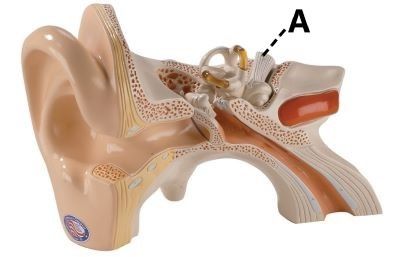
- 53Name the nerve at C and its innervation area, sensory function, brain structure, and motor function.Glossopharyngeal (IX)
Innervation = C - Tongue (Taste buds) and Receptors in Aorta and Carotid arteries
Sensory Function = Taste (also Facial and Vagus); Blood gases and BP (also Vagus)
Brain Structure = Gustatory/Parietal (Taste)
Medulla oblongata (BP and Blood gases)
Motor Function = Swallowing and Speech (also Hypoglossal)
Brain Structure = Primary Motor (swallowing) and Broca's (speech)/Frontal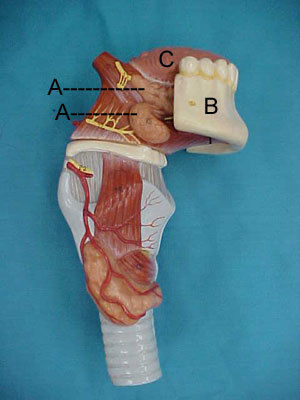
- 54Name the nerve at A, B, C, D, & E and their innervation area, sensory function, brain structure, and motor function.Vagus nerve (X)
Innervation - Lungs (A), Heart (B), Stomach (C), Large intestine (D), Small intestine (E); receptors in arteries for BP & blood gases
Sensory function = Visceral sensations, Blood gases, Blood pressure (also Glossopharyngeal (IX) for neck area), Taste (also Facial (VII), and Glossopharyngeal (IX)
Brain Structure = Medulla oblongata (Visceral sensations, blood gases and BP), and Gustatory/Parietal (Taste)
Motor function - heart rate, respiration, digestion (peristalsis)
Brain Structure = Medulla oblongata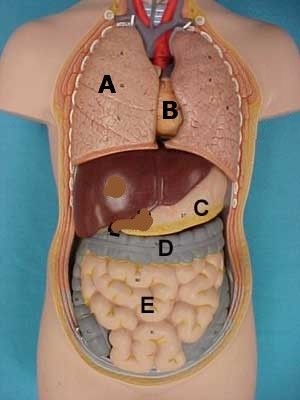
- 55Name the nerve at A and its innervation area, sensory function, brain structure, and motor functionAccessory (XI)
Innervation = Neck and Shoulder muscles
Sensory Function = Minimal - Proprioception
Brain Structure = Primary Somatosensory/Parietal
Motor Function = Neck and shoulder movement (Shrugging shoulders; turning head; yes/no)
Brain Structure = Primary Motor/Frontal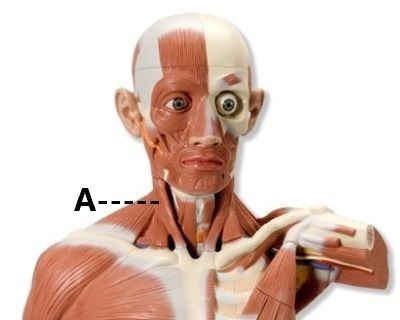
- 56Name the nerve at A and its innervation area, sensory function, brain structure, and motor functionAccessory (XI)
Innervation = Neck and Shoulder muscles
Sensory Function = Minimal - Proprioception
Brain Structure = Primary Somatosensory/Parietal
Motor Function = Neck and shoulder movement (Shrugging shoulders; turning head; yes/no)
Brain Structure = Primary Motor/Frontal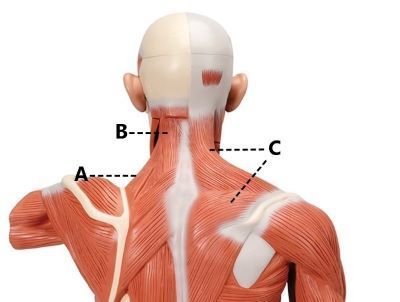
- 57Name the nerve at C and its innervation area, sensory function, brain structure, and motor function.Hypoglossal (XII)
Innervation = C = Tongue muscles
Sensory function = Minimal - Proprioception
Brain structure = Primary
Somatosensory/Parietal
Motor function = Swallowing and Speech (also Glossopharyngeal (IX)
Brain Structure = Primary motor (Swallowing) and Broca's (speech) /Frontal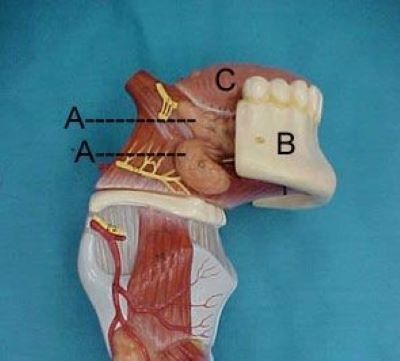
- 58Identify the nerves, sensory functions, brain structures, and motor functions related to Tongue Intervation.Tongue Innervation
Sensory function = Taste
Nerves = Facial (VII), Glossopharyngeal (IX), Vagus (X)
Brain Structure = Gustatory/Parietal
Motor function = Swallowing and Speech
Nerves = Glossopharyngeal (IX) and Hypoglossal (XII)
Brain Structure = Primary Motor (swallowing) and Broca's (speech)/Frontal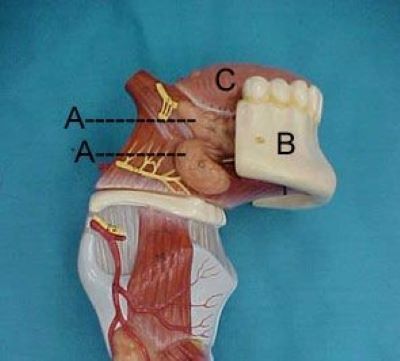
- 59Identify the spinal cord structure with deep, butterfly shaped gray matter containing cell bodies (also non-myelinated axons and dendrites).Horns
- 60Identify the spinal cord structure with superficial, white matter containing myelinated axons.Tracts
- 61Identify the spinal cord structure with sensory and motor axons that enter/exit spinal cord.Roots
- 62Identify the spinal cord structure in the center of gray matter.Central canal
Cord ends around L1 – only lumbar and sacral nerve roots inferior to end of spinal cord - 63What is the function of Cerebrospinal fluid in the central canal?transports nutrients and gases to tissue in CNS; cushions brain and spinal cord
Información
- Descripción
- Fichas sobre Practical 3 - Topic 11, creado por Lo ABC el 28/11/2022.
- Creado por
- Lo ABC
- Visitas
- 1
- Valoración