
Fichas
Science - Semester 1 Final
Fichas del conjunto (61)
- 1Developed the first theory of continental drift.Alfred Wegener
- 2German meteorologist and geophysicistAlfred Wegener
- 3What is the hypothesis of Continental Drift?The continents had once formed a single landmass, called Pangaea, before breaking apart and drifting to their present locations.
- 4The continents in the southern hemisphere exhibit an identical pattern of rock and fossils known as the "Gondwana sequence.Evidence of Continental Drift
- 5The glacial till deposits in the southern hemisphere. With the continents in their present positions, the till deposits indicate erratic glacier motion.Evidence of Continental Drift
- 6What lead to the renaming of Continental Drift?The discovery of thermal convection which is causes repeated heating and cooling results in a current which may be enough to cause continents to move.
- 73 types of Plate Tectonic Boundariesconvergent, divergent, or transform
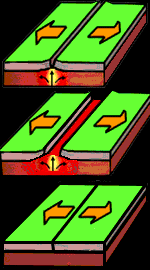
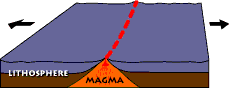
- 8Divergent BoundaryWhen two tectonic plates move away from each other.
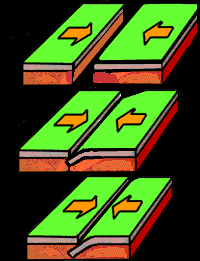
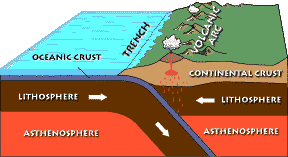
- 9Convergent BoundaryWhen two plates come together.
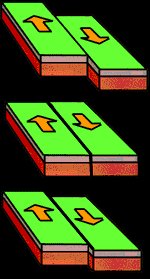
- 10Transform Plate BoundaryTwo plates sliding past each other.
- 11Results from a Divergent Boundary1. Lava spews from long fissures and geysers spurt superheated water. 2. Frequent earthquakes strike along the rift.
3. Beneath the rift, magma—molten rock—rises from the mantle.
4. It oozes up into the gap and hardens into solid rock, forming new crust on the torn edges of the plates.
5. Magma from the mantle solidifies into basalt.
6. Oceanic crust, made of basalt, is created. - 12Results from a Convergent Boundary1.The impact of the two colliding plates buckles the edge of one or both plates up into a rugged mountain range, and sometimes bends the other down into a deep seafloor trench.
2.A chain of volcanoes often forms parallel to the boundary, to the mountain range, and to the trench.
3. Powerful earthquakes shake a wide area on both sides of the boundary.
4. If one of the colliding plates is topped with oceanic crust, it is forced down into the mantle where it begins to melt.
5. Magma rises into and through the other plate, solidifying into new crust.
6. Magma formed from melting plates solidifies into granite, a light colored, low-density rock that makes up the continents.
7. Thus at convergent boundaries, continental crust, made of granite, is created, and oceanic crust is destroyed. - 13Results from a Transform Plate Boundary1. Natural or human-made structures that cross a transform boundary are offset—split into pieces and carried in opposite directions.
2. Rocks that line the boundary are pulverized as the plates grind along, creating a linear fault valley or undersea canyon.
3. As the plates alternately jam and jump against each other, earthquakes rattle through a wide boundary zone.
4. In contrast to convergent and divergent boundaries, no magma is formed.
5. Crust is cracked and broken at transform margins, but is not created or destroyed. - 14—Divergent
- 15—Convergent Boundary
- 16—Transform Plate Boundary
- 17—Convergent Boundary
- 18—Divergent Boundary
- 19—Transform Plate Boundary
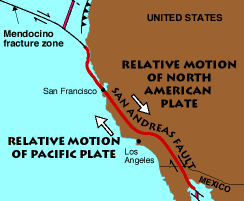
- 20What is San Andreas Fault an example of?Transform Boundary
- 21What are the Himalayas an example of?Convergent Boundary
- 22What are the Southern Alps an example of?Convergent Boundary
- 23The Andes are an example of?Convergent Boundary
- 24A mid-ocean ridge is an example of?Divergent Boundary
- 25Name the 4 layers of the Earth.Inner Core
Outer Core
Mantle
Crust - 26Earthquakes are created within which type of boundary?Transform Plate Boundary
- 27What occurs in a normal fault?The block above the fault moves down relative to the block below the fault. This fault motion is caused by tensional forces and results in extension.
- 28What occurs in a reverse fault?The block above the fault moves up relative to the block below the fault. This fault motion is caused by compressional forces and results in shortening.
- 29What occurs in a strike-slip fault?The movement of blocks along a fault is horizontal. If the block on the far side of the fault moves to the left, the fault is called left-lateral. If the block on the far side moves to the right, the fault is called right-lateral. The fault motion of a strike-slip fault is caused by shearing forces.
- 30What occurs in a transform fault?A transform fault is a type of strike-slip fault wherein the relative horizontal slip is accommodating the movement between two ocean ridges or other tectonic boundaries.
- 31What is the difference between Primary waves & Secondary waves.The P-wave (primary or pressure wave) is a pulse of energy that travels quickly through the earth and through liquids. It forces the ground to move backwards and forwards as it is compressed and expanded. The S-wave (secondary or shear wave) follows more slowly, with a swaying, rolling motion that shakes the ground back and forth perpendicular to the direction of the wave.
- 32What kinds of materials can a P wave travel through?Solid, Liquid, or Gas
- 33What kinds of materials can a S wave travel through?Only Solids
- 34Which type of wave is larger?S wave
- 35Which type of wave causes more damage?S wave. They move the earth around them with greater force, and are able to actually shake the surface of the earth. P waves, though easier to record, are significantly smaller and do not cause as much damage because they compress particles in only one direction.
- 36What is the Shadow Zone?The shadow zone is the area of the earth from angular distances of 104 to 140 degrees from a given earthquake that does not receive any direct P waves. The shadow zone results from S waves being stopped entirely by the liquid core and P waves being bent (refracted) by the liquid core.
- 37We understand the outer core to be ____________ based on our knowledge of P & S waves.Liquid
- 38How many seismic stations are necessary to locate an earthquake epicenter?3
- 39A resource that can be renewed as quickly as it is used up and can, in theory, last indefinitely.Renewable Resource
- 40A natural resource that replaces itself unless overused, e.g. animal or plant life or fresh waterRenewable Resource
- 41A source of alternative energy, e.g. sunlight, wind, or wavesRenewable Resource
- 42What is the difference between renewable and non-renewable resources?Renewable resources are able to be renewed faster as non-renewable resources may run out.
- 43Examples of renewable resources.solar, hydro electric, wind
- 44Examples of non-renewable resources.Fossil fuels, coal, oil
- 45Where do fossil fuels come from?Organic material
- 46The difference between conservation and recycling.Conservation is to conserve resources while recycling is giving back resources.
- 47What are the affects of mining on the landscape?Mining can be harmful by killing grass and polluting the air.
- 48What is mechanical weathering?The breakdown of rocks and minerals by physical agents such as frost, wind, and tree roots, with no chemical alteration
- 49What is chemical weathering?The erosion or disintegration of rocks, building materials, etc., caused by chemical reactions
- 50What is the difference between chemical and mechanical weathering?Chemical weathering demands chemical reactions with minerals inside the rock and causes changes in rock composition. Sometimes this process will produce a different kind of product due to the reaction. Mechanical weathering only involves the physical breakage of rocks to smaller pieces of fragments. Without changing the physical composition of the rocks, mechanical weathering disintegrates rocks with nature’s own physical pressures.
- 51What are the types of mechanical weathering?organic matter, ice wedging, and abrasion
- 52When 2 plates collide, one normally slides underneath. Why does this occur?In a subduction zone of a convergent boundary, the subducting plate, which is normally a plate with oceanic crust, moves beneath the other plate, which can be made of either oceanic or continental crust. Where a dense oceanic plate collides with a less-dense continental plate, the oceanic plate is typically thrust underneath because of the greater buoyancy of the continental lithosphere, forming a subduction zone.
- 53Where are deep sea trenches located? Why do they exist?They typically form in locations where one tectonic plate subducts under another on a convergent boundary. That is where a lithospheric plate bearing oceanic crust slides down into the upper mantle under the force of gravity. The result is a topographic depression where the oceanic plate comes in contact with the overriding plate, which may be either oceanic or continental creating a deep sea trench.
- 54What is Paleomagnitism?The magnetism in rocks that was induced by the earth's magnetic field.
- 55What happens to the age of the seafloor as you move away from the boundary towards the coast?The age of the seafloor is progressively older away from mid-ocean ridges.
- 56Non-renewable resources are mainly derived from what?Fossil Fuels
- 57What is a benefit of Ur (nuclear energy) being used in a nuclear reactor over other non-renewable resources?It takes a long time to burn and gives a lot of power.
- 58What kind of climate, year round average, would most likely benefit most by investing in solar power?Desert
- 59How can reducing electricity in your home also reduce pollution and save money?Reducing electricity in the home reduces pollution since we are not burning coal that has gases releasing in the atmosphere. Using a renewable resource such as solar saves the consumer money because it is renewable and everywhere.
- 60The different types of volcanoes.Shield
cinder cone
composite - 61Where are shield volcanoes located?Shield volcanoes are located near water and are not explosive inless water gets through the vent.