
Fichas
A-Level Chemistry Flashcards
Fichas del conjunto (25)
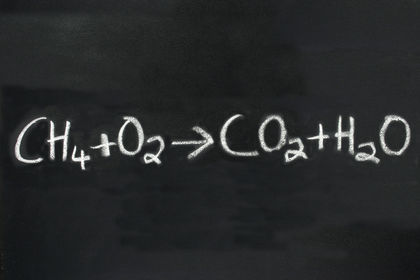
- 1Define the parts of a chemical formula. For example:Left of Arrow = Reactants
Right of Arrow = Products
Subscripts = Number of that type of atom (e.g. In CH4, there is 1 Carbon atom and 4 Hydrogen atoms)
Coefficients = Number of moles
(No coefficient = 1 mole of substance) - 2What are Lewis Structures used for? Show the Lewis Structure for Sodium Chloride (NaCl).Lewis Structures are cross and dot diagrams which allow us to visualise the number of valence electrons of each atom in order to predict how they bond.

- 3What is VSEPR modelling? List the main expressions.Valence Shell Electron Pair Repulsion (VSEPR) theory is a model used to predict the geometry of individual molecules from the number of electron pairs surrounding their central atoms.

- 4Draw the flowchart for determining Intermolecular Forces.
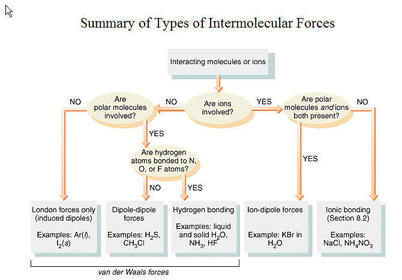
- 5Define the strength of each type of Intermolecular Forces as well as the nature of the attraction.

- 6What is Avogadro's Constant?Avogadro's Constant is the number of atoms in a mole.
There are 6.022 x 10^23 atoms per mole. - 7How do you convert the number of atoms in a substance to moles and visa versa?Divide the number of atoms by Avogadro's Constant (6.022 x 10^23) to give the number of moles.
Multiply the number of moles by Avogadro's Constant to find the number of atoms. - 8How do you convert moles to grams and visa versa?Multiple moles by molecular mass to convert to grams.
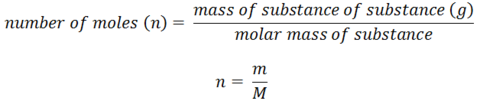
Divide grams by molecular mass to convert to moles. - 9How do you find the amount of moles in a sample?
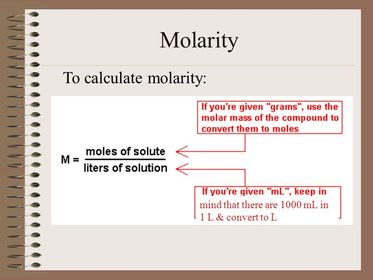
- 10How do you calculate the molarity (concentration) of a solution?
- 11Label the reaction types:
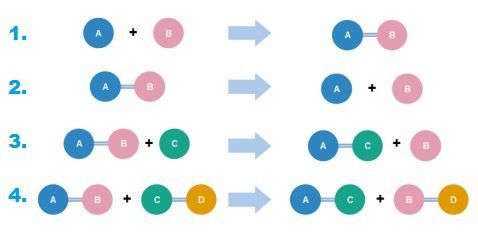
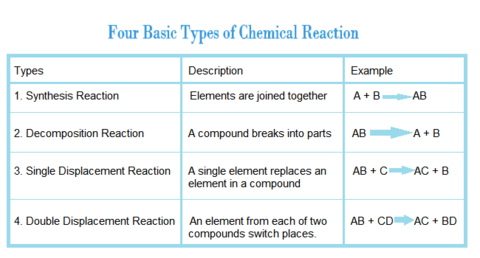
- 12When determining oxidation states, which elements/elemental groups do we generally trust and what are their oxidation numbers?Trust:
Oxygen = -2
Hydrogen = +1
Group 1 & 2 Metals = +1 & +2
Halogens (F, Cl, Br, I, At) = -1
If in pure elemental form = 0 - 13Redox Equations First stepAssign oxidation states.
- 14Redox Equations Second stepDivide into half-reactions.
e.g. Reduction and Oxidation. - 15Redox Equations Third StepBalance each half-reaction.
- Balance elements other than H and O.
- Balance O by adding H2O as needed.
- Balance H by adding H+ as needed.
- Balance the charge by adding e-'s. - 16Redox Equations Fourth StepBalance Half-Reactions.
- Multiply all oxidation half-reaction by number of electrons in the reduction half-reaction.
- Multiple all reduction half-reaction by number of electrons in the oxidation half-reaction. - 17Redox Equations Final StepAdd the two half-reactions together again, cancelling out any substances occurring on both sides and electrons.
- 18What goes where on the pH scale?1 = Acid (H+)
7 = Neutral (H2O)
14 = Alkaline (OH) - 19How do you calculate the pH of an acid and an alkaline?Acid
pH = -log10(Molarity)
Alkaline
pOH = -log10(Molarity) = x
pH = 14 - x - 20What is the law of the conservation of energy? (First law of thermodynamics)Energy can neither be created nor destroyed; rather, it transforms from one form to another.
The law of conservation of energy states that the total energy of an isolated system remains constant—it is said to be conserved over time. - 21When considering the energy of reactions, what is meant by the 'system' and what is meant by the 'surroundings'?System = reactions & products
Surroundings = container & everything beyond it. - 22Define: Endothermic ExothermicEndothermic = system absorbs heat.
Exothermic = system loses heat.
En - Enter. Ex - Exit. - 23If the change in a system's internal energy, (U), is positive, is it endothermic or exothermic? Why?It is endothermic as a positive value indicates the system has
GAINED energy.
So if a change in U is negative, it is exothermic as the negative value indicates a loss of energy from the system. - 24What is enthalpy? What is the basic enthalpy equation?Enthalpy (H) accounts for heat flow in processes occurring at constant pressure.
H = U + PV
P = Pressure, V = Volume. - 25What does a change in enthalpy mean? Basic equation?A change in enthalpy equals the heat gained or lost at constant pressure by the system.
DH = DU + P(DV)
D = Delta = Change/Variation
DH+ = endothermic, DH- = exothermic
Información
- Descripción
- A-Level Chemistry Flashcards
- Creado por
- Natalie_B
- Visitas
- 211
- Etiquetas
- Valoración