
Fichas
Sound ✔
Fichas del conjunto (26)
- 1How are sounds made?Sounds are made when objects vibrate. The vibration makes the air around vibrate, and the air vibrations enter your ear.
- 2Can air travel through a vacuum (empty space- it doesn't even have air)?No.
Sound needs a medium to travel through, so it can only travel through a solid, gas, or liquid. - 3True or False: Loud sounds have less energy than softer ones.False.
Loud sounds have more energy than softer ones. - 4Define 'pitch'-the highness/lowness of a sound
-a sound's frequency (f)
-is measured on Hertz (Hz) - 5True or False: If an object vibrates faster, they make higher pitched soundsTrue
If an object vibrates slower, they make lower pitched sounds - 6Fill in the gaps: the _______ the frequency, the higher the ______the greater the frequency, the higher the pitch
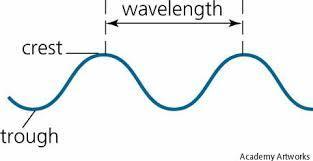
- 7What is wavelength?The distance between two crests or troughs on a wave
- 8Which colour wave has the highest/lowest frequency? -*Bonus: Which wave is the highest amplitude (loudest)?-highest: the pink line has the highest frequency since the waves are close and have a shorter wavelength
-lowest: the red line has the lowest frequency as it has the furthest wavelength
-*Bonus: They all have the same amplitude as they are all the same height away from the midline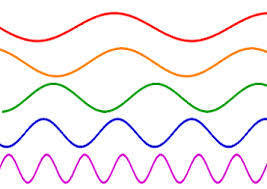
- 9Fill in the gaps: The closer the ________, the ______ the frequency.The closer the wavelength, the higher the frequency.
- 10What is amplitude?-The amount of energy a sound has
-The more the energy, the louder the sound
-The less the energy, the quieter the sound
-Half the distance between the trough and crest of a wave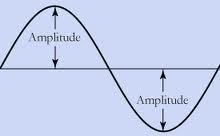
- 11Label a) and b)a) amplitude
b) wavelength--> pitch--> frequency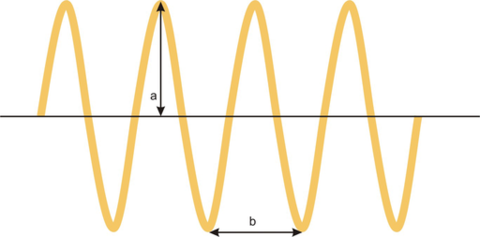
- 12Name whether the sound is quiet; loud; high; low:1. Quiet, low sound
2. Loud, low sound
3. Loud, high sound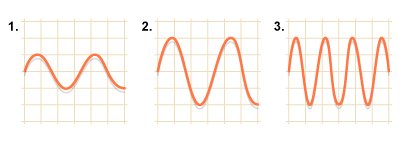
- 13Which medium does sound travel the fastest in?Sound travels the fastest in a solid because the material is more dense, therefore the vibration can be passed between the air particles more quickly.
- 14Which medium does sound travel the slowest in?Sound travels slowest in gas as the material is less dense, meaning they are far away from each other, so the vibration is harder and takes longer to pass through.
- 15What is density?The density of a material is how close the particles are.
Can you guess which box is a solid?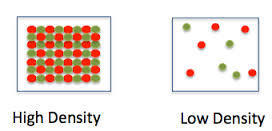
- 16Why do we see a lightning strike before a thunder clap?This is simply because sound travels slower than light.
- 17Why is an echo caused?Echoes are caused when sound waves are reflected from some surfaces. Harder surfaces reflect sound more than softer surfaces.
- 18How do you calculate the speed of sound?speed of sound (m/s) =
distance traveled (metres)/
time taken (seconds) - 19Speed of sound in air = 330m/s How far does sound travel in a. 2 seconds? b. 15 seconds?a. 660m
--> 330m= 1 second
--> 330m x 2 = 660m = 2 seconds
b. 16500m
--> 330m x 15 = 16500m = 15 seconds - 20Define: 1. compression 2. rarefaction1. compression: a high pressure area
2. rarefaction: a low pressure area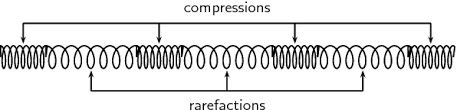
- 21What is a longitudinal wave?A longitudinal wave is when energy passes through the spring in the same direction as the forwards and backwards vibrations.
- 22Fill in the gaps: A _____ ______ passes through the air because the moving _______ bump into their neighbours. When they collide the particles pass the ________ energy and the sound wave ______ through the air. WORDS: sound wave; particles; vibration; movesA [sound wave] passes through the air because the moving [particles] bump into their neighbours. When they collide the particles pass the [vibration] energy and the sound wave [moves] through the air.
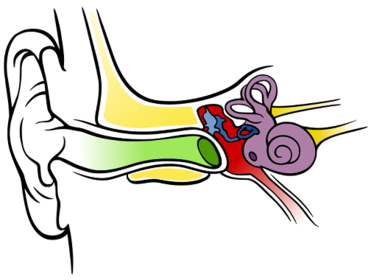
- 23How many sections is the ear divided into?The ear is split into three sections:
-the outer ear
-the middle ear
-the inner ear - 24Name the- -light green -dark green -blue -purple -yellow lines -parts.-LG: ear canal
-DG: ear drum
-B: Ossicles
-P: cochlea
-YL: auditory nerves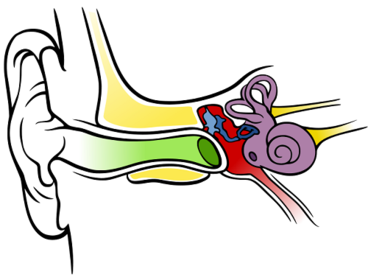
- 25Which range of sounds are humans adapted to hear?20 Hz and 20 000 Hz.
- 26Name the 8 steps in how a sound reaches the brain.1. The sound wave is produced.
2. It travels through the air to the ear
3. The sound wave is funnelled through the ear canal.
4. These vibrations cause the ear drum to vibrate.
5. Then these get to the ossicles which also start to vibrate.
6. This causes the cochlea to vibrate.
7. These vibrations are detected by the hair cells lining the cochlea.
8. The vibrations are then detected by the auditory nerve that sends a nerve impulse to the brain.