
Fichas
ABG Definitions
Fichas del conjunto (39)
- 1Relative Atomic MassThe weighed mean mass of an atom of an element compared to the mass of 1/12th of an atom of carbon-12.
- 2Relative Isotopic MassThe mass of an atom of an isotope of an element compared to the mass of 1/12th of an atom of carbon-12.
- 3Covalent BondThe bonding between non-metals when a pair of electrons is shared between atoms.
- 4Ionic BondThe electrostatic attraction between oppositely charged ions.
- 5Lone PairAn electron pair that is not involved in a covalent bond.
- 6Dative Covalent BondA covalent bond in which one of the atoms supplies both the shared electrons to the bond.
- 7Relative Molecular MassThe total sum of the relative atomic masses of the atoms in the molecule.
- 8MoleThe amount of any substance containing as many particles as there are carbon atoms in exactly 12g of the carbon-12 isotope.
- 9Avogadro ConstantThe number of atoms per mole of the carbon-12 isotope
n= 6.02x10²³ molˉˡ - 10Molar MassThe mass per mole of a substance.
- 11Empirical FormulaThe simplest whole number ratio of atoms of each element present in a compound.
- 12Avogadro's HypothesisEqual volumes of gases at the same temperature and pressure contain equal numbers of molecules.
- 13Molar VolumeThe volume per mole of a gas. At RTP the molar volume is dm³ molˉˡ.
- 14Standard SolutionA solution of known concentration, that are usually used in titrations to determine unknown information about another substance.
- 15Concentrated SolutionA solution with a large amount of solute per dm³.
- 16Dilute SolutionA solution with a small amount of solute per dm³.
- 17AcidA proton donor that gives a solution with a pH of less than 7.
- 18BaseA species that is a proton acceptor.
- 19AlkaliA special type of base that dissolves in water forming aqueous OHˉ ions and a solution with a pH greater than 7.
- 20SaltAn ionic compound where the H+ ion from the parent acid has been replaced by a metal or ammonium ion.
- 21Oxidation NumberA measure of the number of electrons that an atom uses to bond with atoms of another element.
- 22First Ionisation EnergyThe energy required to remove one outermost electron from each atom in one mole of gaseous atoms to form one mole of gaseous ions.
- 23π BondThe sideways overlap of two p-orbitals.
- 24Quantum NumberNumbers used to describe the electrons in atoms. The Principle Quantum Number indicates the shell an electron occupies.
- 25Atomic OrbitalA region within an atom that can hold up to two electrons with opposite spins.
- 26RegionA space within an atom that electrons could be found.
- 27Non-Polar BondA bond where the electrons in the bond are evenly distributed.
- 28Polar BondA bond in which the electrons are attracted to one of the atoms in the bond more than the other.
- 29ElectronegativityA measure of the attraction of a bonded atom for the pair of electrons in a covalent bond.
- 30Intermolecular ForcesForces that act between different molecules and are much weaker than ionic or covalent bonds.
- 31Permanent DipoleA weak attractive force between permanent dipoles (polar bonds) in neighbouring polar molecules.
- 32Van der Waals ForcesAttractive forces between induced dipoles in neighbouring molecules, caused by random movement of electrons.
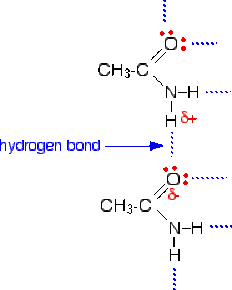
- 33Hydrogen Bond
- 34Metallic BondThe electrostatic attraction between positive metal ions and delocalised negative electrons.
- 35Delocalised ElectronsElectrons that are shared between more than two atoms.
- 36Giant Covalent StructureA structure in which atoms are held in a lattice in all directions by strong covalent bonds.
- 37Giant Ionic LatticeA structure held together by ionic bonds, because each ion attracts oppositely charged ions from all directions.
- 38DisproportionationA reaction in which the same element is both reduced and oxidised.
- 39Precipitation ReactionA reaction that takes place in aqueous solutions when aqueous ions react together to form a solid precipitate.
Información
- Descripción
- Definitions of key words and terms for the atoms, bonds and groups exam.
- Creado por
- Amy96
- Visitas
- 109
- Etiquetas
- Valoración