
Fichas
Topic 2 flashcards
Fichas del conjunto (34)
- 1What is a "pairwise" comparison?It is the difference between 2 means
- 2What does J=3 mean?It means that there are three inferences that can be made for comparisons
- 3In a J=3 experiment, what are the possible outcomes with respect to Type 1 errors?1. NO type 1 errors (no comparison Has rejected)
2. ONE type 1 error (Ho rejected for one comparison)
3. TWO type 1 errors (Ho rejected for two comparisons)
4. THREE type 1 errors (Ho rejected for three comparisons) - 4What is the Per-Comparison Error Rate? (PCER)?It is in a multiple inference context where we take to Type I error rate (a) for an individual comparison
- 5What is the Familywise Error Rate (FWER)?It is in the multiple inference context, the probability of one or more Type I errors occurring in a set of inferences/ comparisons
- 6What does a sig of 0 means?A non-significant result
- 7What does a sig of 1 equal?A significant result
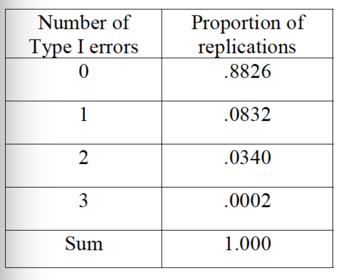
- 8What do you do when you get the Type I error rate for a set of comparisons?We could up the number of replications on which 1, 2 or 3 Type 1 errors have been made
- 9What does the FWER usually show for a study where J = 3 ?It usually shows that the error rate is inflated above the nominal a = 0.05
- 10Calculate to FWER for this set of of comparisonsType 1 errors across the set of comparisons = 0.0832 + 0.034 + 0.0002 = 0.1174
- 11Define the FWERThe probability of making at least one Type I error for a set of comparisons
- 12What do this calculate?The number of possible pairwise comparisons
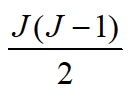
- 13What does J refer to in this equation?The number of groups in an experiment
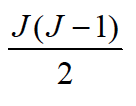
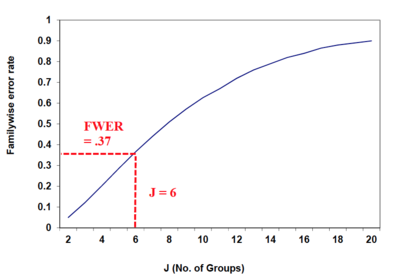
- 14As J increases, what occurs?The opportunity for making Type I errors increases
- 15What does more multiple comparisons mean for Type I errors?More multiple comparisons leads to more Type I errors
- 16What does this picture depict?FWER as a function of J, and for J = 6 actual FWER = 0.37 (inflated above 0.05)
- 17What is a "post-hoc analysis"?It is where the analysis is guided by the way the data have turned out
- 18A "maximal comparison" is a "post-hoc" comparison -true or false?True
- 19What is a "maximal comparison"?It is where we wish to examine comparisons that reflect the biggest differences between sample means. It includes Mmax - Mmin
- 20Do we know which two means make up the min and max in a maximal comparison at the beginning of an experiment? ?No, we have to wait until the sample data are known
- 21From replication to replication, do the sample means that make up the maximal comparison vary or stay the same?They vary, for example on trial 4811 the maximal comparison may equal M1 - M2 but on trial 4812 the maximal comparison may equal M3 - M1
- 22What is the most opposite comparison to a maximal comparison?A "fixed comparison" where we have planned which parameters we want to look at, e.g.: U1 - U2 we would look at M1 - M2
- 23Is the average value for a maximal comparison larger or smaller than for a fixed comparison?Larger
- 24What are the four main consequences for paying more attention to the "bigger" differences between sample means? (using maximal comparison)1) On any replication where there is 1+ significant outcomes, the Mmax - Mmin MUST BE significant
2) "easier" to make type 1 error for maximal comparison than for fixed comparison
3) Across replications, more type 1 errors will be made for maximal than for fixed comparisons
4) Type 1 error rate larger for maximal than fixed comparison (i.e. larger than a = 0.05) - 25Pick out where this output list the Type I error rate for the maximal comparison:It is the 11.7% which is equal to a type I error rate for Mmax - Mmin of 0.117
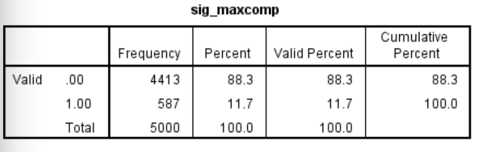
- 26What is the type I error rate for maximal comparison equal to?The family wise error rate. That is "the proportion of replication producing at least one type I error across a set of comparisons (family wise error rate) = type I error rte for maximal comparison
- 27What is the appropriate error rate unit for post-hoc analyses?The familywise error rate
- 28What does "statistical dependences among comparisons" mean in the context of FWER?It is referring to the fact that when J > 2, inferences on all comparisons are not statically independent, that is; they influence each other
- 29What does this comparison of M1 - M2 and M1 - M3 show?It is a bivariate distribution showing a positive correlation between M1 - M3 and M1 - M2, this also indicate that they are statistically dependent because they share a common value (M1)
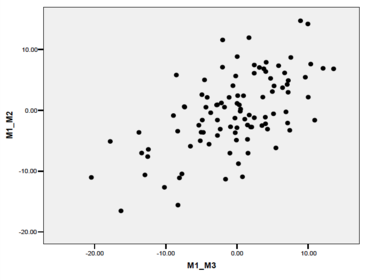
- 30What is the consequence of statistical dependence among comparisons?The consequence is that a replication which produces a Type 1 error for M1 - M2 is likely to produce a Type 1 error for M1 - M3 as well... that is when statistical outcomes are correlated, Type 1 error tend to occur in clusters
- 31What is a non-coverage error?A non-coverage error is when the H0 is false, but the parameter that we are estimating with the statistics lies outside our CI, so we have not covered it. Here no type 1 error has been made, but a nonycoverage error HAS
- 32In the case of multiple comparisons, what does the t-test procedure do ?1) t-test controls Type 1 error at a for individual comparisons (PCER)
2) BUT DOES NOT control the Type 1 error rate at a for a set of comparisons (FWER) - 33In the context of multiple comparisons, what is true of individual t-based CI and nonycoverage errors?1) individual t-based 95% CI procedure controls non-coverage error rate at a for individual comparisons
2) BUT DOES NOT control the non-coverage error rate at a for the set of comparisons i.e. family wise non-coverage error rate is inflated above a - 34When is FWER control particularly important?1) when the data influence which comparisons are considered worth examining (post-hoc analysis)
2) when comparisons are included in the analysis which have statically dependent outcomes
Información
- Descripción
- PSYC3001 - Research Methods 3 Fichas sobre Topic 2 flashcards, creado por Rosie Johnson el 03/03/2017.
- Creado por
- Rosie Johnson
- Visitas
- 0
- Valoración