
Fichas
Business Management Chapter 1: Business, a definition
Fichas del conjunto (36)
- 1BusinessThe organised effort of individuals to produce and sell the good and services that satisfy society's needs for a profit
- 2Three types of businesses1. Manufacturing businesses
2. service businesses
3. marketing intermediaries - 3Manufacturing businessesBusinesses that process various materials
- 4Service BusinessesBusinesses that render a service (eg. Banks)
- 5Marketing intermediariesBusinesses that buy products and resell them (eg. Game)
- 6ProfitThe money that remains after all business expenses have been deducted
- 7StakeholdersThe different people that are affected by the policies and decisions made by a firm
- 8Factors of productionResources used to produce goods and services. Consist of:
1. capital
2. labour
3. land and natural resources
4. entrepreneurship - 9CapitalismAn economic system in which individuals own and operate majority of businesses that provides goods and services
- 10Invisible hand theory -by Adam SmithWhen individuals act to improve their own fortunes, they indirectly promote the good of their community.
- 11Market economyAn economic system in which businesses and individuals decide what to produce and buy and the market determines prices and quantities sold
- 12Mixed economiesExhibits elements of both capitalism and socialism
- 13Householdsmade up of individuals who are the consumers of goods as well as the owners of some factors of production
- 14Businessesexchange money for natural resources, labour and capital in order to produce goods and services
- 15GovernmentsPromote and protect public welfare. Their services are important as they would not be produced by private businesses or would only be produced for those that can't afford them
- 16Command Economies1. Socialism
2. Communism - 17Socialism-key industries owned and controlled by government
-small scale private businesses allowed
-workers may choose own occupation
-production determined by national goals
-distribution of goods and services controlled by the state - 18Aim of socialismThe equitable distribution of income, the elimination of poverty and economic waste, the providing of social services to all that need them and the
- 19Disadvantages of socialismThere is increased taxation and the loss of incentive and motivation for individuals and businesses
- 20Communism-all factors of production are owned and controlled by the government
-production is based on centralized state planning to meet the needs of the state
-the state dictates occupational choices and sets prices and wages - 21Aim of communismTo create Karl Marx's concept of a classless society where all contribute according to their ability and receive benefits according to their needs
- 22ProductivityThe average level of output per worker per hour
- 23Important aspects of improving productivity1. reducing costs
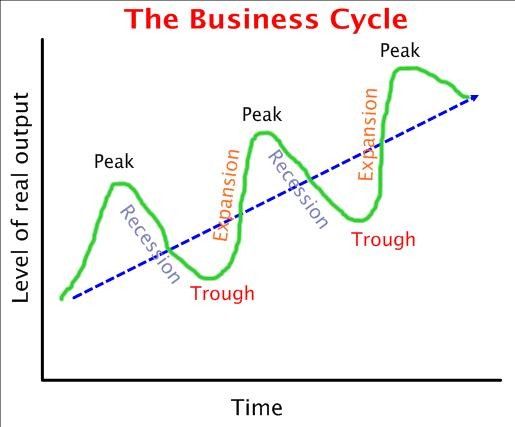
2. enabling employees to work more efficiently - 24The Business Cycle
- 25Types of competition1. perfect competition
2. monopolistic competition
3. oligopoly
4. monopoly - 26Perfect Competition-many buyers and sellers of a single product and neither are able to affect the price of the product
-no restrictions on firms entering the industry
-all buyers and sellers accept going price - 27Monopolistic Competition-many businesses with relatively large number of sellers that differentiate their product
-products similar in nature and satisfy the same need - 28Oligopoly-few sellers
-sizable investments required to enter market
-market actions of one affects others - 29Monopoly-one seller
-barriers in place to keep firms from entering industry
-sellers have complete control over price
-firms must consider demand and set price at most profitable level - 30PESTLE Analysis1. political environment
2. economic environment
3. social environment
4. technological environment
5. legal environment
6. environmental environment - 31Political EnvironmentThe influence different political systems have on the environment (government plays a role here)
- 32Economic environmentAnalyzing changes in the economy to understand trends and make forecasts for business planning
- 33Social EnvironmentAnalyzing how the business impacts society and its consumer market
- 34Technological environmentResponding to the fast-paced changes in technology
- 35Legal environmentConsists of national legal systems, regional legal frameworks and international law
- 36Environmental environmentThe effects of pollution, wastage of resources, deforestation, natural disasters etc on the firm
Información
- Descripción
- Covers: 1. the definition of a business 2. the types of economic systems 3. Measuring economic performance 4. the types of competition 5. The business environment
- Creado por
- Chandré Matlala · jun 2017
- Actualizado
- 9 jun 2017
- Visitas
- 8
- Etiquetas
- Valoración