
Fichas
Viruses, Bacteria & Archaea
Fichas del conjunto (68)
- 1Virusan infective agent that typically consists of a nucleic acid molecule in a protein coat, is too small to be seen by light microscopy, and is able to multiply ONLY within the living cells of a host.
- 2What is the major limitation of a virus?It can only reproduce using the metabolic machinery of the host cell
- 3Why can't viruses reproduce on their own?DO NOT CONTAIN:
1) Membranes of their own
2) Ribosomes-needed to make proteins
3) Cytoplasm
4) Energy source - 4Are viruses cells?No. They are noncellular.
- 5What kind of genome do viruses have?DNA or RNA genome.
- 6What surrounds a virus?A protein coat
- 7Where do viral protein coats come from?The host cells
- 8What kind of microscope is needed to see a virus?electron microscope
- 9What do viral protein coats facilitate?The penetration of prospective host cells.
- 10Three factors of virus classification1) Type of nucleic acid
2) Size and shape
3) Presence / absence of outer envelope - 11What, specifically, do viruses rely once inside host cells?The host cell's: enzymes, ribosomes, transfer RNA (tRNA), and ATP for its own replication
- 12BacteriophageViruses that infect bacterial cells
- 13What targeting mechanism do bacteriophages use?Portions of capsid adhere to specific receptor on the host bacterial cell
- 14Lytic cycle (5 stages)1) Attachment
2) Penetration
3) Biosynthesis
4) Maturation
5) Release - 15Lysogenic cycle1) Becomes integrated into the host genome
2) Becomes latent
3) May later reenter the lytic cycle - 16prophageviral genetic material already integrated into the host bacterial cell
- 17Why are the Lytic & Lysogenic Cycles important in the field of medicine?They are key factors in targeting drug-resistant bacteria
- 18Retrovirusesany of a group of RNA viruses that insert a DNA copy of their genome into the host cell in order to replicate, e.g., HIV.
- 19a key enzyme in retrovirusesreverse transcriptase
- 20cDNAa DNA that is complementary to a given RNA which serves as a template for synthesis of the DNA in the presence of reverse transcriptase
- 21retrovirus action pathway1) viral RNA enters host cell → cDNA reverse transcription
2) cDNA becomes integrated into host DNA and is replicated as host DNA replicates
3) Viral DNA is transcribed; new viruses are produced - 22What cells does HIV infect?helper T-cells
- 23helper T-cella cell that influences or controls the differentiation or activity of other cells of the immune system.
- 24integrasevirally encoded enzyme responsible for integrating viral DNA into host DNA
- 25What allows viruses to jump from one species to another?Changes in the capsid or spikes of the virus
- 26What is the major drawback of anti-viral medications?They destroy the host cells
- 27How do anti-viral medications target infected cells?They are synthesized to target the enzymes which the virus needs to use for replication
- 28ViroidNaked strands of RNA that lack capsids/Protein coats
- 29Prionsmisfolded protein molecules with contagious tertiary structures
- 30What do prions lack?genetic material
- 31What tissues do prions affect?They only affect neuronal or brain tissue.
- 32Are prion diseases treatable?No. All are untreatable and extremely fatal.
- 33Prokaryotea microscopic single-celled organism that has neither a distinct nucleus with a membrane nor other specialized organelles
- 34Peptidoglycana substance forming the cell walls of many bacteria, consisting of glycosaminoglycan chains interlinked with short peptides
- 35plasmida genetic structure in a cell that can replicate independently of the chromosomes, typically a small circular DNA strand in the cytoplasm of a bacterium
- 36How do prokaryotes reproduce?Asexually by means of binary fission
- 37ConjugationA method of genetic recombination where a sex pilus forms between two cells
and the donor cell passes DNA to recipient
cell through it - 38TransformationA method of genetic recombination where a cell picks up pieces of DNA from the
surrounding media in a test tube or dish - 39TransductionA method of genetic recombination where bacteriophages carry portions of DNA
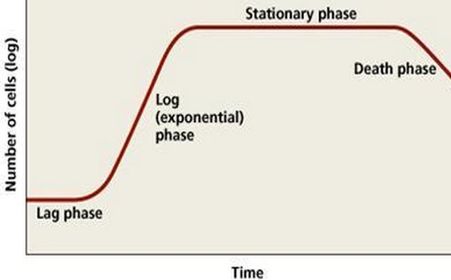
from one bacterial cell to another - 40Bacterial Growth Curve
- 41lag phase1st phase of bacterial growth. There is no increase in cell number; however cells are actively metabolizing, in preparation for cell division
- 42factor contributing to length of lag phasegrowth medium
- 43exponential phase (log phase)2nd stage of bacterial growth. DNA replication begins and cells begin to divide
- 44What factors affect the duration of exponential phase (aka generation)?the organism itself, the growth medium, and the temperature
- 45stationary phase3rd stage of bacterial growth. Metabolic activity slows and the cells cease rapid cell division
- 46death phase4th stage of bacterial growth. Here, cells quickly lose the ability to divide (even if they are placed in fresh medium)
- 47Obligate aerobesProkaryotes that are unable to grow in the absence of free oxygen
- 48Obligate anaerobesProkaryotes that are unable to grow in the presence of free oxygen
- 49Facultative anaerobesProkaryotes that are able to grow in either the presence or absence of free oxygen
- 50MesophilesBacteria that grow in ambient/room temp
- 51ThermophilesBacteria that grow in hot temp. (45oC/ 113 oF)
- 52PsychrophilesBacteria that grow in cold temp. [grow very slowly] (0 to -15 oC/32-5 oF)
- 53ExtremophilesBacteria that grow in extremely hot temps (100-120oC/ 212-248 oF)
- 54What important enzyme is derived from extremophiles?DNA polymerase from Thermus aquaticus for PCR (polymerase chain reaction )
- 55HalophilesBateria that grow in high salt areas
- 56Gram stain procedureA laboratory staining procedure important for distinguishing bacteria based on cell wall structure. Classified as gram positive and negative.
- 57Gram-positive bacteriaAppear purple. THICK peptidoglycan on the very outside of their cell walls
- 58Gram-negative bacteriaAppear pink. Have a THIN peptidoglycan hidden inside a much more COMPLEX cell wall
- 59Three bacterial classes based on shapespirilli, bacilli, cocci)
- 60spirilliSpiral shaped
- 61bacilliRod shaped
- 62cocciRound shaped
- 63CyanobacteriaGram-negative bacteria that undergo photosynthesis
- 64lichenA symbiotic relationship where the cyanobacteria provides the fungus with
organic nutrients and the fungus protects the cyanobacteria and supplies it with inorganic nutrients - 65ArchaeaChemoautotrophs, do not contain peptidoglycan, and are related to eukaryotes
- 66ChemoautotrophOxidize inorganic compounds (i.e., H2 gas, NH3)
to obtain the energy needed to break down CO2 into an - 67lipopolysaccharide (LPS)Gram-negative bacteria have this on their cell walls to protect agaist chemical agents that may destroy it. They are very toxic to animals
- 68ENDOTOXINChemical in Gram-negative bacteria released into host only when the bacterial cell wall is destroyed
Información
- Descripción
- MCAT (Viruses, Bacteria & Archaea) Biology II Fichas sobre Viruses, Bacteria & Archaea, creado por Gerard Jitechian el 08/06/2014.
- Creado por
- Gerard Jitechian
- Visitas
- 51
- Valoración