
Diagrama de flujo
Sin título
Contenido del diagrama
Strategic Capability and Competencies
4. Assessing strategic capability
1. Supply chain analysis
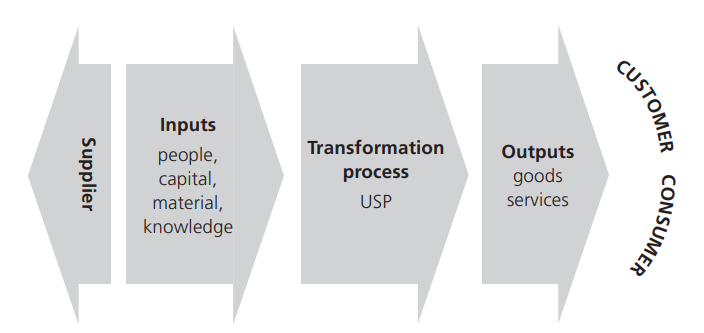
- inputs within the supply chain will form the resources
- transformation process represents the capability of the organisation, and its individuals, to apply and use these resources to create a distinctive unique selling point (USP)
- final proof of the capability and competence of the supply chain is actually the point at which the customer or consumer pays for the goods or services and therefore funds the entire supply chain
- model can be used to assess the resources required; the capability of the organisation to apply those resources; and the competence of the organisation to utilise the resources and the capability to deliver
2. Value-chain analysis
- A value chain is a set of activities that an organization carries out to create value for its customers
- Porter described a chain of activities common to all businesses, and he divided them into primary and support activities
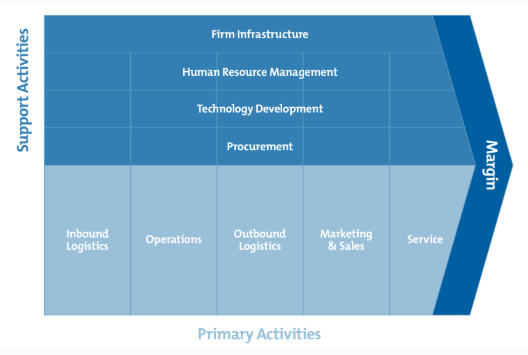
Primary activities
relate directly to the physical creation, sale, maintenance and support of a product or service
1. Inbound logistics – These are all the processes related to receiving, storing, and distributing inputs internally. Your supplier relationships are a key factor in creating value here.
2. Operations – These are the transformation activities that change inputs into outputs that are sold to customers. Here, your operational systems create value.
3. Outbound logistics – These activities deliver your product or service to your customer. These are things like collection, storage, and distribution systems, and they may be internal or external to your organization.
4. Marketing and sales – These are the processes you use to persuade clients to purchase from you instead of your competitors. The benefits you offer, and how well you communicate them, are sources of value here.
5. Service – These are the activities related to maintaining the value of your product or service to your customers, once it's been purchased.
Support activities
support the primary functions
1. Procurement (purchasing) – This is what the organization does to get the resources it needs to operate. This includes finding vendors and negotiating best prices.
2. Human resource management – This is how well a company recruits, hires, trains, motivates, rewards, and retains its workers. People are a significant source of value, so businesses can create a clear advantage with good HR practices.
3. Technological development – These activities relate to managing and processing information, as well as protecting a company's knowledge base. Minimizing information technology costs, staying current with technological advances, and maintaining technical excellence are sources of value creation.
4. Infrastructure – These are a company's support systems, and the functions that allow it to maintain daily operations. Accounting, legal, administrative, and general management are examples of necessary infrastructure that businesses can use to their advantage.
3. Benchmarking and gap analysis
an important method of determining which aspects of the operational flow, the resources and the capabilities are operating as intended, and which areas may need attention.
benefits of benchmarking
- alignment of performance against strategic and operational goals and objectives
- acceleration of management of change having recognised the need for such change
- improvement of operational processes
Lynch - the real benefit is to use the benchmarking exercise as a means of enhancing overall competitive advantage
- explore the results and analyse the reasons for the differences
- redefine performance targets after discussion with key employees
- redevelop the assets and systems of the organisation using the learning from the benchmarking exercise
- develop new performance objectives for individuals and groups, changing expectations and attitudes to what is possible as a result of the learning from the benchmarking exercise.
4. SWOT analysis
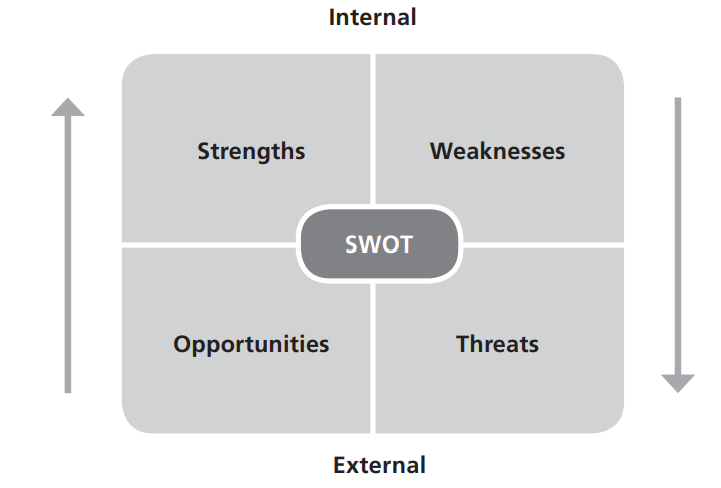
- resources of the organisation can be analysed to determine the respective strengths and weaknesses that exist
- deeper analysis will enable the organisation to understand its capabilities in the utilisation of its resources, and how these capabilities are perceived and demanded by the various stakeholders (its competencies).
- the real benefit comes from the recognition of how the strengths and weaknesses identified within the internal environment can be used to enhance the opportunities or thwart threats that are perceived within the external environment.
5. The McKinsey 7S framework
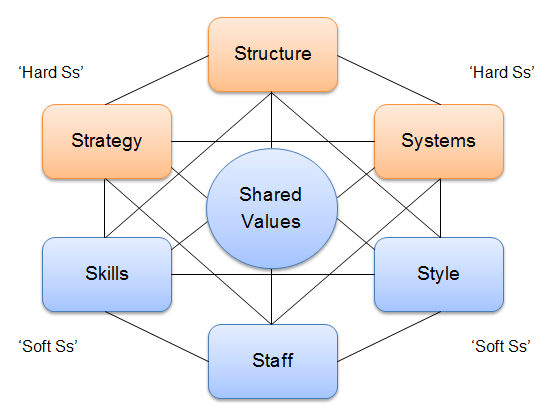
- each of the seven elements is constantly interacting with each of the other elements in the daily operation of an organisation
- Strategy, structure and systems are hard elements that are much easier to identify and manage
- soft areas, although harder to manage, are the foundation of the organization and are more likely to create the sustained competitive advantage.
1. Strategy - plan/vision of achieving sustainable competitive advantage
2. Structure - organisational hierarchy and lines of accountability
3. Systems - activities, policies and procedures that enable day-to-day tasks to be completed.
4. Style- nature of leadership, levels of empowerment, communication channels
5. Staff - mixture of employees and the combination of the capabilities
6. Skills - specific competencies of each individual employee within the organisation
7. Shared values - norms and standards that guide employee behavior and company actions
Información
- Descripción
- Diagrama sobre Sin título, creado por Elena Thorne el 26/01/2020.
- Creado por
- Elena Thorne
- Visitas
- 0
- Valoración