
Diagrama de flujo
RCP
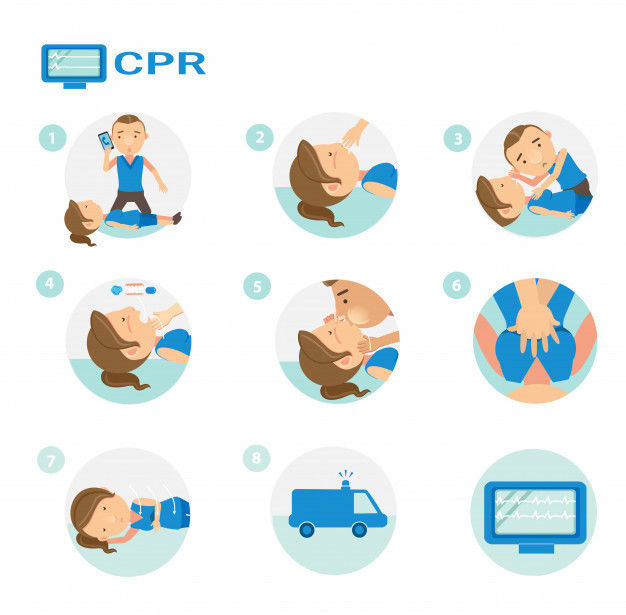
Contenido del diagrama
Basic resuscitation
Consists of chest compressions and assisted ventilation to maintain circulation and oxygenation during resuscitation. (1)
It is done when the patient is in cardiac arrest (abrupt loss of cardiac function)
It is contraindicated only in very few cases when there is an order not to resuscitate; or when the treating physician believes that the outcome of such resuscitation will be associated with profound morbidity based on clinical judgment. (1)
REFERENCES
1. Aliyu I, Michael G, Ibrahim H, Ibrahim Z, Idris U, Zubayr B, et al. Practice of cardiopulmonary resuscitation among ealth care providers in a tertiary health centre in a semi-urban setting. Journal of Acute Disease [Internet]. 2019 Jul [cited 2021 Mar 27];8(4):160–4. Available from: https://search.ebscohost.com/login.aspx?direct=true&AuthType=ip&db=edb&AN=138056118&lang=es&site=eds-live&scope=site
2. Morton SB. The Effect of High-Fidelity Simulation on Medical-Surgical Nurses’ Mock Code Performance and Self-Confidence. MEDSURG Nursing [Internet]. 2019 May [cited 2021 Mar 27];28(2):177–82. Available from: https://search.ebscohost.com/login.aspx?direct=true&AuthType=ip&db=edb&AN=137042885&lang=es&site=eds-live&scope=site
3. Lin H-L, Lin M-H, Ho C-C, Fu C-H, Koo M. Psychometric properties of the Chinese version of the attitudes towards cardiopulmonary resuscitation with defibrillation (ACPRD-C) among female hospital nurses in Taiwan. International emergency nursing [Internet]. 2017 Jul [cited 2021 Mar 25];33:7–13. Available from: https://search.ebscohost.com/login.aspx?direct=true&AuthType=ip&db=cmedm&AN=28256337&lang=es&site=eds-live&scope=site
GENERALITIES
- Contact with patient secretions should be avoided
- Check the patient's breathing and if there is presence of hemorrhage, evaluate circulation. If there is absence, start RCP.
- Perform care with A (respiratory route) B (respiratory rate) C (circulation) D (consciousness) E (wounds / injuries)
Maneuver of the RCP
1. Shoulders aligned with hands and legs
2. Palm of the hand on the sternum and intertwine with the other (dominant down)
3. Push with the weight of the body 5cm, without flexing the arms
4. 30 compressions x 2 breaths
- Call 911 before starting compressions
RECOMMENDATION
It is vital to prepare nurses for quality resuscitation care; the use of simulation training can improve supplier performance and the quality of the RCP. In particular, training programs using high-fidelity simulation can provide a safe environment for nurses to learn and practice necessary skills during stress situations emergency.
It is recommended to provide effective patient care during cardiac arrest. It also provides a safe environment for nurses to practice and hone their skills, which can increase self-confidence for performance skills. (2)
Nurses can make a critical difference in cardiac resuscitation outcomes, particularly in hospital settings where they are often the first responders to responses. Cardiac arrests. However, barriers, including inadequate knowledge, poor skill retention, and insufficient organizational support, have been suggested to prevent adoption of nurse-led defibrillation in hospitals. Therefore, when evaluating the overall effectiveness of any educational program, the attitude aspect, in addition to knowledge and skill levels, of CPR with defibrillation should be included. (3)
V: see breathing
Or: hear sighs
S: feel air
Lina Xiomara Salamanca Cárdenas - Marzo 27/21 - Cuidado al Adulto II 2021-1 - María Angelica Rojas
Información
- Descripción
- Diagrama sobre RCP, creado por Lina Salamanca el 28/03/2021.
- Creado por
- Lina Salamanca
- Visitas
- 0
- Valoración