
CPR and Basic Life Support
121 resources created by 110 users
This CPR and Basic Life Support page on GoConqr gathers community-made quizzes, mind maps, flashcards, flowcharts and notes, from the BLS survey and chest compressions to defibrillation, airway management and ACLS. It's built for university students and professional candidates practising the steps of resuscitation, and for teachers after ready-made material. There are over 100 resources here, including more than 20 quizzes, over 40 mind maps and more than 20 flashcard decks. Try a quiz to find your gaps, then revise from the maps.
Top CPR and Basic Life Support resources
-
26 cardsResus NGT or IDC size Calculation
-
42 questionsEMT 11 A 60-year-old male is found to be unresponsive, pulseless, and apneic. You should:
-
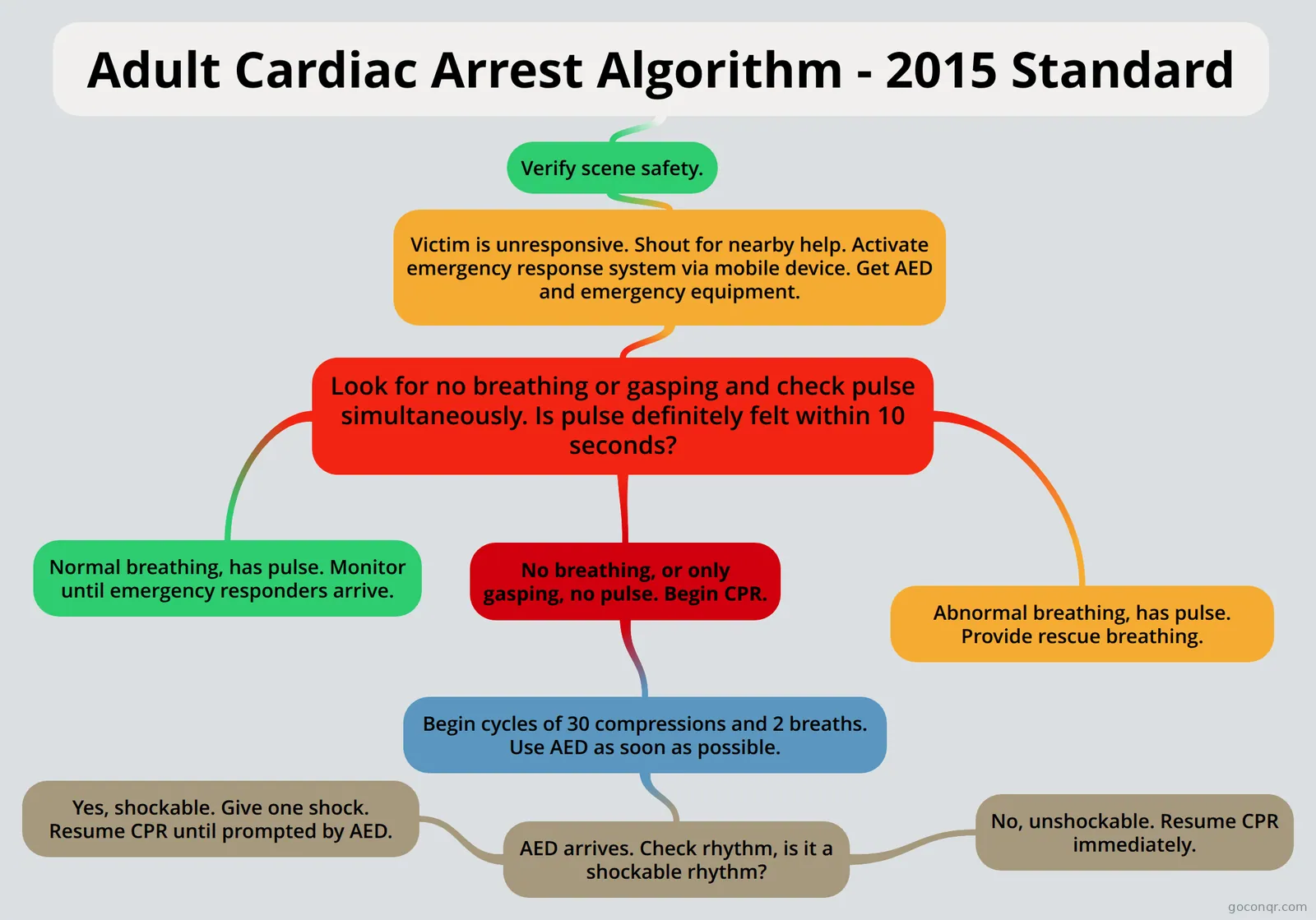 Mind map Adult Cardiac Arrest Algorithm - 2015 Standard Map of adult cardiac arrest protocol
-
Flowchart ECMO configuración Breve descripción de los soportes de ECMO VA-VV
-
Mind map Cardiopulmonary Resuscitation ED 6thEd B&C
-
18 cardsBasic Life Support True or False? 30 minutes is the maximum time a person should be left in the recovery position before movin...
-
10 questionsCPR AED Theory Assessment What does CPR stands for?
-
Mind map ACLS
Quizzes
See all 26 quizzes-
42 questionsEMT 11 A 60-year-old male is found to be unresponsive, pulseless, and apneic. You should:
-
10 questionsCPR AED Theory Assessment What does CPR stands for?
-
156 questionsUntitled A 62 y.o. M has been found unconscious and pulseless outdoors at Cradle Mountain. You commence the Cardiac ...
-
30 questionsEmergencies (421-450) Which of these is not one of the first aid measures to follow in case of a severe cut?
-
25 questionsFinal Exam Why is defibrillation important?
-
30 questionsEmergency (31-60) Acute coronary syndromes (ACS) are presented by:
-
19 questionsEmergencies (451-469) You are alone and find an unconscious 50 years-old victim on the ground who may need CPR. The scene is safe...
-
50 questionsBLS Protocol Test An EMT can administer nebulized albuterol under what type of order?
Mind maps
See all 46 mind maps-
Adult Cardiac Arrest Algorithm - 2015 Standard Map of adult cardiac arrest protocol
-
Cardiopulmonary Resuscitation ED 6thEd B&C
-
ACLS
-
Airway Management
-
Cardiopulmonary Resuscitation
-
Basic Resuscitation.
-
How a resuscitation is performed quality basic cardiopulmonary (1)
-
BASIC CARDIOPULMONARY RESUSCITATION
Flashcards
See all 28 flashcards-
26 cardsResus NGT or IDC size Calculation
-
18 cardsBasic Life Support True or False? 30 minutes is the maximum time a person should be left in the recovery position before movin...
-
24 cardsACLS CARDS How hard and how fast should you push during CPR
-
9 cardsCardiac arrest Outline the approach to a patient in cardiac arrest (unresponsive and not breathing normally)
-
76 cardsEmergency Cardiovascular Life Support: Fundamentals of Respiratory Care 1. Do Respiratory Therapists play a vital role in emergency cardiovascular life support?
-
54 cardsBasics of CPR and First Aids Early recognition and Call for help (*to prevent cardiac arrest)
-
18 cardsCPR flash cards What does CPR stand for?
-
20 cardsBLS Survey Using the systematic approach, if a patient appears CONSCIOUS the rescuer should use which survey and when?
Flowcharts
See all 13 flowcharts
Notes
-
Untitled DEFINITION OF CPR • CardioPulmonary Resucitation Heart disease • Heart disease is the number one killer in the United States today, and over 60% of all victims will die before they reach the hospital! • The ...
-
CPR + Fluid Theray CPR Describe general principles of CPR and its application in cardiopulmonary Arrest (CPA) CPA Heart not beating Patient stoped breathing CPR as quickly as poss. Delay ? Brain damage Aim to return spontane...
-
CAMERON1 _1 Bystander call for help andCPR critical to survival ECC alone may be superior to ECC + EAR early defibrillation essential - ambulance/coresponders via EAD
-
CPR Health Notes What does CPR stand for:C: Cardio- Heart Perform 30 chest compressions in 18 seconds. 2 - 2.8 inches deep 100-120 chest compressions per minute P: Pulmonary- Lungs Perform 2 breaths for both adult and child 1 second p...
-
Untitled If the patient appears unconscious, the BLS survey is used for the initial assessment of the patient. After completing the appropriate steps in the BLS survey, the ACLS survey is utilized for more advanced assessment ...
-
Neonate Resuscitation
Slides
Topics in CPR and Basic Life Support
More Emergency medicine and first aid topics
About CPR and Basic Life Support
GoConqr OriginalWhat this unit covers
This unit sits in the Resuscitation and Airway strand of Emergency medicine and first aid. It follows a rescue from first response to advanced care. Many resources are mind maps, and many of those cover basic resuscitation under slightly different names.
Where to start
Begin with the flashcard deck Basic Life Support. It asks where to place compressions, what age counts as a child and which guidelines suit older children. Then open BLS Survey, which covers the systematic approach and how to check responsiveness in an adult.
Next, look at the mind map Adult Cardiac Arrest Algorithm - 2015 Standard. It starts with an unresponsive victim, shouting for help, calling the emergency response system and fetching an AED.
Going further
- Airway Management covers head tilt chin lift, jaw thrust and basic airway manoeuvres.
- ACLS CARDS asks about compression depth and rate, V-tach and shock energy on a monophasic defibrillator.
- Reversible Causes of Cardiac Arrest is a mind map for the causes to think through during a resuscitation.
- Chain of Survival is a flowchart that shows the links in order.
- Neonatal resuscitation and PEDIATRIC CPR are mind maps for younger patients.
Using quizzes and maps together
Read a map first, then test yourself. Basic CPR Exam, BLS Protocol Test and CPR Written Exam Prep are good checks on the basics. CPR and defibrillation- June OSCE 2021 suits practical exam preparation. The quiz iACLS September 2017 and the slide set ACLS suit those working towards ACLS.
Note which questions you miss. Go back to the matching map or deck, then try the quiz again.
Make it your own
Teachers can pick a map or quiz for a class session. Everyone can choose one resource today and see how it goes.
Frequently asked questions
Which resource should I open first?
Start with the Basic Life Support flashcard deck, then BLS Survey. They cover compression position, the child age question and how to assess responsiveness. After that, the Adult Cardiac Arrest Algorithm mind map shows how those steps fit into a full sequence.
What do the mind maps cover?
They cover adult cardiac arrest, airway management, ACLS drugs such as epinephrine and amiodarone, chest compression technique, defibrillators, reversible causes, neonatal resuscitation and paediatric CPR. Many others summarise basic resuscitation, so you can compare several versions of the same topic.
Are the resources free to use?
Yes. Every resource listed here is free to open, study and take, with no account needed. They were made by GoConqr users, not by GoConqr. A free account also saves your quiz scores and lets you make your own quizzes, mind maps, flashcards and notes.
Who are these resources suited to?
They suit university students and professional candidates practising resuscitation steps, algorithms and drug or equipment details. Teachers can also use the quizzes, maps and slide sets as ready-made material. Some resources mention ACLS, so they fit that kind of course.
Is there anything on ACLS?
Yes. There is an ACLS mind map covering signs, risk factors, medications and first line interventions, plus the ACLS CARDS flashcards, an ACLS slide set and the iACLS September 2017 quiz. Use the flashcards for recall and the quiz to check it.
What if I cannot find the topic I need?
Browse the other formats on this page first, since a topic may appear as a flowchart or note rather than a quiz. If it is still missing, make your own mind map, flashcards or quiz with a free account and keep it for revision.