
Diagrama de flujo
Presente perfecto simple y continuo en inglés
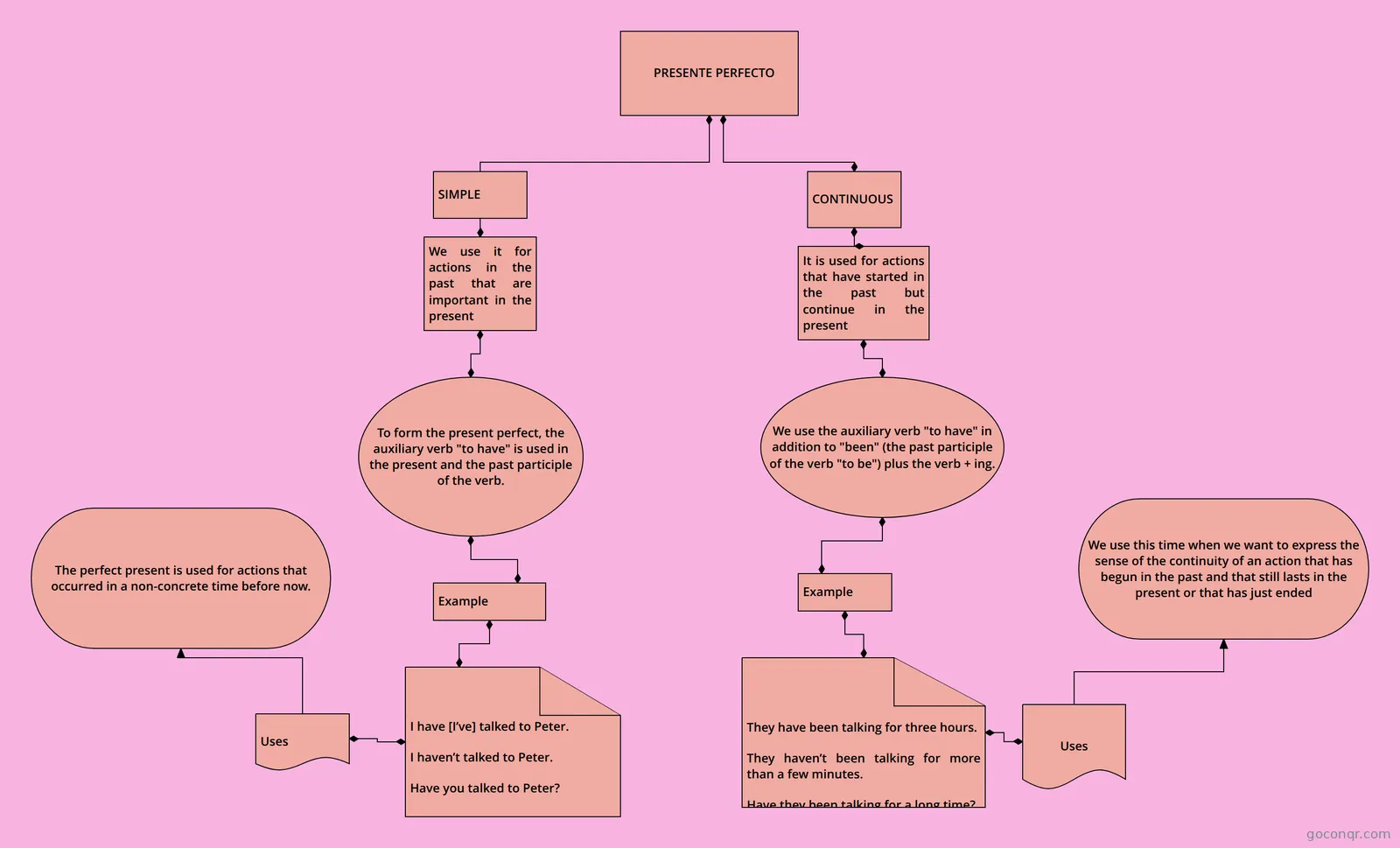
Diagrama de flujo: presente perfecto
Contenido del diagrama
PRESENTE PERFECTO
We use it for actions in the past that are important in the present
SIMPLE
To form the present perfect, the auxiliary verb "to have" is used in the present and the past participle of the verb.
Example
I have [I’ve] talked to Peter.
I haven’t talked to Peter.
Have you talked to Peter?
CONTINUOUS
It is used for actions that have started in the past but continue in the present
We use the auxiliary verb "to have" in addition to "been" (the past participle of the verb "to be") plus the verb + ing.
Example
They have been talking for three hours.
They haven’t been talking for more than a few minutes.
Have they been talking for a long time?
Uses
We use this time when we want to express the sense of the continuity of an action that has begun in the past and that still lasts in the present or that has just ended
Uses
The perfect present is used for actions that occurred in a non-concrete time before now.
Información
- Descripción
- Diagrama sobre Sin título, creado por Jennifer Dayana el 14/05/2019.
- Creado por
- Jennifer Dayana
- Visitas
- 1
- Valoración
Más sobre Presente perfecto simple y continuo