
Mapa mental
Literacy Terms
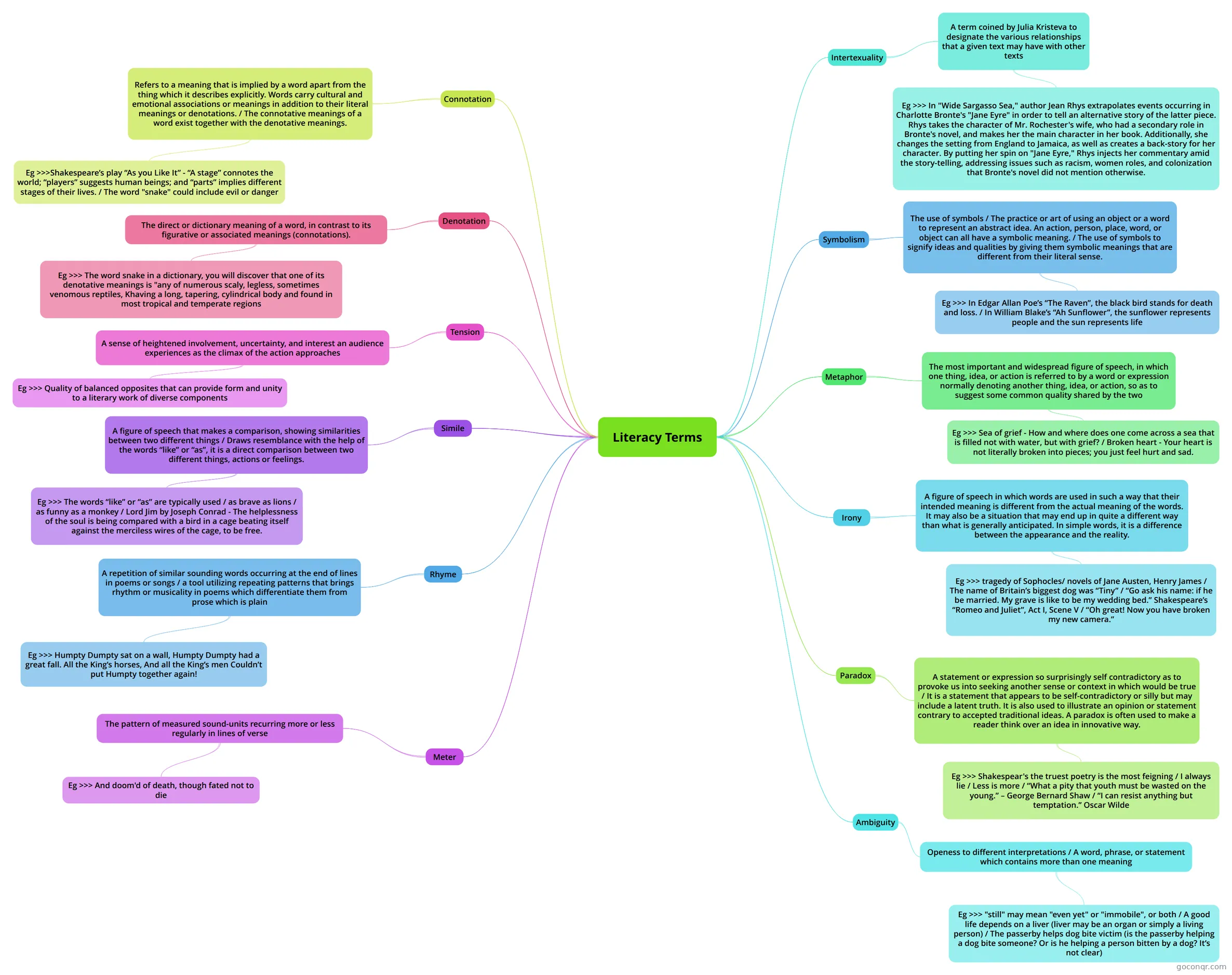
Mind map: Literacy terms
Contenido del mapa
Literacy Terms
Intertexuality
- A term coined by Julia Kristeva to designate the various relationships that a given text may have with other texts
- Eg >>> In "Wide Sargasso Sea," author Jean Rhys extrapolates events occurring in Charlotte Bronte's "Jane Eyre" in order to tell an alternative story of the latter piece. Rhys takes the character of Mr. Rochester's wife, who had a secondary role in Bronte's novel, and makes her the main character in her book. Additionally, she changes the setting from England to Jamaica, as well as creates a back-story for her character. By putting her spin on "Jane Eyre," Rhys injects her commentary amid the story-telling, addressing issues such as racism, women roles, and colonization that Bronte's novel did not mention otherwise.
- A term coined by Julia Kristeva to designate the various relationships that a given text may have with other texts
Symbolism
- The use of symbols / The practice or art of using an object or a word to represent an abstract idea. An action, person, place, word, or object can all have a symbolic meaning. / The use of symbols to signify ideas and qualities by giving them symbolic meanings that are different from their literal sense.
- Eg >>> In Edgar Allan Poe’s “The Raven”, the black bird stands for death and loss. / In William Blake’s “Ah Sunflower”, the sunflower represents people and the sun represents life
- The use of symbols / The practice or art of using an object or a word to represent an abstract idea. An action, person, place, word, or object can all have a symbolic meaning. / The use of symbols to signify ideas and qualities by giving them symbolic meanings that are different from their literal sense.
Metaphor
- The most important and widespread figure of speech, in which one thing, idea, or action is referred to by a word or expression normally denoting another thing, idea, or action, so as to suggest some common quality shared by the two
- Eg >>> Sea of grief - How and where does one come across a sea that is filled not with water, but with grief? / Broken heart - Your heart is not literally broken into pieces; you just feel hurt and sad.
- The most important and widespread figure of speech, in which one thing, idea, or action is referred to by a word or expression normally denoting another thing, idea, or action, so as to suggest some common quality shared by the two
Irony
- A figure of speech in which words are used in such a way that their intended meaning is different from the actual meaning of the words. It may also be a situation that may end up in quite a different way than what is generally anticipated. In simple words, it is a difference between the appearance and the reality.
- Eg >>> tragedy of Sophocles/ novels of Jane Austen, Henry James / The name of Britain’s biggest dog was “Tiny” / “Go ask his name: if he be married. My grave is like to be my wedding bed.” Shakespeare’s “Romeo and Juliet”, Act I, Scene V / “Oh great! Now you have broken my new camera.”
- A figure of speech in which words are used in such a way that their intended meaning is different from the actual meaning of the words. It may also be a situation that may end up in quite a different way than what is generally anticipated. In simple words, it is a difference between the appearance and the reality.
Paradox
- A statement or expression so surprisingly self contradictory as to provoke us into seeking another sense or context in which would be true / It is a statement that appears to be self-contradictory or silly but may include a latent truth. It is also used to illustrate an opinion or statement contrary to accepted traditional ideas. A paradox is often used to make a reader think over an idea in innovative way.
- Eg >>> Shakespear's the truest poetry is the most feigning / I always lie / Less is more / “What a pity that youth must be wasted on the young.” – George Bernard Shaw / “I can resist anything but temptation.” Oscar Wilde
- A statement or expression so surprisingly self contradictory as to provoke us into seeking another sense or context in which would be true / It is a statement that appears to be self-contradictory or silly but may include a latent truth. It is also used to illustrate an opinion or statement contrary to accepted traditional ideas. A paradox is often used to make a reader think over an idea in innovative way.
Ambiguity
- Openess to different interpretations / A word, phrase, or statement which contains more than one meaning
- Eg >>> "still" may mean "even yet" or "immobile", or both / A good life depends on a liver (liver may be an organ or simply a living person) / The passerby helps dog bite victim (is the passerby helping a dog bite someone? Or is he helping a person bitten by a dog? It’s not clear)
- Openess to different interpretations / A word, phrase, or statement which contains more than one meaning
Connotation
- Refers to a meaning that is implied by a word apart from the thing which it describes explicitly. Words carry cultural and emotional associations or meanings in addition to their literal meanings or denotations. / The connotative meanings of a word exist together with the denotative meanings.
- Eg >>>Shakespeare’s play “As you Like It” - “A stage” connotes the world; “players” suggests human beings; and “parts” implies different stages of their lives. / The word "snake" could include evil or danger
- Refers to a meaning that is implied by a word apart from the thing which it describes explicitly. Words carry cultural and emotional associations or meanings in addition to their literal meanings or denotations. / The connotative meanings of a word exist together with the denotative meanings.
Denotation
- The direct or dictionary meaning of a word, in contrast to its figurative or associated meanings (connotations).
- Eg >>> The word snake in a dictionary, you will discover that one of its denotative meanings is "any of numerous scaly, legless, sometimes venomous reptiles, Khaving a long, tapering, cylindrical body and found in most tropical and temperate regions
- The direct or dictionary meaning of a word, in contrast to its figurative or associated meanings (connotations).
Tension
- A sense of heightened involvement, uncertainty, and interest an audience experiences as the climax of the action approaches
- Eg >>> Quality of balanced opposites that can provide form and unity to a literary work of diverse components
- A sense of heightened involvement, uncertainty, and interest an audience experiences as the climax of the action approaches
Simile
- A figure of speech that makes a comparison, showing similarities between two different things / Draws resemblance with the help of the words “like” or “as”, it is a direct comparison between two different things, actions or feelings.
- Eg >>> The words “like” or “as” are typically used / as brave as lions / as funny as a monkey / Lord Jim by Joseph Conrad - The helplessness of the soul is being compared with a bird in a cage beating itself against the merciless wires of the cage, to be free.
- A figure of speech that makes a comparison, showing similarities between two different things / Draws resemblance with the help of the words “like” or “as”, it is a direct comparison between two different things, actions or feelings.
Rhyme
- A repetition of similar sounding words occurring at the end of lines in poems or songs / a tool utilizing repeating patterns that brings rhythm or musicality in poems which differentiate them from prose which is plain
- Eg >>> Humpty Dumpty sat on a wall, Humpty Dumpty had a great fall. All the King’s horses, And all the King’s men Couldn’t put Humpty together again!
- A repetition of similar sounding words occurring at the end of lines in poems or songs / a tool utilizing repeating patterns that brings rhythm or musicality in poems which differentiate them from prose which is plain
Meter
- The pattern of measured sound-units recurring more or less regularly in lines of verse
- Eg >>> And doom'd of death, though fated not to die
- The pattern of measured sound-units recurring more or less regularly in lines of verse
Información
- Descripción
- Mapa Mental sobre Literacy Terms, creado por 银焰 el 02/07/2014.
- Creado por
- 银焰
- Visitas
- 31
- Valoración