
Mapa mental
THE VIKINGS
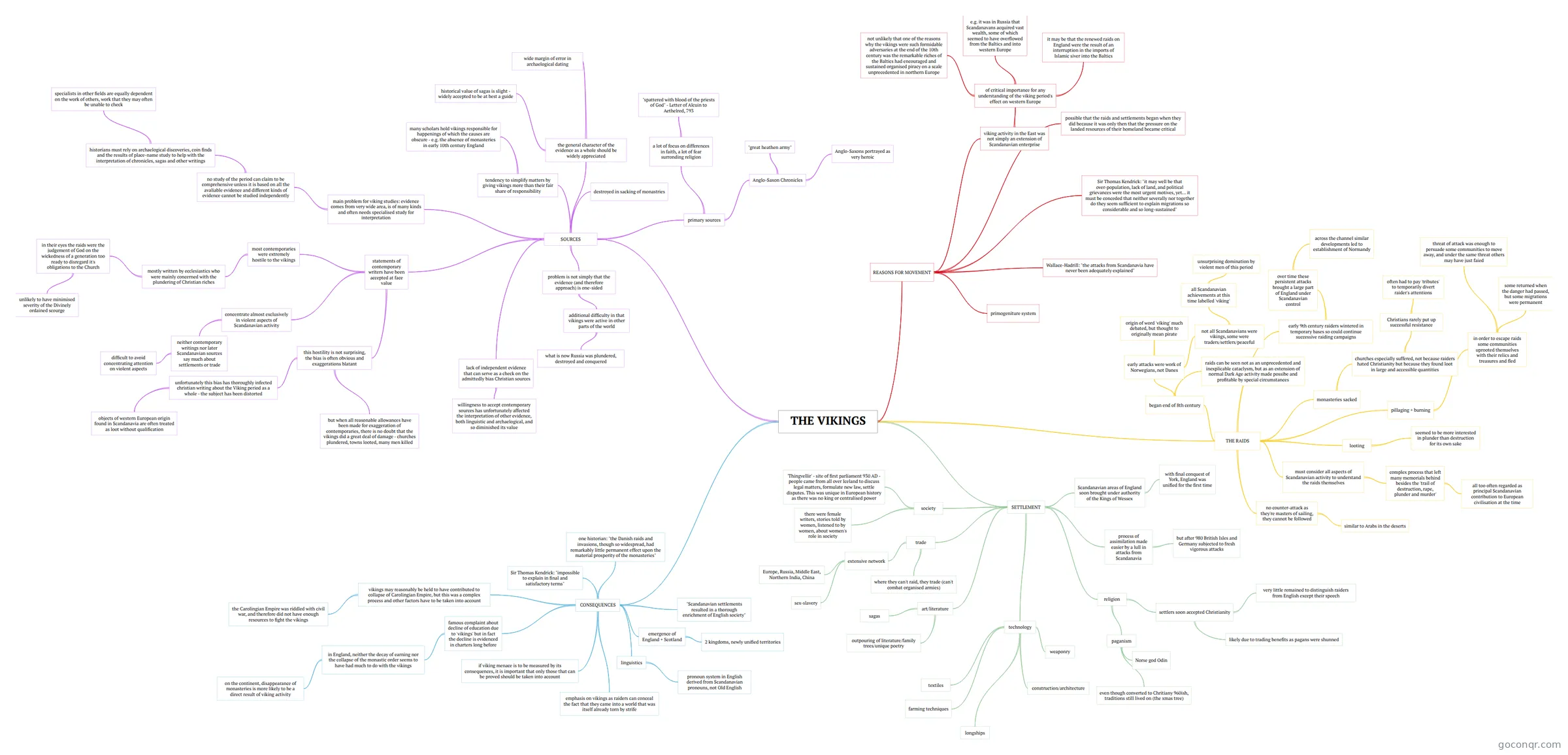
Mind map: The Vikings
Contenido del mapa
THE VIKINGS
REASONS FOR MOVEMENT
- primogeniture system
- viking activity in the East was not simply an extension of Scandanavian enterprise
- of critical importance for any understanding of the viking period's effect on western Europe
- e.g. it was in Russia that Scandanavans acquired vast wealth, some of which seemed to have overflowed from the Baltics and into western Europe
- it may be that the renewed raids on England were the result of an interruption in the imports of Islamic siver into the Baltics
- not unlikely that one of the reasons why the vikings were such formidable adversaries at the end of the 10th century was the remarkable riches of the Baltics had encouraged and sustained organised piracy on a scale unprecedented in northern Europe
- of critical importance for any understanding of the viking period's effect on western Europe
- Sir Thomas Kendrick: "it may well be that over-population, lack of land, and political grievances were the most urgent motives, yet... it must be conceded that neither severally nor together do they seem sufficient to explain migrations so considerable and so long-sustained"
- Wallace-Hadrill: "the attacks from Scandanavia have never been adequately explained"
- possible that the raids and settlements began when they did because it was only then that the pressure on the landed resources of their homeland became critical
CONSEQUENCES
- linguistics
- pronoun system in English derived from Scandanavian pronouns, not Old English
- emergence of England + Scotland
- 2 kingdoms, newly unified territories
- vikings may reasonably be held to have contributed to collapse of Carolingian Empire, but this was a complex process and other factors have to be taken into account
- the Carolingian Empire was riddled with civil war, and therefore did not have enough resources to fight the vikings
- one historian: "the Danish raids and invasions, though so widespread, had remarkably little permanent effect upon the material prosperity of the monasteries"
- famous complaint about decline of education due to 'vikings' but in fact the decline is evidenced in charters long before
- in England, neither the decay of earning nor the collapse of the monastic order seems to have had much to do with the vikings
- on the continent, disappearance of monasteries is more likely to be a direct result of viking activity
- in England, neither the decay of earning nor the collapse of the monastic order seems to have had much to do with the vikings
- if viking menace is to be measured by its consequences, it is important that only those that can be proved should be taken into account
- emphasis on vikings as raiders can conceal the fact that they came into a world that was itself already torn by strife
- Sir Thomas Kendrick: "impossible to explain in final and satisfactory terms"
- "Scandanavian settlements resulted in a thorough enrichment of English society"
- linguistics
THE RAIDS
- pillaging + burning
- in order to escape raids some communities uprooted themselves with their relics and treasures and fled
- some returned when the danger had passed, but some migrations were permanent
- threat of attack was enough to persuade some communities to move away, and under the same threat others may have just faied
- in order to escape raids some communities uprooted themselves with their relics and treasures and fled
- looting
- seemed to be more interested in plunder than destruction for its own sake
- monasteries sacked
- churches especially suffered, not because raiders hated Christianity but because they found loot in large and accessible quantities
- Christians rarely put up successful resistance
- often had to pay 'tributes' to temporarily divert raider's attentions
- Christians rarely put up successful resistance
- churches especially suffered, not because raiders hated Christianity but because they found loot in large and accessible quantities
- began end of 8th century
- early attacks were work of Norwegians, not Danes
- origin of word 'viking' much debated, but thought to originally mean pirate
- not all Scandanavians were vikings, some were traders/settlers/peaceful
- all Scandanavian achievements at this time labelled 'viking'
- unsurprising domination by violent men of this period
- all Scandanavian achievements at this time labelled 'viking'
- raids can be seen not as an unprecedented and inexplicable cataclysm, but as an extension of normal Dark Age activity made possibe and profitable by special circumstances
- early attacks were work of Norwegians, not Danes
- early 9th century raiders wintered in temporary bases so could continue successive raiding campaigns
- over time these persistent attacks brought a large part of England under Scandanavian control
- across the channel similar developments led to establishment of Normandy
- over time these persistent attacks brought a large part of England under Scandanavian control
- must consider all aspects of Scandanavian activity to understand the raids themselves
- complex process that left many memorials behind besides the 'trail of destruction, rape, plunder and murder'
- all too often regarded as principal Scandanavian contribution to European civilisation at the time
- complex process that left many memorials behind besides the 'trail of destruction, rape, plunder and murder'
- no counter-attack as they're masters of sailing, they cannot be followed
- similar to Arabs in the deserts
- pillaging + burning
SETTLEMENT
- religion
- paganism
- Norse god Odin
- even though converted to Chritiany 960ish, traditions still lived on (the xmas tree)
- settlers soon accepted Christianity
- very little remained to distinguish raiders from English except their speech
- likely due to trading benefits as pagans were shunned
- paganism
- trade
- extensive network
- Europe, Russia, Middle East, Northern India, China
- sex-slavery
- where they can't raid, they trade (can't combat organised armies)
- extensive network
- technology
- longships
- weaponry
- construction/architecture
- farming techniques
- textiles
- art/literature
- sagas
- outpouring of literature/family trees/unique poetry
- Scandanavian areas of England soon brought under authority of the Kings of Wessex
- with final conquest of York, England was unified for the first time
- process of assimilation made easier by a lull in attacks from Scandanavia
- but after 980 British Isles and Germany subjected to fresh vigorous attacks
- society
- 'Thingvellir' - site of first parliament 930 AD - people came from all over Iceland to discuss legal matters, formulate new law, settle disputes. This was unique in European history as there was no king or centralised power
- there were female writers, stories told by women, listened to by women, about women's role in society
- religion
SOURCES
- destroyed in sacking of monastries
- problem is not simply that the evidence (and therefore approach) is one-sided
- additional difficulty in that vikings were active in other parts of the world
- what is now Russia was plundered, destroyed and conquered
- additional difficulty in that vikings were active in other parts of the world
- main problem for viking studies: evidence comes from very wide area, is of many kinds and often needs specialised study for interpretation
- no study of the period can claim to be comprehensive unless it is based on all the avaliable evidence and different kinds of evidence cannot be studied independently
- historians must rely on archaelogical discoveries, coin finds and the results of place-name study to help with the interpretation of chronicles, sagas and other writings
- specialists in other fields are equally dependent on the work of others, work that they may often be unable to check
- historians must rely on archaelogical discoveries, coin finds and the results of place-name study to help with the interpretation of chronicles, sagas and other writings
- no study of the period can claim to be comprehensive unless it is based on all the avaliable evidence and different kinds of evidence cannot be studied independently
- the general character of the evidence as a whole should be widely appreciated
- wide margin of error in archaelogical dating
- historical value of sagas is slight - widely accepted to be at best a guide
- statements of contemporary writers have been accepted at face value
- most contemporaries were extremely hostile to the vikings
- mostly written by ecclesiastics who were mainly concerned with the plundering of Christian riches
- in their eyes the raids were the judgement of God on the wickedness of a generation too ready to disregard it's obligations to the Church
- unlikely to have minimised severity of the Divinely ordained scourge
- in their eyes the raids were the judgement of God on the wickedness of a generation too ready to disregard it's obligations to the Church
- mostly written by ecclesiastics who were mainly concerned with the plundering of Christian riches
- concentrate almost exclusively in violent aspects of Scandanavian activity
- neither contemporary writings nor later Scandanavian sources say much about settlements or trade
- difficult to avoid concentrating attention on violent aspects
- neither contemporary writings nor later Scandanavian sources say much about settlements or trade
- this hostility is not surprising, the bias is often obvious and exaggerations blatant
- unfortunately this bias has thoroughly infected christian writing about the Viking period as a whole - the subject has been distorted
- objects of western European origin found in Scandanavia are often treated as loot without qualification
- but when all reasonable allowances have been made for exaggeration of contemporaries, there is no doubt that the vikings did a great deal of damage - churches plundered, towns looted, many men killed
- unfortunately this bias has thoroughly infected christian writing about the Viking period as a whole - the subject has been distorted
- most contemporaries were extremely hostile to the vikings
- lack of independent evidence that can serve as a check on the admittedly bias Christian sources
- willingness to accept contemporary sources has unfortunately affected the interpretation of other evidence, both linguistic and archaelogical, and so diminished its value
- tendency to simplify matters by giving vikings more than their fair share of responsibility
- many scholars hold vikings responsible for happenings of which the causes are obscure - e.g. the absence of monasteries in early 10th century England
- primary sources
- a lot of focus on differences in faith, a lot of fear surronding religion
- "spattered with blood of the priests of God" - Letter of Alcuin to Aethelred, 793
- Anglo-Saxon Chronicles
- "great heathen army"
- Anglo-Saxons portrayed as very heroic
- a lot of focus on differences in faith, a lot of fear surronding religion
Información
- Descripción
- Undergraduate (HIST115) History 1st Year Mapa Mental sobre THE VIKINGS, creado por Josie Whitelegg el 16/01/2018.
- Creado por
- Josie Whitelegg
- Visitas
- 0
- Valoración