
Mapa mental
Integration Techniques
Contenido del mapa
Integration Techniques
1) Double Substitution/Change of Variable Technique
- Used when
- You can't apply integration formulas directly. This means that dx (that came from the derivative of "u") can't cancel anything else.
- Steps to follow
- 1) Determine value of u
- 3) Get derivative of u
- 4) Isolate dx
- 5) Now that you have x and dx, ¡SUBSTITUTE on original integral!
- 6) Cancell anything that you can.
- 7) Write the result in terms of x, using the substitution of u.
- 6) Cancell anything that you can.
- 5) Now that you have x and dx, ¡SUBSTITUTE on original integral!
- 4) Isolate dx
- 2) Isolate x
- 3) Get derivative of u
- 1) Determine value of u
- Used when
3) Integration by Parts Technique
- Used when
- You have two functions multiplied together, one that you can integrate and one that you can differentiate.
- Formula you'll use later
- Sudv = uv - Svdu
- Formula you'll use later
- You have two functions multiplied together, one that you can integrate and one that you can differentiate.
- Steps to follow
- 1) Identify function "u" and the differential "dv"
- 2) To identify "u", use the nemotechnique LATE
- L (logarithmic) A (algebraic) T (trigonometric) E (exponential)
- 3) Once you have your function "u", elements remaining will be "dv"
- 4) Derivate "u" to get -> du Integrate "dv" to get -> v
- 5) Substitute "u", "v", and "dv"in the formula
- Formula : Sudv = uv - Sv(du)
- 6) Integrate anything that still has the integral symbol (S).
- 5) Substitute "u", "v", and "dv"in the formula
- 4) Derivate "u" to get -> du Integrate "dv" to get -> v
- 2) To identify "u", use the nemotechnique LATE
- 1) Identify function "u" and the differential "dv"
- Special cases
- SHORTCUT TABULATION
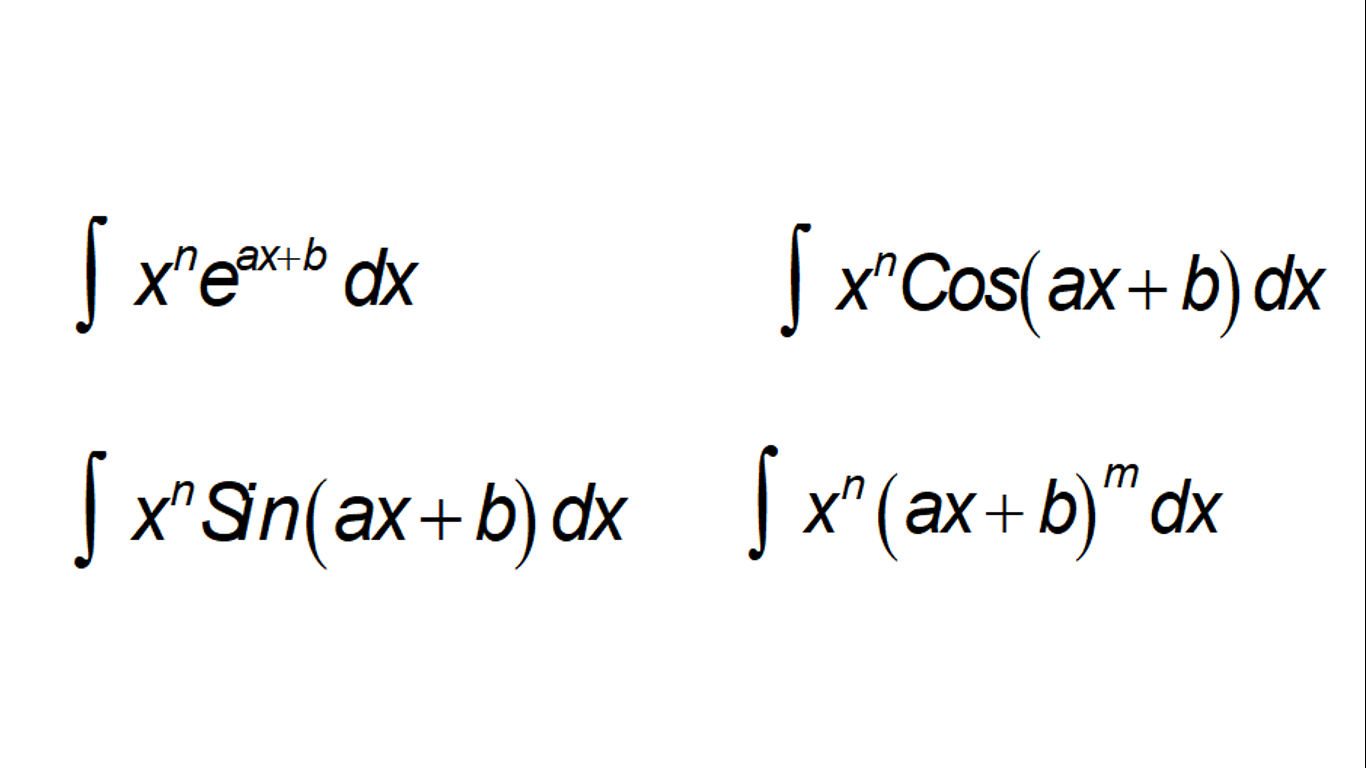
- Where “a” and “b” represent real numbers, “m” is a positive real number and “n” is any whole number
- In this cases "u"= x^n and the rest is "dv"
- You will design a table to get to the solution with the next columns and lines
- 1st column: you place downwards "+" and "-" signs. START with + sign and alternate.
- Sign sticks to the element the square to its right
- 2nd column: you place the function "u" in the first square of the column and downwards you insert its derivatives
- 1st square of this column multiplies with 2nd square of the column to the right, 2nd square of this column multiplies with 3rd square of column to the right, and so on forming diagonals.
- THE SOLUTION is obtained adding the products of the entrance of the diagonals. (don't forget to add C if it is indefinite integral)
- 1st square of this column multiplies with 2nd square of the column to the right, 2nd square of this column multiplies with 3rd square of column to the right, and so on forming diagonals.
- 3rd column: you place the differential "dv" in the first square of column and downwards its anti-derivatives.
- 1st column: you place downwards "+" and "-" signs. START with + sign and alternate.
- You will design a table to get to the solution with the next columns and lines
- In this cases "u"= x^n and the rest is "dv"
- Where “a” and “b” represent real numbers, “m” is a positive real number and “n” is any whole number
- EXPONENTS MATTER
- When you have an integral: "part algebraic & part trigonometric" OR "part algebraic & part exponential"
- Exponent of algebraic part determines how many integrations you need to do
- When you have an integral: "part algebraic & part trigonometric" OR "part algebraic & part exponential"
- SHORTCUT TABULATION
- Used when
2) Partial Fractions Technique
- Used when
- You get an integral given as a fraction and the denominator can't cancel the numerator when you integrate.
- Notice you can factor denominator
- You get an integral given as a fraction and the denominator can't cancel the numerator when you integrate.
- Steps to follow
- 1) Factor denominator of the function in the Original Integral
- 2) Make the fraction (of your integral) EQUAL (=) to A+B+C+... EACH LETTER will have as denominator the elements of the factorized denominator of the original fraction.
- 3) You will multiply the last whole equality by the factors of the denominator of the original fraction.
- 4) Now you will give convenient values to x, to solve for your letters.
- 5) Now that you have the value of your letters, substitute them and you will integrate that sum of fractions (now that letters have values).
- 4) Now you will give convenient values to x, to solve for your letters.
- ATTENTION WITH MULTIPLICITY
- Watch out with the multiplicity that you may get in the factorized denominator.
- FOR EXAMPLE: if you have x(x+1)^2
- You'll need to put {A/x} + {B/(x+1)} + {C/(x+1)^2}
- FOR EXAMPLE: if you have x(x+1)^2
- Watch out with the multiplicity that you may get in the factorized denominator.
- 3) You will multiply the last whole equality by the factors of the denominator of the original fraction.
- 2) Make the fraction (of your integral) EQUAL (=) to A+B+C+... EACH LETTER will have as denominator the elements of the factorized denominator of the original fraction.
- 1) Factor denominator of the function in the Original Integral
- Used when
Daniela De Alba Calderón A01283221
Sources
- Living Class Lesson Plan Design Committee. (2017). Techniques of Integration. Abril 19, 2018, de Instituto Tecnológico y de Estudios Superiores de Monterrey Sitio web: https://miscursos.tec.mx/bbcswebdav/institution/ITESM/LivingClass/epage/lc/pm6013/ingles/pm6013_t5/html5forpc.html?page=4&bbv=1&pcode=
Imágenes y archivos del mapa
Información
- Descripción
- Integration Techniques Colaborative Project
- Creado por
- Daniela De Alba
- Visitas
- 28
- Valoración