
Mapa mental
MEDIATION / ARBITRATION
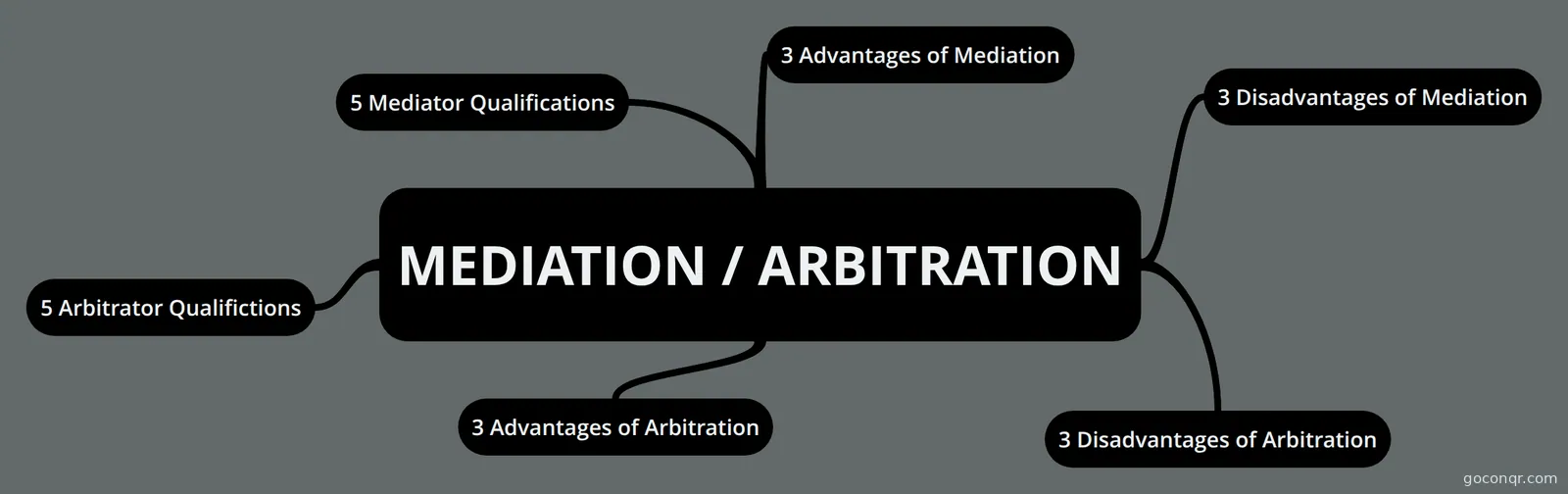
Mind map: mediation and arbitration
Contenido del mapa
MEDIATION / ARBITRATION
- Mediation is conducted with a single mediator who does not judge the case but helps to facilitate discussion and eventual resolution of the dispute. Arbitration is conducted with a panel of multiple arbitrators who take on a role like that of a judge, make decisions about evidence and give written opinions which can be binding or non-binding. Although arbitration is sometimes conducted with one arbitrator, the most common procedure is for each side to select an arbitrator. Decisions are made by majority vote.
3 Advantages of Mediation
- Mediation is much less costly than civil litigation or even arbitration. Most mediators charge by the hour and mediation is usually completed in a couple days. There should be no court filing fees and related expenses. Preparation for mediation is far easier and simpler than is required to prepare for arbitration or litigation.
- Mediation is a much faster process that civil litigation or arbitration. When people use mediation their conflicts are resolved in a fraction of the time. It is not unusual for cases to be completely settled in a short session, lasting less than a day.
- Settlements in mediation are more agreeable to both parties than arbitration, any settlement arrived at through negotiation isn't necessarily agreed to voluntarily by both parties. Obligations under the agreement are more likely to be fulfilled than obligations imposed by a court.
3 Disadvantages of Mediation
- Mediation does not always result in a settlement agreement. Parties might spend their time and money in mediation only to find that they must have their case settled for them by a court, opting for mediation can present something of a risk, further if mediation fails much of a party's "ammunition" might have already been exposed to the opposing party. Therefor, becoming far less useful in the ensuing trial.
- Mediation lacks the procedural and constitutional protections guaranteed by the federal and state courts. The lack of formality in mediation could be a benefit or a detriment, mediation between parties of dispute levels of sophistication and power, and have diparte amounts of resources available, might result in an equitable settlement as the less-well positioned party is overwhelmed and unprotected.
- Mediation has no formal discovery process. If one of the parties to a dispute cannot fully address the case without first receiving information from the other party. There is no way to compel disclosure of such information. The party seeking disclosure must rely instead on the other party's good faith, which may or may not be good enough.
5 Mediator Qualifications
- Most court appointed mediators must be licensed lawyers in good standing with their state bar. Some states will accept mediators with a degree in their specialization rather than a law degree.
- A mediator must have good moral character with out taking sides. This is very important there must be no bias in a mediators decision making.
- Mediation training, most states require certified court mediators to have undergone mediation training. The amount of training hours that are required vary by which state you are in.
- Mediation experience, some states allow relevant work experience to serve as a substitute for example California allows mediator candidates to show alternative education, training, skills that closely match its training and education requirements.
- Certification - Once a person has fulfilled its sates requirements to be certified as a mediator, they must apply for a certification. Some courts require continuing education such as a refresher course every year to maintain their certification.
3 Advantages of Arbitration
- In arbitration, the parties to the dispute usually agree on the arbitrator. It will be someone both sides have confidence will be impartial and fair.
- Arbitration is essentially a private procedure, if the parties desire privacy than the dispute and the resolution can be kept confidential.
- If arbitration is binding there are very limited opportunities for either side to appeal therefor, the arbitration will be the end of the dispute. That gives finality not often present with a trail decision
3 Disadvantages of Arbitration
- Rules of evidence may prevent some evidence from being considered by a judge or a jury, but an arbitrator may consider that evidence. Thus, an arbitrators decision may be based on information that a judge or jury would not consider at trial.
- If certain information from a witness is presented by documents, Then there is no opportunity to cross-examine the testimony of that witness.
- If arbitration is binding both parties give up their right to an appeal. This means there is no real opportunity to correct what one party may feel is an erroneous arbitration decision.
5 Arbitrator Qualifictions
- Arbitrators wishing to practice in states where a law degree is not required will need to hold at a minimum a bachelors degree. However most states prefer arbitrators to hold a law degree and have prior experience as an attorney or business professional.
- Currently there is no national certification for arbitrators. Some states require arbitrators to be licensed and certified through the state.
- You have relevant experience. Court appointed arbitrators are usually asked to show at least 10 years of relevant experience to even be considered for an official court roster. Internship is a way to obtain experience in arbitration with an arbitrator firm.
- Membership in a professional association.
- Continuing education, some states require arbitrators to have 2 1/2 hours of approved training every year.
Información
- Descripción
- Mapa Mental sobre MEDIATION / ARBITRATION, creado por Rhonda Arce el 04/05/2018.
- Creado por
- Rhonda Arce
- Visitas
- 0
- Valoración
Más sobre Comparing Mediation, Arbitration and Litigation