
Mapa mental
Factors Affecting Encoding and Retrieval.
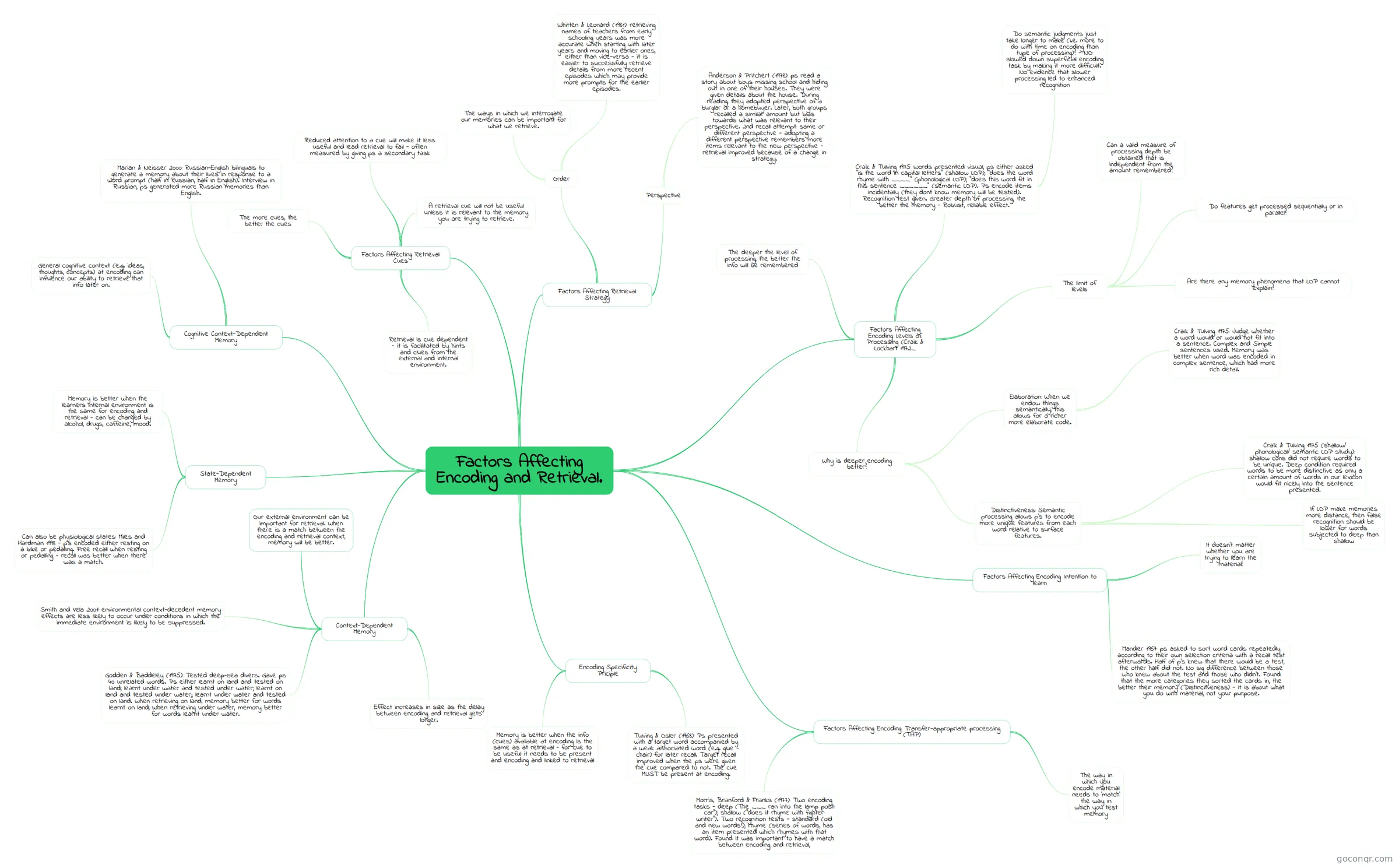
Mind map: Factors affecting encoding and retrieval
Contenido del mapa
Factors Affecting Encoding and Retrieval.
Factors Affecting Encoding: Levels of Processing (Craik & Lockhart 1972_
- The deeper the level of processing, the better the info will be remembered
- Craik & Tulving 1975: Words presented visual, ps either asked "is the word in capital letters" (shallow LOP); "does the word rhyme with ____" (phonological LOP); "does this word fit in this sentence ______" (semantic LOP). Ps encode items incidentally (they dont know memory will be tested). Recognition test given. Greater depth of processing, the better the memory - Robust, reliable effect.
- Do semantic judgments just take longer to make (i.e. more to do with time on encoding than type of processing)? - NO: slowed down superficial encoding task by making it more difficult. No evidence that slower processing led to enhanced recognition
- The limit of levels
- Can a valid measure of processing depth be obtained that is independent from the amount remembered?
- Do features get processed sequentially or in parallel?
- Are there any memory phenomena that LOP cannot explain?
- Why is deeper encoding better?
- Elaboration: When we endow things semantically, this allows for a richer more elaborate code.
- Craik & Tulving 1975: Judge whether a word would or would not fit into a sentence. Complex and Simple sentences used. Memory was better when word was encoded in complex sentence, which had more rich detail.
- Distinctiveness: Semantic processing allows p's to encode more unique features from each word relative to surface features.
- Craik & Tulving 1975 (shallow/ phonological/ semantic LOP study): shallow cons did not require words to be unique. Deep condition required words to be more distinctive as only a certain amount of words in our lexicon would fit nicely into the sentence presented.
- If LOP make memories more distance, then false recognition should be lower for words subjected to deep than shallow
- Elaboration: When we endow things semantically, this allows for a richer more elaborate code.
Factors Affecting Encoding: Intention to learn
- It doesn't matter whether you are trying to learn the material!
- Mandler 1967: ps asked to sort word cards repeatedly according to their own selection criteria with a recall test afterwards. Half of p's knew that there would be a test, the other half did not. No sig difference between those who knew about the test and those who didn't. Found that the more categories they sorted the cards in, the better their memory (Distincitveness) - it is about what you do with material, not your purpose.
Factors Affecting Encoding: Transfer-appropriate processing (TAP)
- The way in which you encode material needs to 'match' the way in which you test memory
- Morris, Branford & Franks (1977): Two encoding tasks - deep (The ___ ran into the lamp post: car"); shallow ("does it rhyme with fighter: writer"). Two recognition tests - standard (old and new words?); rhyme (series of words, has an item presented which rhymes with that word). Found it was important to have a match between encoding and retrieval,
Encoding Specificity Priciple
- Memory is better when the info (cues) available at encoding is the same as at retrieval - for cue to be useful it needs to be present and encoding and linked to retrieval
- Tulving & Osler (1968): Ps presented with a target word accompanied by a weak associated word (e.g. glue - chair) for later recall. Target recall improved when the ps were given the cue compared to not. The cue MUST be present at encoding.
Context-Dependent Memory
- Our external environment can be important for retrieval. When there is a match between the encoding and retrieval context, memory will be better.
- Godden & Baddeley (1975): Tested deep-sea divers. Gave ps 40 unrelated words. Ps either learnt on land and tested on land; learnt under water and tested under water; learnt on land and tested under water;; learnt under water and tested on land. When retrieving on land, memory better for words learnt on land; When retrieving under water, memory better for words learnt under water.
- Effect increases in size as the delay between encoding and retrieval gets longer.
- Smith and Vela 2001: environmental context-decedent memory effects are less likely to occur under conditions in which the immediate environment is likely to be suppressed.
State-Dependent Memory
- Memory is better when the learners internal environment is the same for encoding and retrieval - can be changed by alcohol, drugs, caffeine, mood.
- Can also be physiological states: Miles and Hardman 1998 - p's encoded either resting on a bike or pedalling. Free recall when resting or pedalling - recall was better when there was a match.
Cognitive Context-Dependent Memory
- Marian & Neisser 2000: Russian-English bilinguals to generate a memory about their lives in response to a word prompt (half in Russian, half in English). Interview in Russian, ps generated more Russian memories than English.
- General cognitive context (e.g. ideas, thoughts, concepts) at encoding can influence our ability to retrieve that info later on.
Factors Affecting Retrieval: Cues
- Retrieval is cue dependent - it is facilitated by hints and clues from the external and internal environment.
- Reduced attention to a cue will make it less useful and lead retrieval to fail - often measured by giving ps a secondary task
- The more cues, the better the cues
- A retrieval cue will not be useful unless it is relevant to the memory you are trying to retrieve.
Factors Affecting Retrieval: Strategy
- Order
- The ways in which we interrogate our memories can be important for what we retrieve.
- Whitten & Leonard (1981): retrieving names of teachers from early schooling years was more accurate when starting with later years and moving to earlier ones, either than vice-versa - it is easier to successfully retrieve details from more recent episodes which may provide more prompts for the earlier episodes.
- Perspective
- Anderson & Pritchert (1978): ps read a story about boys missing school and hiding out in one of their houses. They were given details about the house. During reading, they adopted perspective of a burglar or a homebuyer. Later, both groups recalled a similar amount but bias towards what was relevant to their perspective. 2nd recall attempt: same or different perspective - adopting a different perspective remembers more items relevant to the new perspective - retrieval improved because of a change in strategy.
- Order
Información
- Descripción
- Mapa Mental sobre Factors Affecting Encoding and Retrieval., creado por Emily Collyer el 15/05/2018.
- Creado por
- Emily Collyer
- Visitas
- 0
- Valoración