
Mapa mental
AS philosophy indirect and direct arguments: epistimology
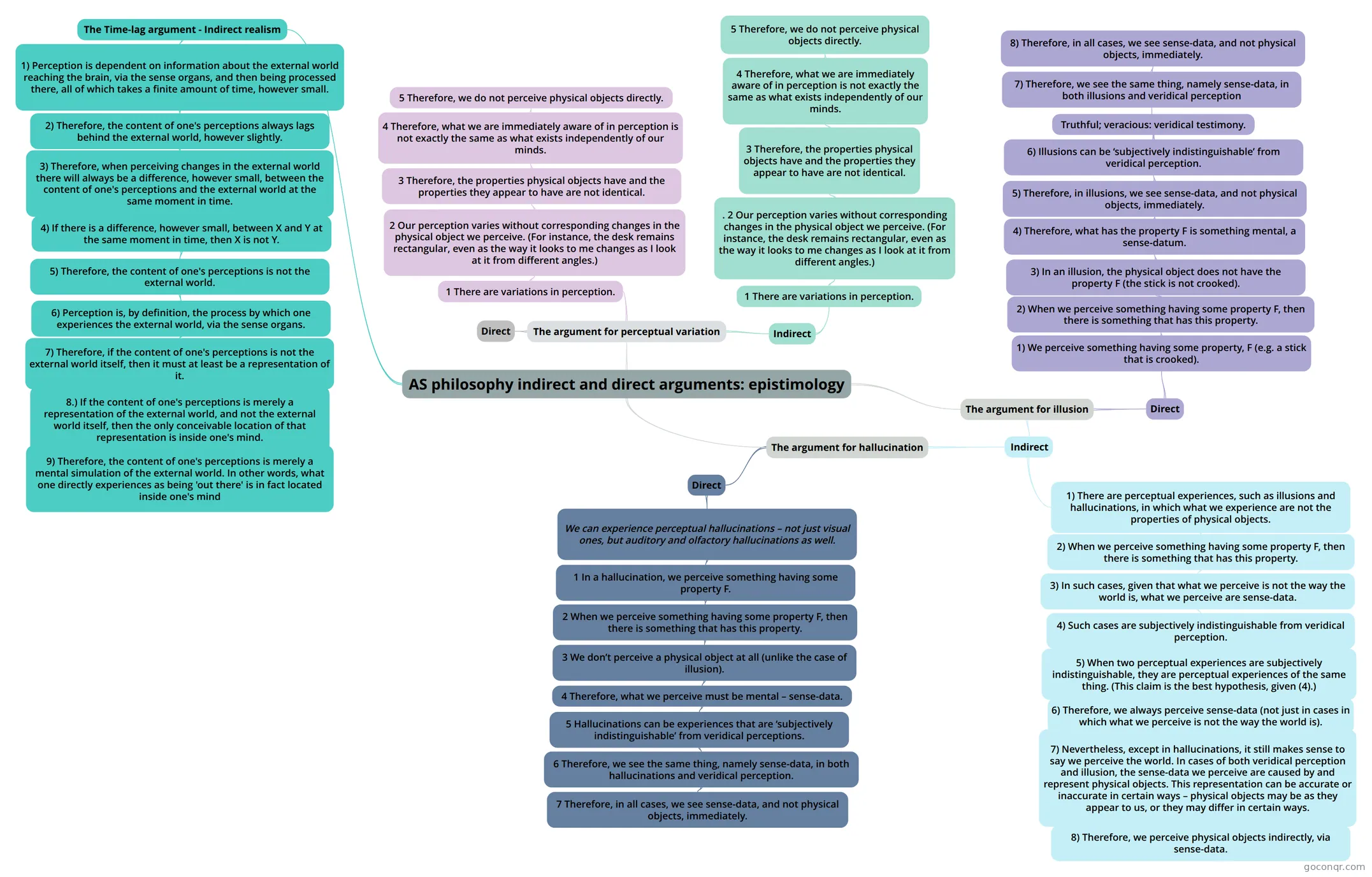
Mind map: AS philosophy direct and indirect arguments epistemology
Contenido del mapa
AS philosophy indirect and direct arguments: epistimology
The Time-lag argument - Indirect realism
- 1) Perception is dependent on information about the external world reaching the brain, via the sense organs, and then being processed there, all of which takes a finite amount of time, however small.
- 2) Therefore, the content of one's perceptions always lags behind the external world, however slightly.
- 3) Therefore, when perceiving changes in the external world there will always be a difference, however small, between the content of one's perceptions and the external world at the same moment in time.
- 4) If there is a difference, however small, between X and Y at the same moment in time, then X is not Y.
- 5) Therefore, the content of one's perceptions is not the external world.
- 6) Perception is, by definition, the process by which one experiences the external world, via the sense organs.
- 7) Therefore, if the content of one's perceptions is not the external world itself, then it must at least be a representation of it.
- 8.) If the content of one's perceptions is merely a representation of the external world, and not the external world itself, then the only conceivable location of that representation is inside one's mind.
- 9) Therefore, the content of one's perceptions is merely a mental simulation of the external world. In other words, what one directly experiences as being 'out there' is in fact located inside one's mind
- 8.) If the content of one's perceptions is merely a representation of the external world, and not the external world itself, then the only conceivable location of that representation is inside one's mind.
- 7) Therefore, if the content of one's perceptions is not the external world itself, then it must at least be a representation of it.
- 6) Perception is, by definition, the process by which one experiences the external world, via the sense organs.
- 5) Therefore, the content of one's perceptions is not the external world.
- 4) If there is a difference, however small, between X and Y at the same moment in time, then X is not Y.
- 3) Therefore, when perceiving changes in the external world there will always be a difference, however small, between the content of one's perceptions and the external world at the same moment in time.
- 2) Therefore, the content of one's perceptions always lags behind the external world, however slightly.
- 1) Perception is dependent on information about the external world reaching the brain, via the sense organs, and then being processed there, all of which takes a finite amount of time, however small.
The argument for hallucination
- Indirect
- 1) There are perceptual experiences, such as illusions and hallucinations, in which what we experience are not the properties of physical objects.
- 2) When we perceive something having some property F, then there is something that has this property.
- 3) In such cases, given that what we perceive is not the way the world is, what we perceive are sense-data.
- 4) Such cases are subjectively indistinguishable from veridical perception.
- 5) When two perceptual experiences are subjectively indistinguishable, they are perceptual experiences of the same thing. (This claim is the best hypothesis, given (4).)
- 6) Therefore, we always perceive sense-data (not just in cases in which what we perceive is not the way the world is).
- 7) Nevertheless, except in hallucinations, it still makes sense to say we perceive the world. In cases of both veridical perception and illusion, the sense-data we perceive are caused by and represent physical objects. This representation can be accurate or inaccurate in certain ways – physical objects may be as they appear to us, or they may differ in certain ways.
- 8) Therefore, we perceive physical objects indirectly, via sense-data.
- 7) Nevertheless, except in hallucinations, it still makes sense to say we perceive the world. In cases of both veridical perception and illusion, the sense-data we perceive are caused by and represent physical objects. This representation can be accurate or inaccurate in certain ways – physical objects may be as they appear to us, or they may differ in certain ways.
- 6) Therefore, we always perceive sense-data (not just in cases in which what we perceive is not the way the world is).
- 5) When two perceptual experiences are subjectively indistinguishable, they are perceptual experiences of the same thing. (This claim is the best hypothesis, given (4).)
- 4) Such cases are subjectively indistinguishable from veridical perception.
- 3) In such cases, given that what we perceive is not the way the world is, what we perceive are sense-data.
- 2) When we perceive something having some property F, then there is something that has this property.
- 1) There are perceptual experiences, such as illusions and hallucinations, in which what we experience are not the properties of physical objects.
- Direct
- We can experience perceptual hallucinations – not just visual ones, but auditory and olfactory hallucinations as well.
- 1 In a hallucination, we perceive something having some property F.
- 2 When we perceive something having some property F, then there is something that has this property.
- 3 We don’t perceive a physical object at all (unlike the case of illusion).
- 4 Therefore, what we perceive must be mental – sense-data.
- 5 Hallucinations can be experiences that are ‘subjectively indistinguishable’ from veridical perceptions.
- 6 Therefore, we see the same thing, namely sense-data, in both hallucinations and veridical perception.
- 7 Therefore, in all cases, we see sense-data, and not physical objects, immediately.
- 6 Therefore, we see the same thing, namely sense-data, in both hallucinations and veridical perception.
- 5 Hallucinations can be experiences that are ‘subjectively indistinguishable’ from veridical perceptions.
- 4 Therefore, what we perceive must be mental – sense-data.
- 3 We don’t perceive a physical object at all (unlike the case of illusion).
- 2 When we perceive something having some property F, then there is something that has this property.
- 1 In a hallucination, we perceive something having some property F.
- We can experience perceptual hallucinations – not just visual ones, but auditory and olfactory hallucinations as well.
- Indirect
The argument for illusion
- Direct
- 1) We perceive something having some property, F (e.g. a stick that is crooked).
- 2) When we perceive something having some property F, then there is something that has this property.
- 3) In an illusion, the physical object does not have the property F (the stick is not crooked).
- 4) Therefore, what has the property F is something mental, a sense-datum.
- 5) Therefore, in illusions, we see sense-data, and not physical objects, immediately.
- 6) Illusions can be ‘subjectively indistinguishable’ from veridical perception.
- Truthful; veracious: veridical testimony.
- 7) Therefore, we see the same thing, namely sense-data, in both illusions and veridical perception
- 8) Therefore, in all cases, we see sense-data, and not physical objects, immediately.
- 6) Illusions can be ‘subjectively indistinguishable’ from veridical perception.
- 5) Therefore, in illusions, we see sense-data, and not physical objects, immediately.
- 4) Therefore, what has the property F is something mental, a sense-datum.
- 3) In an illusion, the physical object does not have the property F (the stick is not crooked).
- 2) When we perceive something having some property F, then there is something that has this property.
- 1) We perceive something having some property, F (e.g. a stick that is crooked).
- Indirect
- Direct
The argument for perceptual variation
- 1 There are variations in perception.
- 2 Our perception varies without corresponding changes in the physical object we perceive. (For instance, the desk remains rectangular, even as the way it looks to me changes as I look at it from different angles.)
- 3 Therefore, the properties physical objects have and the properties they appear to have are not identical.
- 4 Therefore, what we are immediately aware of in perception is not exactly the same as what exists independently of our minds.
- 5 Therefore, we do not perceive physical objects directly.
- 4 Therefore, what we are immediately aware of in perception is not exactly the same as what exists independently of our minds.
- 3 Therefore, the properties physical objects have and the properties they appear to have are not identical.
- 2 Our perception varies without corresponding changes in the physical object we perceive. (For instance, the desk remains rectangular, even as the way it looks to me changes as I look at it from different angles.)
- Direct
- Indirect
- 1 There are variations in perception.
- . 2 Our perception varies without corresponding changes in the physical object we perceive. (For instance, the desk remains rectangular, even as the way it looks to me changes as I look at it from different angles.)
- 3 Therefore, the properties physical objects have and the properties they appear to have are not identical.
- 4 Therefore, what we are immediately aware of in perception is not exactly the same as what exists independently of our minds.
- 5 Therefore, we do not perceive physical objects directly.
- 4 Therefore, what we are immediately aware of in perception is not exactly the same as what exists independently of our minds.
- 3 Therefore, the properties physical objects have and the properties they appear to have are not identical.
- . 2 Our perception varies without corresponding changes in the physical object we perceive. (For instance, the desk remains rectangular, even as the way it looks to me changes as I look at it from different angles.)
- 1 There are variations in perception.
- 1 There are variations in perception.
Información
- Descripción
- AQA AS Philosophy Mapa Mental sobre AS philosophy indirect and direct arguments: epistimology, creado por slatter.e07 el 06/10/2014.
- Creado por
- slatter.e07
- Visitas
- 71
- Valoración