
Mapa mental
SENTENCE ELEMENTS
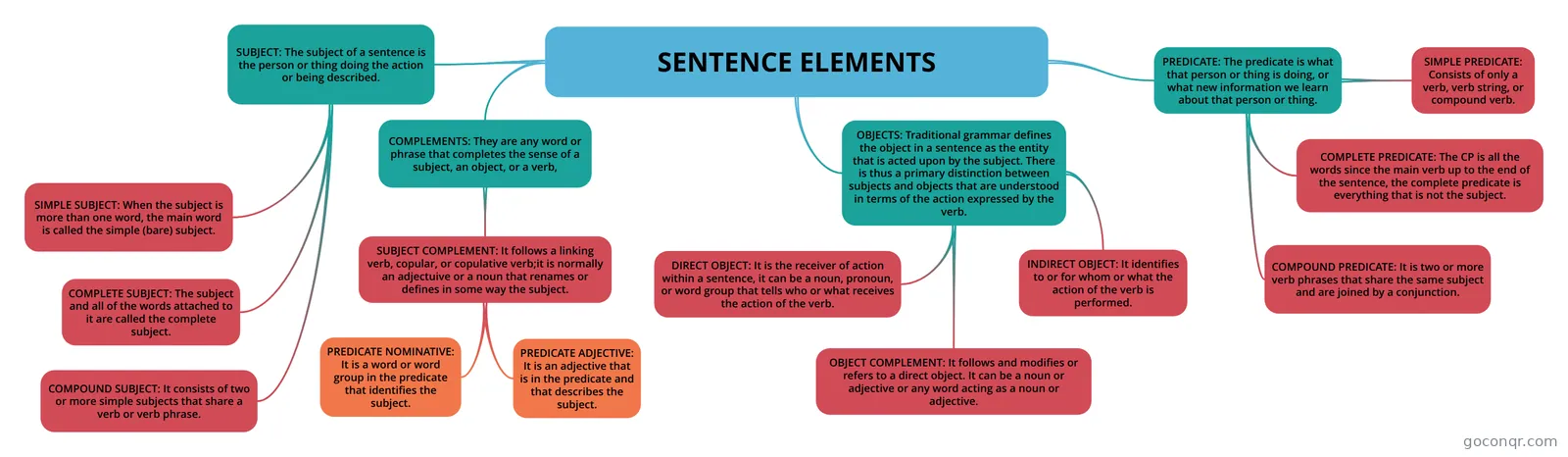
Mind map: sentence elements
Contenido del mapa
SENTENCE ELEMENTS
SUBJECT: The subject of a sentence is the person or thing doing the action or being described.
- SIMPLE SUBJECT: When the subject is more than one word, the main word is called the simple (bare) subject.
- COMPLETE SUBJECT: The subject and all of the words attached to it are called the complete subject.
- COMPOUND SUBJECT: It consists of two or more simple subjects that share a verb or verb phrase.
PREDICATE: The predicate is what that person or thing is doing, or what new information we learn about that person or thing.
- COMPLETE PREDICATE: The CP is all the words since the main verb up to the end of the sentence, the complete predicate is everything that is not the subject.
- SIMPLE PREDICATE: Consists of only a verb, verb string, or compound verb.
- COMPOUND PREDICATE: It is two or more verb phrases that share the same subject and are joined by a conjunction.
COMPLEMENTS: They are any word or phrase that completes the sense of a subject, an object, or a verb,
- SUBJECT COMPLEMENT: It follows a linking verb, copular, or copulative verb;it is normally an adjectuive or a noun that renames or defines in some way the subject.
- PREDICATE NOMINATIVE: It is a word or word group in the predicate that identifies the subject.
- PREDICATE ADJECTIVE: It is an adjective that is in the predicate and that describes the subject.
- SUBJECT COMPLEMENT: It follows a linking verb, copular, or copulative verb;it is normally an adjectuive or a noun that renames or defines in some way the subject.
OBJECTS: Traditional grammar defines the object in a sentence as the entity that is acted upon by the subject. There is thus a primary distinction between subjects and objects that are understood in terms of the action expressed by the verb.
- DIRECT OBJECT: It is the receiver of action within a sentence, it can be a noun, pronoun, or word group that tells who or what receives the action of the verb.
- INDIRECT OBJECT: It identifies to or for whom or what the action of the verb is performed.
- OBJECT COMPLEMENT: It follows and modifies or refers to a direct object. It can be a noun or adjective or any word acting as a noun or adjective.
Información
- Descripción
- Characters, symbols, and themes about grammar.
- Creado por
- Michael Calles
- Visitas
- 38
- Etiquetas
- Valoración