
Mapa mental
Lecture 5 - Learning & Memory
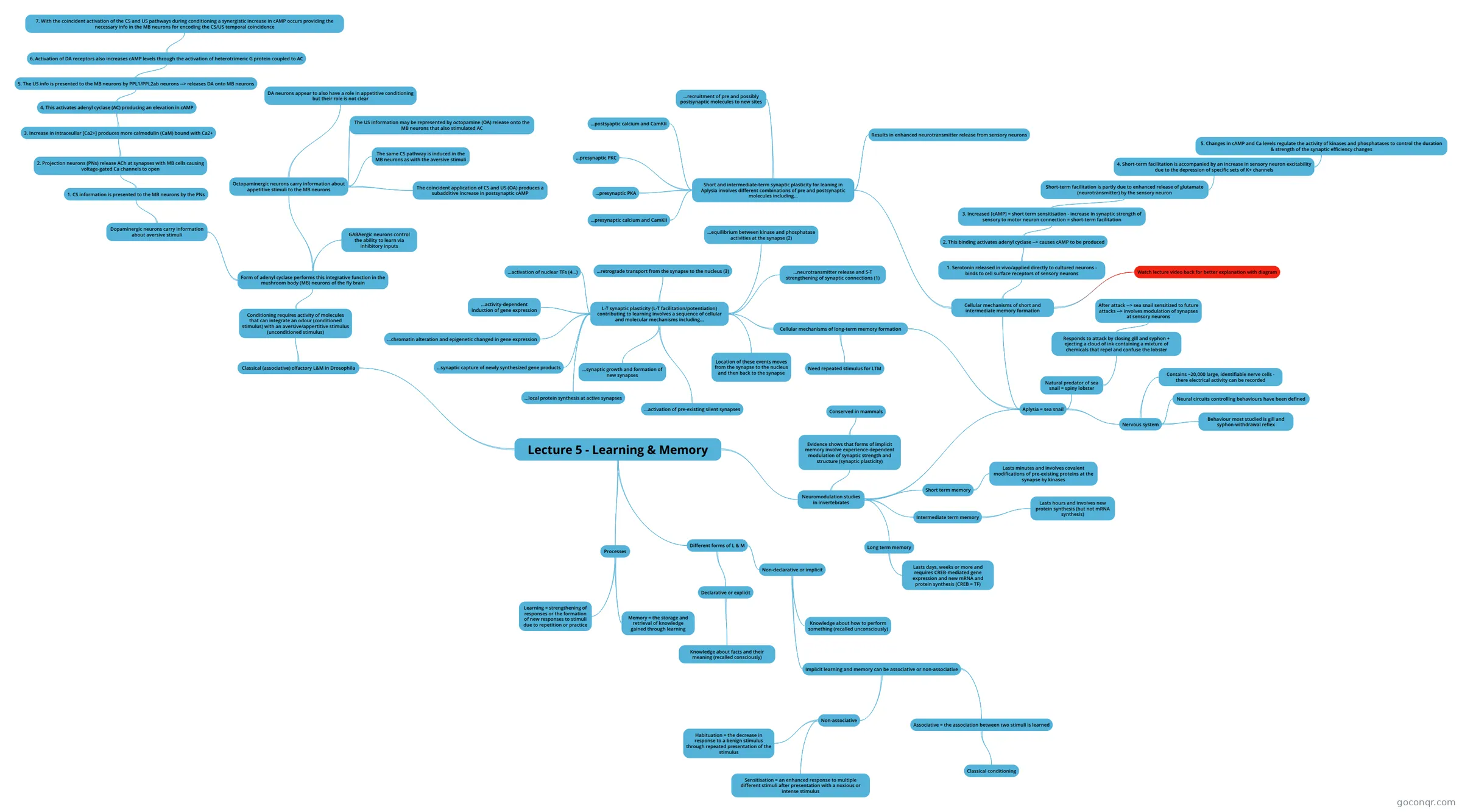
Mind map: Learning and memory processes
Contenido del mapa
Lecture 5 - Learning & Memory
Processes
- Learning = strengthening of responses or the formation of new responses to stimuli due to repetition or practice
- Memory = the storage and retrieval of knowledge gained through learning
Different forms of L & M
- Declarative or explicit
- Knowledge about facts and their meaning (recalled consciously)
- Non-declarative or implicit
- Knowledge about how to perform something (recalled unconsciously)
- Implicit learning and memory can be associative or non-associative
- Non-associative
- Habituation = the decrease in response to a benign stimulus through repeated presentation of the stimulus
- Sensitisation = an enhanced response to multiple different stimuli after presentation with a noxious or intense stimulus
- Associative = the association between two stimuli is learned
- Classical conditioning
- Non-associative
- Declarative or explicit
Neuromodulation studies in invertebrates
- Evidence shows that forms of implicit memory involve experience-dependent modulation of synaptic strength and structure (synaptic plasticity)
- Conserved in mammals
- Short term memory
- Lasts minutes and involves covalent modifications of pre-existing proteins at the synapse by kinases
- Intermediate term memory
- Lasts hours and involves new protein synthesis (but not mRNA synthesis)
- Long term memory
- Lasts days, weeks or more and requires CREB-mediated gene expression and new mRNA and protein synthesis (CREB = TF)
- Aplysia = sea snail
- Natural predator of sea snail = spiny lobster
- Responds to attack by closing gill and syphon + ejecting a cloud of ink containing a mixture of chemicals that repel and confuse the lobster
- After attack --> sea snail sensitized to future attacks --> involves modulation of synapses at sensory neurons
- Responds to attack by closing gill and syphon + ejecting a cloud of ink containing a mixture of chemicals that repel and confuse the lobster
- Nervous system
- Contains ~20,000 large, identifiable nerve cells - there electrical activity can be recorded
- Neural circuits controlling behaviours have been defined
- Behaviour most studied is gill and syphon-withdrawal reflex
- Cellular mechanisms of short and intermediate memory formation
- 1. Serotonin released in vivo/applied directly to cultured neurons - binds to cell surface receptors of sensory neurons
- 2. This binding activates adenyl cyclase --> causes cAMP to be produced
- 3. Increased [cAMP] = short term sensitisation - increase in synaptic strength of sensory to motor neuron connection = short-term facilitation
- Short-term facilitation is partly due to enhanced release of glutamate (neurotransmitter) by the sensory neuron
- 4. Short-term facilitation is accompanied by an increase in sensory neuron excitability due to the depression of specific sets of K+ channels
- 5. Changes in cAMP and Ca levels regulate the activity of kinases and phosphatases to control the duration & strength of the synaptic efficiency changes
- 4. Short-term facilitation is accompanied by an increase in sensory neuron excitability due to the depression of specific sets of K+ channels
- Short-term facilitation is partly due to enhanced release of glutamate (neurotransmitter) by the sensory neuron
- 3. Increased [cAMP] = short term sensitisation - increase in synaptic strength of sensory to motor neuron connection = short-term facilitation
- 2. This binding activates adenyl cyclase --> causes cAMP to be produced
- Short and intermediate-term synaptic plasticity for leaning in Aplysia involves different combinations of pre and postsynaptic molecules including...
- ...presynaptic PKA
- ...presynaptic calcium and CamKII
- ...presynaptic PKC
- ...postsyaptic calcium and CamKII
- ...recruitment of pre and possibly postsynaptic molecules to new sites
- Results in enhanced neurotransmitter release from sensory neurons
- Watch lecture video back for better explanation with diagram
- 1. Serotonin released in vivo/applied directly to cultured neurons - binds to cell surface receptors of sensory neurons
- Cellular mechanisms of long-term memory formation
- L-T synaptic plasticity (L-T facilitation/potentiation) contributing to learning involves a sequence of cellular and molecular mechanisms including...
- ...neurotransmitter release and S-T strengthening of synaptic connections (1)
- ...equilibrium between kinase and phosphatase activities at the synapse (2)
- ...retrograde transport from the synapse to the nucleus (3)
- ...activation of nuclear TFs (4...)
- ...activity-dependent induction of gene expression
- ...chromatin alteration and epigenetic changed in gene expression
- ...synaptic capture of newly synthesized gene products
- ...local protein synthesis at active synapses
- ...synaptic growth and formation of new synapses
- ...activation of pre-existing silent synapses
- Location of these events moves from the synapse to the nucleus and then back to the synapse
- Need repeated stimulus for LTM
- L-T synaptic plasticity (L-T facilitation/potentiation) contributing to learning involves a sequence of cellular and molecular mechanisms including...
- Natural predator of sea snail = spiny lobster
- Evidence shows that forms of implicit memory involve experience-dependent modulation of synaptic strength and structure (synaptic plasticity)
Classical (associative) olfactory L&M in Drosophila
- Conditioning requires activity of molecules that can integrate an odour (conditioned stimulus) with an aversive/appertitive stimulus (unconditioned stimulus)
- Form of adenyl cyclase performs this integrative function in the mushroom body (MB) neurons of the fly brain
- Dopaminergic neurons carry information about aversive stimuli
- 1. CS information is presented to the MB neurons by the PNs
- 2. Projection neurons (PNs) release ACh at synapses with MB cells causing voltage-gated Ca channels to open
- 3. Increase in intraceullar [Ca2+] produces more calmodulin (CaM) bound with Ca2+
- 4. This activates adenyl cyclase (AC) producing an elevation in cAMP
- 5. The US info is presented to the MB neurons by PPL1/PPL2ab neurons --> releases DA onto MB neurons
- 6. Activation of DA receptors also increases cAMP levels through the activation of heterotrimeric G protein coupled to AC
- 7. With the coincident activation of the CS and US pathways during conditioning a synergistic increase in cAMP occurs providing the necessary info in the MB neurons for encoding the CS/US temporal coincidence
- 6. Activation of DA receptors also increases cAMP levels through the activation of heterotrimeric G protein coupled to AC
- 5. The US info is presented to the MB neurons by PPL1/PPL2ab neurons --> releases DA onto MB neurons
- 4. This activates adenyl cyclase (AC) producing an elevation in cAMP
- 3. Increase in intraceullar [Ca2+] produces more calmodulin (CaM) bound with Ca2+
- 2. Projection neurons (PNs) release ACh at synapses with MB cells causing voltage-gated Ca channels to open
- 1. CS information is presented to the MB neurons by the PNs
- Octopaminergic neurons carry information about appetitive stimuli to the MB neurons
- The same CS pathway is induced in the MB neurons as with the aversive stimuli
- The US information may be represented by octopamine (OA) release onto the MB neurons that also stimulated AC
- DA neurons appear to also have a role in appetitive conditioning but their role is not clear
- The coincident application of CS and US (OA) produces a subadditive increase in postsynaptic cAMP
- GABAergic neurons control the ability to learn via inhibitory inputs
- Dopaminergic neurons carry information about aversive stimuli
- Form of adenyl cyclase performs this integrative function in the mushroom body (MB) neurons of the fly brain
- Conditioning requires activity of molecules that can integrate an odour (conditioned stimulus) with an aversive/appertitive stimulus (unconditioned stimulus)
Información
- Descripción
- Mapa Mental sobre Lecture 5 - Learning & Memory, creado por Anna Hollywood el 26/10/2018.
- Creado por
- Anna Hollywood
- Visitas
- 0
- Valoración