
Mapa mental
Cell Cycle: Mitosis
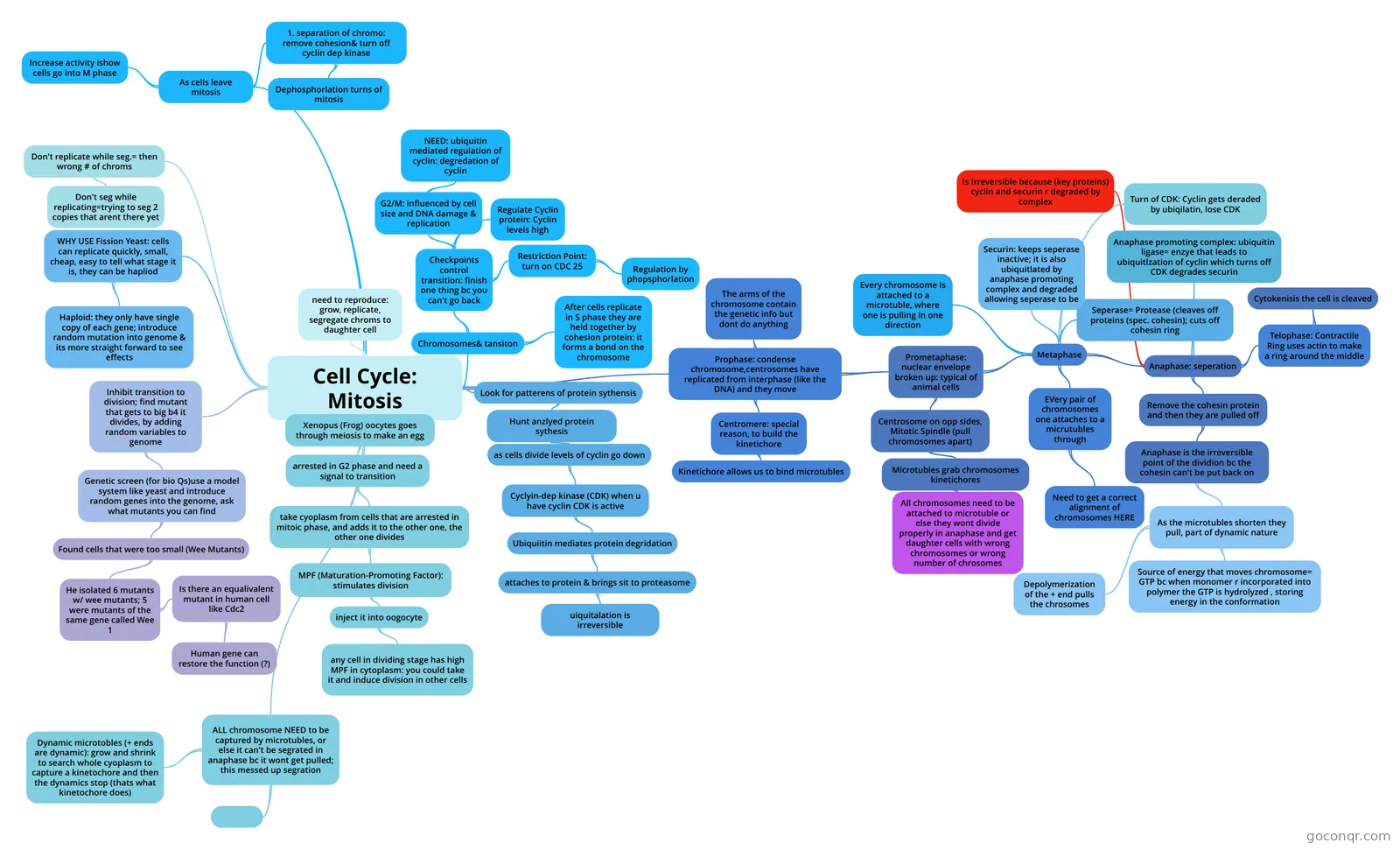
Mind map: Cell cycle: mitosis
Contenido del mapa
Cell Cycle: Mitosis
need to reproduce: grow, replicate, segregate chroms to daughter cell
Don't replicate while seg.= then wrong # of chroms
- Don't seg while replicating=trying to seg 2 copies that arent there yet
WHY USE Fission Yeast: cells can replicate quickly, small, cheap, easy to tell what stage it is, they can be hapliod
- Haploid: they only have single copy of each gene; introduce random mutation into genome & its more straight forward to see effects
Inhibit transition to division; find mutant that gets to big b4 it divides, by adding random variables to genome
- Genetic screen (for bio Qs)use a model system like yeast and introduce random genes into the genome, ask what mutants you can find
- Found cells that were too small (Wee Mutants)
- He isolated 6 mutants w/ wee mutants; 5 were mutants of the same gene called Wee 1
- Is there an equalivalent mutant in human cell like Cdc2
- Human gene can restore the function (?)
- Is there an equalivalent mutant in human cell like Cdc2
- He isolated 6 mutants w/ wee mutants; 5 were mutants of the same gene called Wee 1
- Found cells that were too small (Wee Mutants)
- Genetic screen (for bio Qs)use a model system like yeast and introduce random genes into the genome, ask what mutants you can find
Xenopus (Frog) oocytes goes through meiosis to make an egg
- arrested in G2 phase and need a signal to transition
- take cyoplasm from cells that are arrested in mitoic phase, and adds it to the other one, the other one divides
- MPF (Maturation-Promoting Factor): stimulates division
- inject it into oogocyte
- any cell in dividing stage has high MPF in cytoplasm: you could take it and induce division in other cells
- inject it into oogocyte
- MPF (Maturation-Promoting Factor): stimulates division
- take cyoplasm from cells that are arrested in mitoic phase, and adds it to the other one, the other one divides
- arrested in G2 phase and need a signal to transition
Look for patterens of protein sythensis
- Hunt anzlyed protein sythesis
- as cells divide levels of cyclin go down
- Cyclyin-dep kinase (CDK) when u have cyclin CDK is active
- Ubiquiitin mediates protein degridation
- attaches to protein & brings sit to proteasome
- uiquitalation is irreversible
- attaches to protein & brings sit to proteasome
- Ubiquiitin mediates protein degridation
- Cyclyin-dep kinase (CDK) when u have cyclin CDK is active
- as cells divide levels of cyclin go down
- Hunt anzlyed protein sythesis
Chromosomes& tansiton
- Checkpoints control transition: finish one thing bc you can't go back
- G2/M: influenced by cell size and DNA damage & replication
- NEED: ubiquitin mediated regulation of cyclin: degredation of cyclin
- Regulate Cyclin protein: Cyclin levels high
- Restriction Point: turn on CDC 25
- Regulation by phopsphorlation
- G2/M: influenced by cell size and DNA damage & replication
- After cells replicate in S phase they are held together by cohesion protein: it forms a bond on the chromosome
- Checkpoints control transition: finish one thing bc you can't go back
Prophase: condense chromosome,centrosomes have replicated from interphase (like the DNA) and they move
- Centromere: special reason, to build the kinetichore
- Kinetichore allows us to bind microtubles
- The arms of the chromosome contain the genetic info but dont do anything
- Prometaphase: nuclear envelope broken up: typical of animal cells
- Centrosome on opp sides, Mitotic Spindle (pull chromosomes apart)
- Microtubles grab chromosomes kinetichores
- All chromosomes need to be attached to microtuble or else they wont divide properly in anaphase and get daughter cells with wrong chromosomes or wrong number of chrosomes
- Microtubles grab chromosomes kinetichores
- Metaphase
- Anaphase: seperation
- Remove the cohesin protein and then they are pulled off
- Anaphase is the irreversible point of the dividion bc the cohesin can't be put back on
- As the microtubles shorten they pull, part of dynamic nature
- Source of energy that moves chromosome= GTP bc when monomer r incorporated into polymer the GTP is hydrolyzed , storing energy in the conformation
- Depolymerization of the + end pulls the chrosomes
- As the microtubles shorten they pull, part of dynamic nature
- Anaphase is the irreversible point of the dividion bc the cohesin can't be put back on
- Telophase: Contractile Ring uses actin to make a ring around the middle
- Cytokenisis the cell is cleaved
- Anaphase promoting complex: ubiquitin ligase= enzye that leads to ubiquitlzation of cyclin which turns off CDK degrades securin
- Is irreversible because (key proteins) cyclin and securin r degraded by complex
- Remove the cohesin protein and then they are pulled off
- EVery pair of chromosomes one attaches to a micrutubles through
- Need to get a correct alignment of chromosomes HERE
- Seperase= Protease (cleaves off proteins (spec. cohesin); cuts off cohesin ring
- Turn of CDK: Cyclin gets deraded by ubiqilatin, lose CDK
- Securin: keeps seperase inactive; it is also ubiquitlated by anaphase promoting complex and degraded allowing seperase to be
- Every chromosome is attached to a microtuble, where one is pulling in one direction
- Anaphase: seperation
- Centrosome on opp sides, Mitotic Spindle (pull chromosomes apart)
- Centromere: special reason, to build the kinetichore
ALL chromosome NEED to be captured by microtubles, or else it can't be segrated in anaphase bc it wont get pulled; this messed up segration
- Dynamic microtobles (+ ends are dynamic): grow and shrink to search whole cyoplasm to capture a kinetochore and then the dynamics stop (thats what kinetochore does)
As cells leave mitosis
- 1. separation of chromo: remove cohesion& turn off cyclin dep kinase
- Dephosphorlation turns of mitosis
- Increase activity ishow cells go into M phase
- 1. separation of chromo: remove cohesion& turn off cyclin dep kinase
Información
- Descripción
- Mapa Mental sobre Cell Cycle: Mitosis, creado por mafriyie el 15/11/2014.
- Creado por
- mafriyie
- Visitas
- 17
- Valoración
Más sobre Cell Cycle Regulation and Cancer