
Mapa mental
Particle physics
Contenido del mapa
Particle physics
Models of the atom
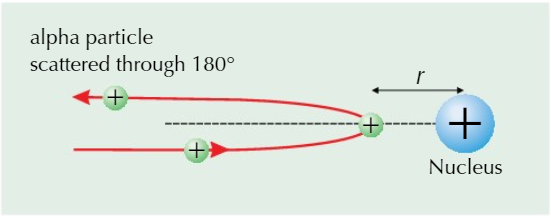
- Rutherfords experiment
- 1) Stream of alpha particles fired at a thin gold leaf
- 2) Record angle of deflection
- 3) They observed that alpha particles were scattered at angles greater than 90 degrees
- Conclusions:
- 1) Most particles went straight through the leaf proving the majority of an atom is empty space
- 2) Some particles were deflected at large angles, so the centre of the atom must have a positive charge to repel the alpha particles
- 3) Very few particles were deflected more than 90 degrees so the nucleus must be tiny
- 4) Most of the mass must be in the nucleus
- Old model of atom was the plum pudding, globule of charge and scattered e-
- Maths of rutherfords experiment
- For an alpha particle about to hit the nucleus head on and be reflected, the electrical potential energy at point r has to be equal to or larger than the particles kinetic energy
- initial KE = kQq/r
- Rutherfords experiment
Particles and antiparticles
- Hadrons
- Particles that feel the strong nuclear force eg protons and neutrons
- The proton is the only stable hadron (neutron will decay if not in an atom)
- Leptons
- Particles that dont feel the strong nuclear force eg electrons and neutrinos
- Neutrinos have nearly no mass and no charge - it can pass through earth without anything happening to it
- The total lepton number in any particle reaction is conserved
- Anti-leptons have a lepton number of -1
- Hadrons
Pair production
- You can create matter and antimatter with energy
- E = mc^2
- When energy is converted to mass you get equal amounts of matter and antimatter
- If you fire 2 protons at eachother at high speeds youll end up with more energy - which might be converted into particles
- Pair production only happens when two gamma rays have enough energy to create mass
- When the photons collide you get an electron positron pair
Annhilation
- When a particle meets its antiparticle the result is annhilation
- All the mass of both particles is converted to energy in the form of 2 identical photons
- 2E = 2mc^2 => E = mc^2
- Observing pair production and annhilation
- A cloud chamber is used which is filled with alcohol or water vapour
- When high energy particles pass through the cloud they ionise gas particles
- The vapour in the clouds condenses around these ions, forming a trail of alcohol droplets
Quarks
- Quarks are fundamental particles
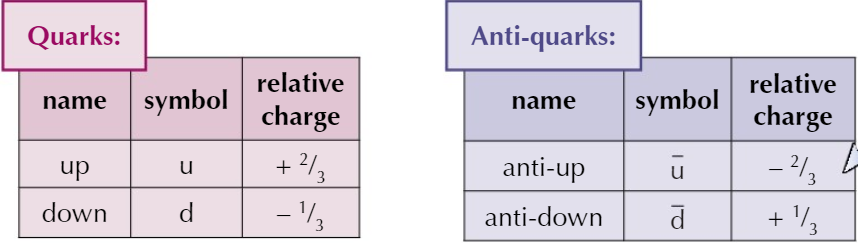
- Quarks and anti-quarks have opposite charge
- Quarks have a fraction of a charge
- Baryons are particles made of 3 quarks and consist of protons and neutrons
- Quarks cant exist on their own, the energy just gets changed into more quarks and antiquarks
- Gluons
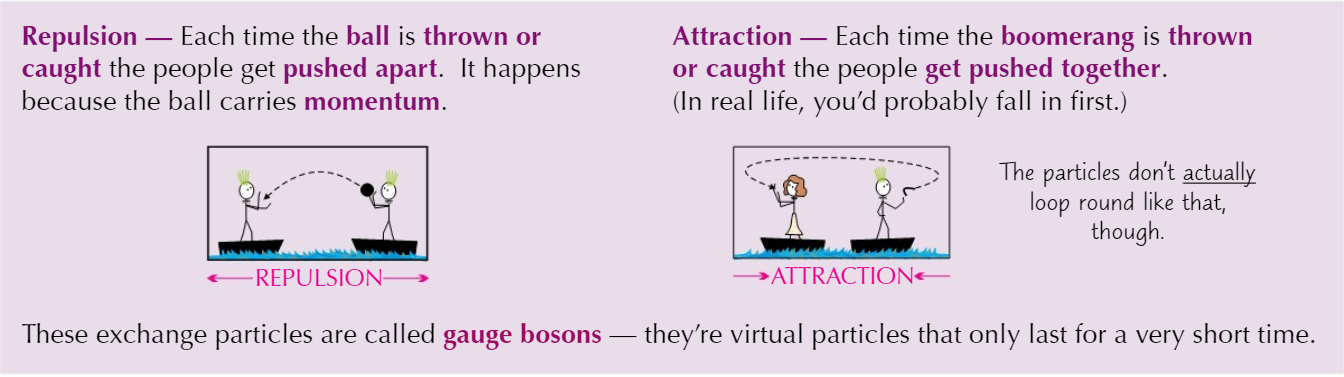
- Gluons provide forces between quarks
- Exchange particles are ways of picturing how forces are applied to each type of particles interaction
- Because gluons provide a force they can be thought as as fields
- As you try to separate quarks you increase the energy in the gluon field, increasing the attraction
- If you keep pulling the quarks away, the energy in the gluon field will be sufficient for pair production
Particle accelerators
- Particle accelerators cause high energy collisions
- Linear accelerator
- A long straight tube containing a series of electrodes
- Alternating current is applied to the electrodes, so that the charge continuously changes between + and -
- The ac is timed so that the charged particles are always attracted to the next electrode
- A particles speed will increase each time it passes an electrode
- The particles then collide with a fixed target at the end of the tube
- Cyclotron
- A circular particle accelerator
- Uses 2 semicircular electrodes to accelerate particles across a gap
- An alternating potential difference is applied between the electrodes - as the particles are attracted from one side to another their energy increases
- A magnetic field is used to keep the particles moving in circular motion
- The combination of electric and magnetic fields makes the particle spiral outwards as their energy increase
- Synchrotrons
- Produce very high energy beams
- Electromagnets keep the particles moving in a circular path in focused beams
- They are very expensive $$$
- Synchrotrons can produce beams of 500GeV+
- You can find the force experienced by a particle by F = Bqv
Weird shit that happens when you go fast
- Masses cannot reach the speed of light
- At high speeds relativity comes into play
- No particle with a mass can move at a speed equal to or greater than the speed of light
- The mass of an object increases with speed
- As you increase the KE of a mass, the more massive it gets
- Its only noticeable as speeds approach the speed of light
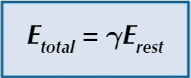
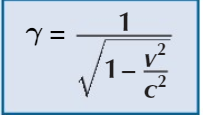
- Relativistic factor
- Masses cannot reach the speed of light
Electron energy levels
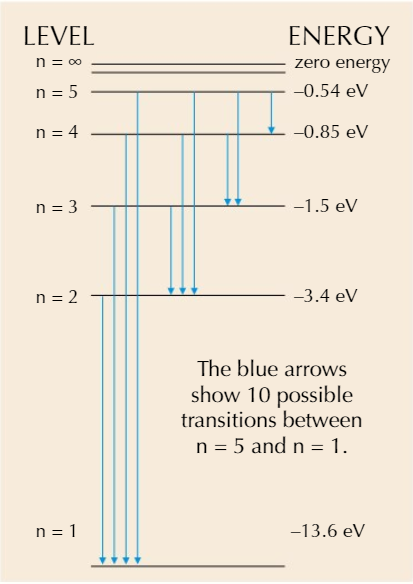
- Electrons in an atom can only exist in well defined energy levels
- All energy values are negative because the electrons are bound in a system and need to pay off an energy debt to be able to escape from that bound system
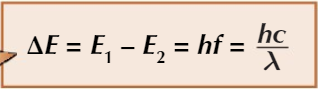
- Electrons can move down an energy level by emmiting a photon and can go up one by absorbing a photon of specific energy
- An electron can only absorb a photon if that photons energy is equal to the difference between 2 energy levels
- Line spectra
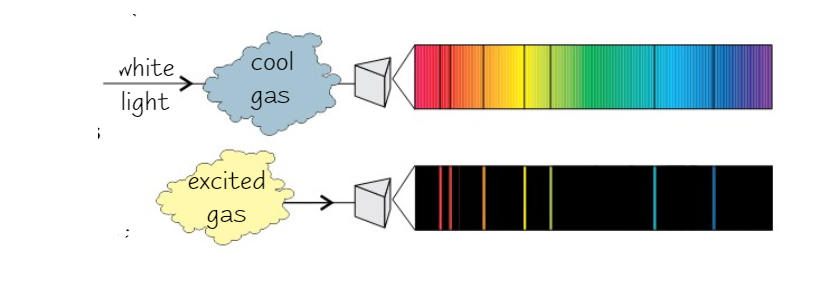
- White light is a continuous spectrum of visible light
- When e- absorb or emit photons they make black lines in the spectra
- Fluorescent tubes
- More evidence for e- energy levels
- They use excited e- to produce light
- Different elements have a pd across them and will emit different wavelengths depending on the voltage
- Wave model of electrons
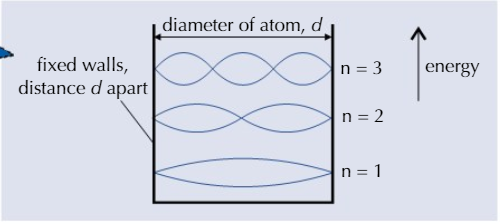
- Electrons act like standing waves
- Standing waves only occur at certain frequencies, just like e- can only occupy certain energy levels
- The principal quantum number, n , is equal to the number of complete waves that fit in that circumference
- You can use the diameter of the atom, d, to find the de broglie wavelength of the e- for n = 1 there is a half wavelength
Imágenes y archivos del mapa

Información
- Descripción
- Mapa Mental sobre Particle physics, creado por Fin Carson el 18/02/2019.
- Creado por
- Fin Carson
- Visitas
- 0
- Valoración