
Mapa mental
The Middle Ages
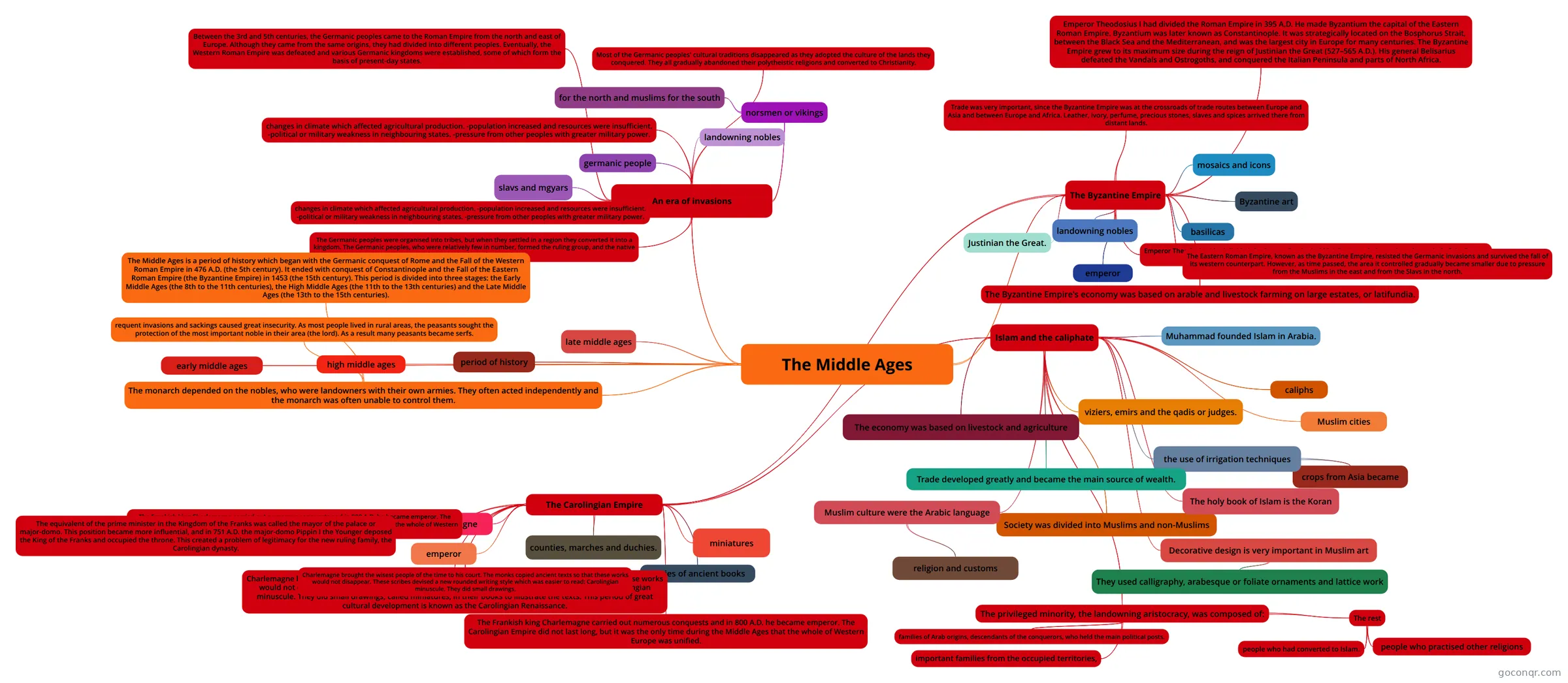
Mind map: The Middle Ages
Contenido del mapa
The Middle Ages
period of history
early middle ages
high middle ages
late middle ages
The Byzantine Empire
- mosaics and icons
- basilicas
- Justinian the Great.
- Byzantine art
- landowning nobles
- emperor
- The Carolingian Empire
- Charlemagne
- emperor
- counties, marches and duchies.
- copies of ancient books
- miniatures
- Islam and the caliphate
- Muhammad founded Islam in Arabia.
- caliphs
- viziers, emirs and the qadis or judges.
- The economy was based on livestock and agriculture
- the use of irrigation techniques
- crops from Asia became
- Trade developed greatly and became the main source of wealth.
- Muslim cities
- Society was divided into Muslims and non-Muslims
- Muslim culture were the Arabic language
- religion and customs
- The holy book of Islam is the Koran
- Decorative design is very important in Muslim art
- They used calligraphy, arabesque or foliate ornaments and lattice work
- The privileged minority, the landowning aristocracy, was composed of:
- families of Arab origins, descendants of the conquerors, who held the main political posts.
- important families from the occupied territories,
- The rest
- people who had converted to Islam.
- people who practised other religions
- The Frankish king Charlemagne carried out numerous conquests and in 800 A.D. he became emperor. The Carolingian Empire did not last long, but it was the only time during the Middle Ages that the whole of Western Europe was unified.
- Charlemagne brought the wisest people of the time to his court. The monks copied ancient texts so that these works would not disappear. These scribes devised a new rounded writing style which was easier to read: Carolingian minuscule. They did small drawings, called miniatures, in their books to illustrate the texts. This period of great cultural development is known as the Carolingian Renaissance.
- Charlemagne brought the wisest people of the time to his court. The monks copied ancient texts so that these works would not disappear. These scribes devised a new rounded writing style which was easier to read: Carolingian minuscule. They did small drawings,
- The Frankish king Charlemagne carried out numerous conquests and in 800 A.D. he became emperor. The Carolingian Empire did not last long, but it was the only time during the Middle Ages that the whole of Western Europe was unified.
- The equivalent of the prime minister in the Kingdom of the Franks was called the mayor of the palace or major-domo. This position became more influential, and in 751 A.D. the major-domo Pippin I the Younger deposed the King of the Franks and occupied the throne. This created a problem of legitimacy for the new ruling family, the Carolingian dynasty.
- The Byzantine Empire's economy was based on arable and livestock farming on large estates, or latifundia.
- Emperor Theodosius I had divided the Roman Empire in 395 A.D. He made Byzantium the capital of the Eastern Roman Empire.
- The Eastern Roman Empire, known as the Byzantine Empire, resisted the Germanic invasions and survived the fall of its western counterpart. However, as time passed, the area it controlled gradually became smaller due to pressure from the Muslims in the east and from the Slavs in the north.
- Trade was very important, since the Byzantine Empire was at the crossroads of trade routes between Europe and Asia and between Europe and Africa. Leather, ivory, perfume, precious stones, slaves and spices arrived there from distant lands.
- Emperor Theodosius I had divided the Roman Empire in 395 A.D. He made Byzantium the capital of the Eastern Roman Empire. Byzantium was later known as Constantinople. It was strategically located on the Bosphorus Strait, between the Black Sea and the Mediterranean, and was the largest city in Europe for many centuries. The Byzantine Empire grew to its maximum size during the reign of Justinian the Great (527–565 A.D.). His general Belisarius defeated the Vandals and Ostrogoths, and conquered the Italian Peninsula and parts of North Africa.
An era of invasions
- germanic people
- slavs and mgyars
- norsmen or vikings
- for the north and muslims for the south
- landowning nobles
- changes in climate which affected agricultural production. -population increased and resources were insufficient. -political or military weakness in neighbouring states. -pressure from other peoples with greater military power.
- The Germanic peoples were organised into tribes, but when they settled in a region they converted it into a kingdom. The Germanic peoples, who were relatively few in number, formed the ruling group, and the native inhabitants had to submit to them.
- changes in climate which affected agricultural production. -population increased and resources were insufficient. -political or military weakness in neighbouring states. -pressure from other peoples with greater military power.
- Between the 3rd and 5th centuries, the Germanic peoples came to the Roman Empire from the north and east of Europe. Although they came from the same origins, they had divided into different peoples. Eventually, the Western Roman Empire was defeated and various Germanic kingdoms were established, some of which form the basis of present-day states.
- Most of the Germanic peoples' cultural traditions disappeared as they adopted the culture of the lands they conquered. They all gradually abandoned their polytheistic religions and converted to Christianity.
The monarch depended on the nobles, who were landowners with their own armies. They often acted independently and the monarch was often unable to control them.
- requent invasions and sackings caused great insecurity. As most people lived in rural areas, the peasants sought the protection of the most important noble in their area (the lord). As a result many peasants became serfs.
- The Middle Ages is a period of history which began with the Germanic conquest of Rome and the Fall of the Western Roman Empire in 476 A.D. (the 5th century). It ended with conquest of Constantinople and the Fall of the Eastern Roman Empire (the Byzantine Empire) in 1453 (the 15th century). This period is divided into three stages: the Early Middle Ages (the 8th to the 11th centuries), the High Middle Ages (the 11th to the 13th centuries) and the Late Middle Ages (the 13th to the 15th centuries).
Información
- Descripción
- Mapa Mental sobre The Middle Ages, creado por erlantz argote el 21/03/2019.
- Creado por
- erlantz argote
- Visitas
- 3
- Historial
-
- Creado por Sandro KASABURI · 7 mar 2019
- Copiado por erlantz argote · 21 mar 2019
- Valoración