
Mapa mental
Aeneid Scholarship
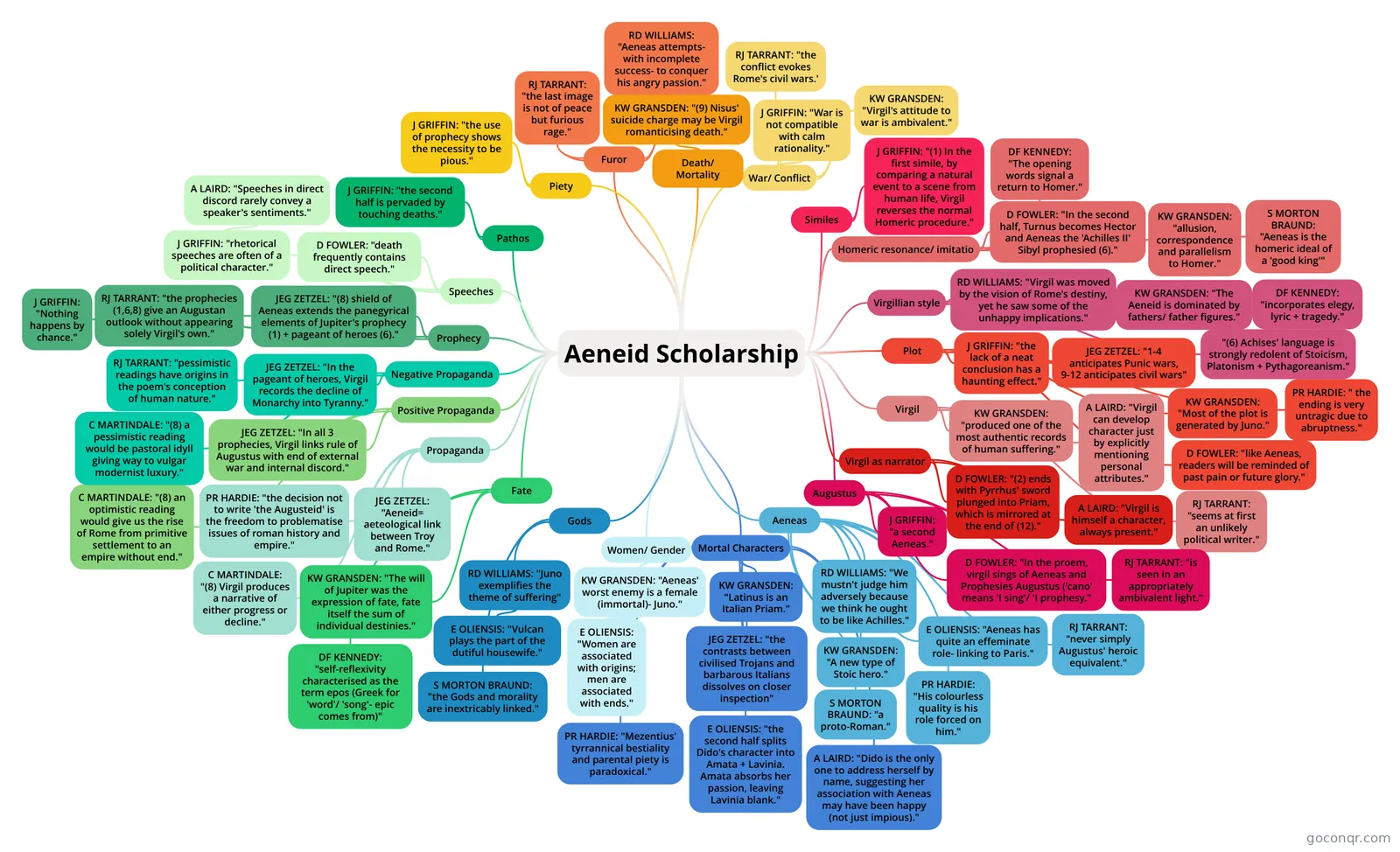
Mind map: Aeneid Scholarship Analysis
Contenido del mapa
Aeneid Scholarship
Virgil
- KW GRANSDEN: "produced one of the most authentic records of human suffering."
- A LAIRD: "Virgil can develop character just by explicitly mentioning personal attributes."
- RJ TARRANT: "seems at first an unlikely political writer."
Plot
- JEG ZETZEL: "1-4 anticipates Punic wars, 9-12 anticipates civil wars"
- D FOWLER: "like Aeneas, readers will be reminded of past pain or future glory."
- J GRIFFIN: "the lack of a neat conclusion has a haunting effect."
- KW GRANSDEN: "Most of the plot is generated by Juno."
- PR HARDIE: " the ending is very untragic due to abruptness."
Virgillian style
- RD WILLIAMS: "Virgil was moved by the vision of Rome's destiny, yet he saw some of the unhappy implications."
- KW GRANSDEN: "The Aeneid is dominated by fathers/ father figures."
- "(6) Achises' language is strongly redolent of Stoicism, Platonism + Pythagoreanism."
- DF KENNEDY: "incorporates elegy, lyric + tragedy."
Virgil as narrator
- D FOWLER: "(2) ends with Pyrrhus' sword plunged into Priam, which is mirrored at the end of (12)."
- A LAIRD: "Virgil is himself a character, always present."
Homeric resonance/ imitatio
- D FOWLER: "In the second half, Turnus becomes Hector and Aeneas the 'Achilles II' Sibyl prophesied (6)."
- KW GRANSDEN: "allusion, correspondence and parallelism to Homer."
- S MORTON BRAUND: "Aeneas is the homeric ideal of a 'good king'"
- DF KENNEDY: "The opening words signal a return to Homer."
Augustus
- D FOWLER: "In the proem, virgil sings of Aeneas and Prophesies Augustus ('cano' means 'I sing'/ 'I prophesy."
- J GRIFFIN: "a second Aeneas."
- RJ TARRANT: "is seen in an appropriately ambivalent light."
Aeneas
- RD WILLIAMS: "We mustn't judge him adversely because we think he ought to be like Achilles."
- KW GRANSDEN: "A new type of Stoic hero."
- E OLIENSIS: "Aeneas has quite an effeminate role- linking to Paris."
- S MORTON BRAUND: "a proto-Roman."
- PR HARDIE: "His colourless quality is his role forced on him."
- RJ TARRANT: "never simply Augustus' heroic equivalent."
Mortal Characters
- JEG ZETZEL: "the contrasts between civilised Trojans and barbarous Italians dissolves on closer inspection"
- KW GRANSDEN: "Latinus is an Italian Priam."
- E OLIENSIS: "the second half splits Dido's character into Amata + Lavinia. Amata absorbs her passion, leaving Lavinia blank."
- A LAIRD: "Dido is the only one to address herself by name, suggesting her association with Aeneas may have been happy (not just impious)."
- PR HARDIE: "Mezentius' tyrrannical bestiality and parental piety is paradoxical."
Gods
- RD WILLIAMS: "Juno exemplifies the theme of suffering"
- E OLIENSIS: "Vulcan plays the part of the dutiful housewife."
- S MORTON BRAUND: "the Gods and morality are inextricably linked."
- RD WILLIAMS: "Juno exemplifies the theme of suffering"
Propaganda
- JEG ZETZEL: "Aeneid= aeteological link between Troy and Rome."
- PR HARDIE: "the decision not to write 'the Augusteid' is the freedom to problematise issues of roman history and empire."
- C MARTINDALE: "(8) Virgil produces a narrative of either progress or decline."
Negative Propaganda
- JEG ZETZEL: "In the pageant of heroes, Virgil records the decline of Monarchy into Tyranny."
- RJ TARRANT: "pessimistic readings have origins in the poem's conception of human nature."
- C MARTINDALE: "(8) a pessimistic reading would be pastoral idyll giving way to vulgar modernist luxury."
Positive Propaganda
- JEG ZETZEL: "In all 3 prophecies, Virgil links rule of Augustus with end of external war and internal discord."
- C MARTINDALE: "(8) an optimistic reading would give us the rise of Rome from primitive settlement to an empire without end."
Prophecy
- JEG ZETZEL: "(8) shield of Aeneas extends the panegyrical elements of Jupiter's prophecy (1) + pageant of heroes (6)."
- J GRIFFIN: "Nothing happens by chance."
- RJ TARRANT: "the prophecies (1,6,8) give an Augustan outlook without appearing solely Virgil's own."
Speeches
- D FOWLER: "death frequently contains direct speech."
- J GRIFFIN: "rhetorical speeches are often of a political character."
- A LAIRD: "Speeches in direct discord rarely convey a speaker's sentiments."
Pathos
- J GRIFFIN: "the second half is pervaded by touching deaths."
Piety
- J GRIFFIN: "the use of prophecy shows the necessity to be pious."
Furor
- RD WILLIAMS: "Aeneas attempts- with incomplete success- to conquer his angry passion."
- RJ TARRANT: "the last image is not of peace but furious rage."
War/ Conflict
- J GRIFFIN: "War is not compatible with calm rationality."
- KW GRANSDEN: "Virgil's attitude to war is ambivalent."
- RJ TARRANT: "the conflict evokes Rome's civil wars.'
Death/ Mortality
- KW GRANSDEN: "(9) Nisus' suicide charge may be Virgil romanticising death."
Similes
- J GRIFFIN: "(1) In the first simile, by comparing a natural event to a scene from human life, Virgil reverses the normal Homeric procedure."
Women/ Gender
- KW GRANSDEN: "Aeneas' worst enemy is a female (immortal)- Juno."
- E OLIENSIS: "Women are associated with origins; men are associated with ends."
- KW GRANSDEN: "Aeneas' worst enemy is a female (immortal)- Juno."
Fate
- KW GRANSDEN: "The will of Jupiter was the expression of fate, fate itself the sum of individual destinies."
- DF KENNEDY: "self-reflexivity characterised as the term epos (Greek for 'word'/ 'song'- epic comes from)"
Información
- Descripción
- Mapa Mental sobre Aeneid Scholarship, creado por flora leather el 15/04/2019.
- Creado por
- flora leather
- Visitas
- 1
- Valoración