
Mapa mental
Qualitative Methods
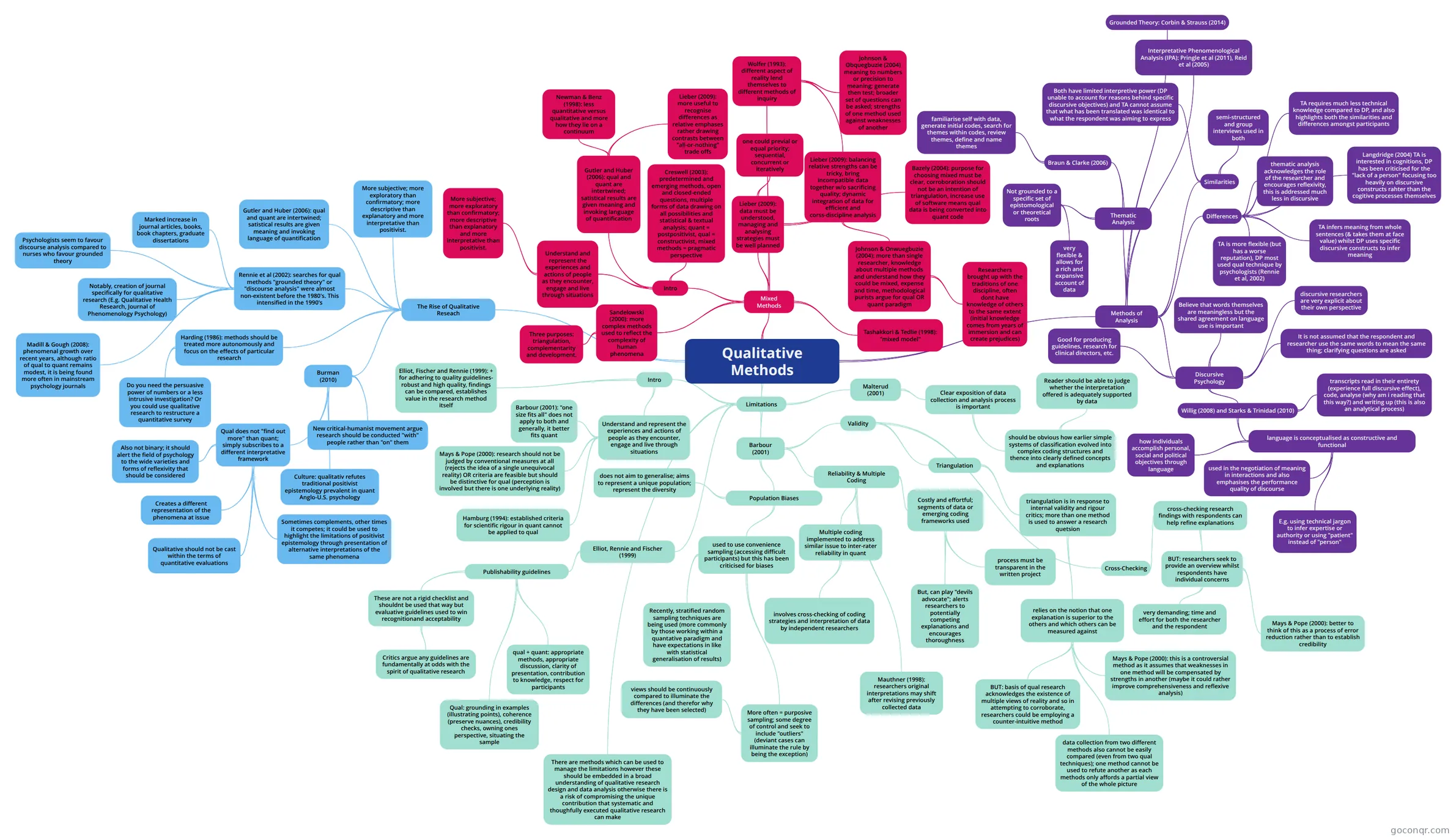
Mind map: Qualitative methods
Contenido del mapa
Qualitative Methods
Mixed Methods
- Intro
- Understand and represent the experiences and actions of people as they encounter, engage and live through situations
- More subjective; more exploratory than confirmatory; more descriptive than explanatory and more interpretative than positivist.
- Gutler and Huber (2006): qual and quant are intertwined; satistical results are given meaning and invoking language of quantification
- Lieber (2009): more useful to recognise differences as relative emphases rather drawing contrasts between "all-or-nothing" trade offs
- Newman & Benz (1998): less quantitative versus qualitative and more how they lie on a continuum
- Creswell (2003): predetermined and emerging methods, open and closed-ended questions, multiple forms of data drawing on all possibilities and statistical & textual analysis; quant = postpositivist, qual = constructivist, mixed methods = pragmatic perspective
- Understand and represent the experiences and actions of people as they encounter, engage and live through situations
- Sandelowski (2000): more complex methods used to reflect the complexity of human phenomena
- Three purposes: triangulation, complementarity and development.
- Lieber (2009): data must be understood, managing and analysing strategies must be well planned
- one could previal or equal priority; sequential, concurrent or iteratively
- Bazely (2004): purpose for choosing mixed must be clear, corroboration should not be an intention of triangulation, increase use of software means qual data is being converted into quant code
- Wolfer (1993): different aspect of reality lend themselves to different methods of inquiry
- Johnson & Obquegbuzie (2004) meaning to numbers or precision to meaning; generate then test; broader set of questions can be asked; strengths of one method used against weaknesses of another
- Lieber (2009): balancing relative strengths can be tricky, bring incompatible data together w/o sacrificing quality; dynamic integration of data for efficient and corss-discipline analysis
- Johnson & Onwuegbuzie (2004): more than single researcher, knowledge about multiple methods and understand how they could be mixed, expense and time, methodological purists argue for qual OR quant paradigm
- Researchers brought up with the traditions of one discipline, often dont have knowledge of others to the same extent (initial knowledge comes from years of immersion and can create prejudices)
- Johnson & Onwuegbuzie (2004): more than single researcher, knowledge about multiple methods and understand how they could be mixed, expense and time, methodological purists argue for qual OR quant paradigm
- Tashakkori & Tedlie (1998): "mixed model"
- Intro
Limitations
- Intro
- Understand and represent the experiences and actions of people as they encounter, engage and live through situations
- Mays & Pope (2000): research should not be judged by conventional measures at all (rejects the idea of a single unequivocal reality) OR criteria are feasible but should be distinctive for qual (perception is involved but there is one underlying reality)
- Hamburg (1994): established criteria for scientific rigour in quant cannot be applied to qual
- Barbour (2001): "one size fits all" does not apply to both and generally, it better fits quant
- Elliot, Fischer and Rennie (1999): + for adhering to quality guidelines- robust and high quality, findings can be compared, establishes value in the research method itself
- Understand and represent the experiences and actions of people as they encounter, engage and live through situations
- Barbour (2001)
- Population Biases
- does not aim to generalise; aims to represent a unique population; represent the diversity
- used to use convenience sampling (accessing difficult participants) but this has been criticised for biases
- More often = purposive sampling; some degree of control and seek to include "outliers" (deviant cases can illuminate the rule by being the exception)
- views should be continuously compared to illuminate the differences (and therefor why they have been selected)
- Recently, stratified random sampling techniques are being used (more commonly by those working within a quantative paradigm and have expectations in like with statistical generalisation of results)
- More often = purposive sampling; some degree of control and seek to include "outliers" (deviant cases can illuminate the rule by being the exception)
- Reliability & Multiple Coding
- Multiple coding implemented to address similar issue to inter-rater reliability in quant
- involves cross-checking of coding strategies and interpretation of data by independent researchers
- Costly and effortful; segments of data or emerging coding frameworks used
- But, can play "devils advocate"; alerts researchers to potentially competing explanations and encourages thoroughness
- process must be transparent in the written project
- Mauthner (1998): researchers original interpretations may shift after revising previously collected data
- Multiple coding implemented to address similar issue to inter-rater reliability in quant
- Validity
- Triangulation
- triangulation is in response to internal validity and rigour critics; more than one method is used to answer a research quetsion
- relies on the notion that one explanation is superior to the others and which others can be measured against
- BUT: basis of qual research acknowledges the existence of multiple views of reality and so in attempting to corroborate, researchers could be employing a counter-intuitive method
- data collection from two different methods also cannot be easily compared (even from two qual techniques); one method cannot be used to refute another as each methods only affords a partial view of the whole picture
- Mays & Pope (2000): this is a controversial method as it assumes that weaknesses in one method will be compensated by strengths in another (maybe it could rather improve comprehensiveness and reflexive analysis)
- relies on the notion that one explanation is superior to the others and which others can be measured against
- triangulation is in response to internal validity and rigour critics; more than one method is used to answer a research quetsion
- Cross-Checking
- cross-checking research findings with respondents can help refine explanations
- BUT: researchers seek to provide an overview whilst respondents have individual concerns
- very demanding; time and effort for both the researcher and the respondent
- Mays & Pope (2000): better to think of this as a process of error reduction rather than to establish credibility
- BUT: researchers seek to provide an overview whilst respondents have individual concerns
- cross-checking research findings with respondents can help refine explanations
- Triangulation
- Population Biases
- Malterud (2001)
- Clear exposition of data collection and analysis process is important
- should be obvious how earlier simple systems of classification evolved into complex coding structures and thence into clearly defined concepts and explanations
- Reader should be able to judge whether the interpretation offered is adequately supported by data
- should be obvious how earlier simple systems of classification evolved into complex coding structures and thence into clearly defined concepts and explanations
- Clear exposition of data collection and analysis process is important
- Elliot, Rennie and Fischer (1999)
- Publishability guidelines
- qual + quant: appropriate methods, appropriate discussion, clarity of presentation, contribution to knowledge, respect for participants
- Qual: grounding in examples (illustrating points), coherence (preserve nuances), credibility checks, owning ones perspective, situating the sample
- These are not a rigid checklist and shouldnt be used that way but evaluative guidelines used to win recognitionand acceptability
- Critics argue any guidelines are fundamentally at odds with the spirit of qualitative research
- Publishability guidelines
- There are methods which can be used to manage the limitations however these should be embedded in a broad understanding of qualitative research design and data analysis otherwise there is a risk of compromising the unique contribution that systematic and thoughfully executed qualitative research can make
- Intro
Methods of Analysis
- Thematic Analysis
- Braun & Clarke (2006)
- familiarise self with data, generate initial codes, search for themes within codes, review themes, define and name themes
- Not grounded to a specific set of epistomological or theoretical roots
- very flexible & allows for a rich and expansive account of data
- Braun & Clarke (2006)
- Discursive Psychology
- Willig (2008) and Starks & Trinidad (2010)
- language is conceptualised as constructive and functional
- used in the negotiation of meaning in interactions and also emphasises the performance quality of discourse
- how individuals accomplish personal, social and political objectives through language
- E.g. using technical jargon to infer expertise or authority or using "patient" instead of "person"
- transcripts read in their entirety (experience full discursive effect), code, analyse (why am i reading that this way?) and writing up (this is also an analytical process)
- language is conceptualised as constructive and functional
- Good for producing guidelines, research for clinical directors, etc.
- Believe that words themselves are meaningless but the shared agreement on language use is important
- It is not assumed that the respondent and researcher use the same words to mean the same thing; clarifying questions are asked
- discursive researchers are very explicit about their own perspective
- Willig (2008) and Starks & Trinidad (2010)
- Similarities
- Both have limited interpretive power (DP unable to account for reasons behind specific discursive objectives) and TA cannot assume that what has been translated was identical to what the respondent was aiming to express
- semi-structured and group interviews used in both
- Differences
- thematic analysis acknowledges the role of the researcher and encourages reflexivity, this is addressed much less in discursive
- TA infers meaning from whole sentences (& takes them at face value) whilst DP uses specific discursive constructs to infer meaning
- TA is more flexible (but has a worse reputation), DP most used qual technique by psychologists (Rennie et al, 2002)
- Langdridge (2004) TA is interested in cognitions, DP has been criticised for the "lack of a person" focusing too heavily on discursive constructs rahter than the cogitive processes themselves
- TA requires much less technical knowledge compared to DP, and also highlights both the similarities and differences amongst participants
- Grounded Theory: Corbin & Strauss (2014)
- Interpretative Phenomenological Analysis (IPA): Pringle et al (2011), Reid et al (2005)
- Thematic Analysis
The Rise of Qualitative Reseach
- More subjective; more exploratory than confirmatory; more descriptive than explanatory and more interpretative than positivist.
- Gutler and Huber (2006): qual and quant are intertwined; satistical results are given meaning and invoking language of quantification
- Rennie et al (2002): searches for qual methods "grounded theory" or "discourse analysis" were almost non-existent before the 1980's. This intensified in the 1990's
- Marked increase in journal articles, books, book chapters, graduate dissertations
- Notably, creation of journal specifically for qualitative research (E.g. Qualitative Health Research, Journal of Phenomenology Psychology)
- Psychologists seem to favour discourse analysis compared to nurses who favour grounded theory
- Madill & Gough (2008): phenomenal growth over recent years, although ratio of qual to quant remains modest, it is being found more often in mainstream psychology journals
- Burman (2010)
- New critical-humanist movement argue research should be conducted "with" people rather than "on" them
- Culture: qualitativ refutes traditional positivist epistemology prevalent in quant Anglo-U.S. psychology
- Qual does not "find out more" than quant; simply subscribes to a different interpretative framework
- Creates a different representation of the phenomena at issue
- Sometimes complements, other times it competes; it could be used to highlight the limitations of positivist epistemology through presentation of alternative interpretations of the same phenomena
- Also not binary; it should alert the field of psychology to the wide varieties and forms of reflexivity that should be considered
- Qualitative should not be cast within the terms of quantitative evaluations
- Harding (1986): methods should be treated more autonomously and focus on the effects of particular research
- Do you need the persuasive power of numbers or a less intrusive investigation? Or you could use qualitative research to restructure a quantitative survey
Información
- Descripción
- Mapa Mental sobre Qualitative Methods, creado por isladougall el 10/12/2014.
- Creado por
- isladougall
- Visitas
- 15
- Valoración