
Mapa mental
OPERATIONS
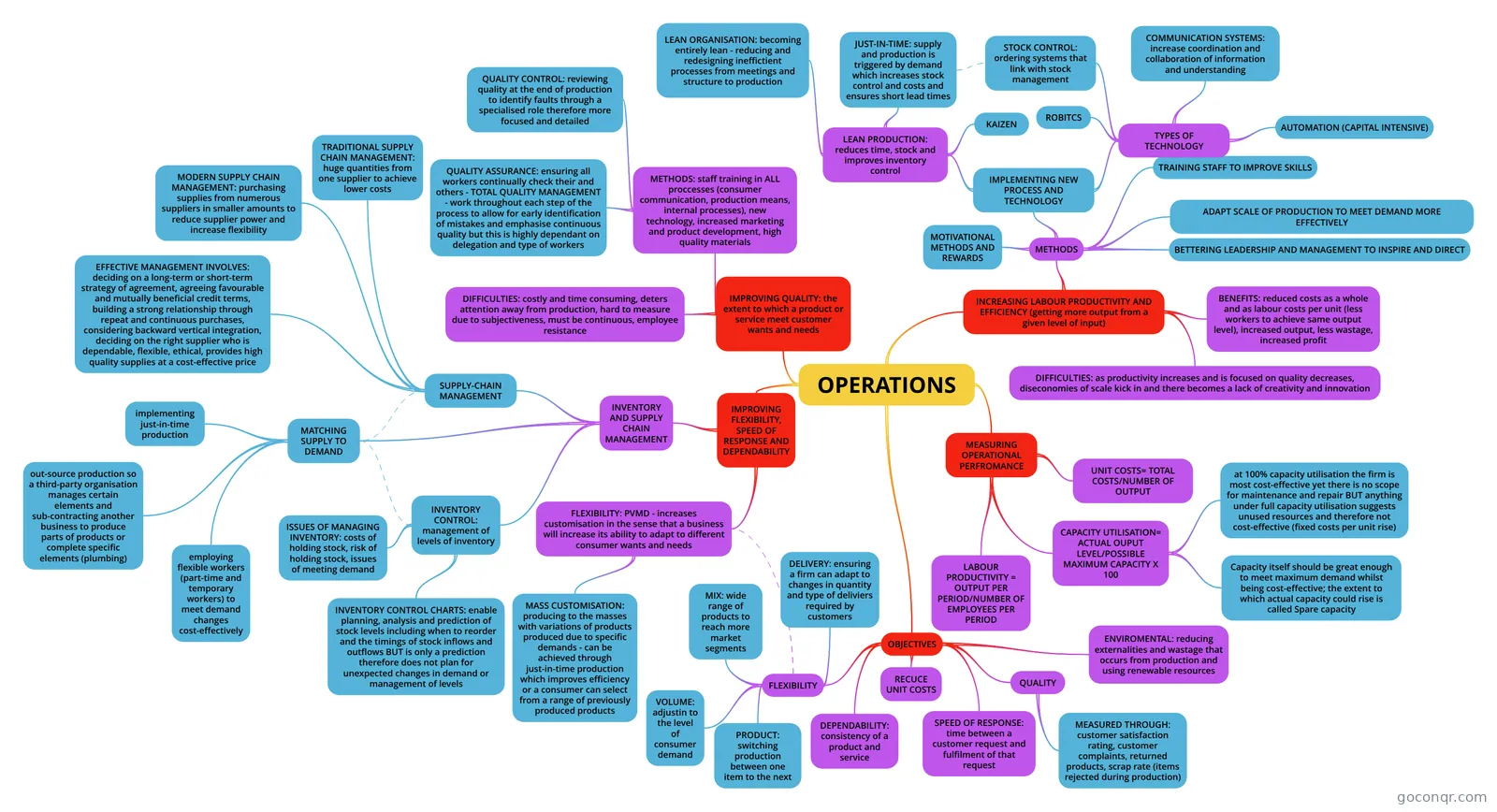
Mind map: Operations Management Concepts
Contenido del mapa
OPERATIONS
OBJECTIVES
- RECUCE UNIT COSTS
- QUALITY
- MEASURED THROUGH: customer satisfaction rating, customer complaints, returned products, scrap rate (items rejected during production)
- SPEED OF RESPONSE: time between a customer request and fulfilment of that request
- FLEXIBILITY
- PRODUCT: switching production between one item to the next
- VOLUME: adjustin to the level of consumer demand
- MIX: wide range of products to reach more market segments
- DELIVERY: ensuring a firm can adapt to changes in quantity and type of deliviers required by customers
- DEPENDABILITY: consistency of a product and service
- ENVIROMENTAL: reducing externalities and wastage that occurs from production and using renewable resources
MEASURING OPERATIONAL PERFROMANCE
- LABOUR PRODUCTIVITY = OUTPUT PER PERIOD/NUMBER OF EMPLOYEES PER PERIOD
- UNIT COSTS= TOTAL COSTS/NUMBER OF OUTPUT
- CAPACITY UTILISATION= ACTUAL OUPUT LEVEL/POSSIBLE MAXIMUM CAPACITY X 100
- Capacity itself should be great enough to meet maximum demand whilst being cost-effective; the extent to which actual capacity could rise is called Spare capacity
- at 100% capacity utilisation the firm is most cost-effective yet there is no scope for maintenance and repair BUT anything under full capacity utilisation suggests unused resources and therefore not cost-effective (fixed costs per unit rise)
INCREASING LABOUR PRODUCTIVITY AND EFFICIENCY (getting more output from a given level of input)
- BENEFITS: reduced costs as a whole and as labour costs per unit (less workers to achieve same output level), increased output, less wastage, increased profit
- METHODS
- MOTIVATIONAL METHODS AND REWARDS
- BETTERING LEADERSHIP AND MANAGEMENT TO INSPIRE AND DIRECT
- IMPLEMENTING NEW PROCESS AND TECHNOLOGY
- LEAN PRODUCTION: reduces time, stock and improves inventory control
- JUST-IN-TIME: supply and production is triggered by demand which increases stock control and costs and ensures short lead times
- KAIZEN
- LEAN ORGANISATION: becoming entirely lean - reducing and redesigning ineffictient processes from meetings and structure to production
- TYPES OF TECHNOLOGY
- ROBITCS
- AUTOMATION (CAPITAL INTENSIVE)
- COMMUNICATION SYSTEMS: increase coordination and collaboration of information and understanding
- STOCK CONTROL: ordering systems that link with stock management
- LEAN PRODUCTION: reduces time, stock and improves inventory control
- TRAINING STAFF TO IMPROVE SKILLS
- ADAPT SCALE OF PRODUCTION TO MEET DEMAND MORE EFFECTIVELY
- DIFFICULTIES: as productivity increases and is focused on quality decreases, diseconomies of scale kick in and there becomes a lack of creativity and innovation
IMPROVING QUALITY: the extent to which a product or service meet customer wants and needs
- METHODS: staff training in ALL proccesses (consumer communication, production means, internal processes), new technology, increased marketing and product development, high quality materials
- QUALITY CONTROL: reviewing quality at the end of production to identify faults through a specialised role therefore more focused and detailed
- QUALITY ASSURANCE: ensuring all workers continually check their and others - TOTAL QUALITY MANAGEMENT - work throughout each step of the process to allow for early identification of mistakes and emphasise continuous quality but this is highly dependant on delegation and type of workers
- DIFFICULTIES: costly and time consuming, deters attention away from production, hard to measure due to subjectiveness, must be continuous, employee resistance
- METHODS: staff training in ALL proccesses (consumer communication, production means, internal processes), new technology, increased marketing and product development, high quality materials
IMPROVING FLEXIBILITY, SPEED OF RESPONSE AND DEPENDABILITY
- FLEXIBILITY: PVMD - increases customisation in the sense that a business will increase its ability to adapt to different consumer wants and needs
- MASS CUSTOMISATION: producing to the masses with variations of products produced due to specific demands - can be achieved through just-in-time production which improves efficiency or a consumer can select from a range of previously produced products
- INVENTORY AND SUPPLY CHAIN MANAGEMENT
- MATCHING SUPPLY TO DEMAND
- implementing just-in-time production
- employing flexible workers (part-time and temporary workers) to meet demand changes cost-effectively
- out-source production so a third-party organisation manages certain elements and sub-contracting another business to produce parts of products or complete specific elements (plumbing)
- INVENTORY CONTROL: management of levels of inventory
- INVENTORY CONTROL CHARTS: enable planning, analysis and prediction of stock levels including when to reorder and the timings of stock inflows and outflows BUT is only a prediction therefore does not plan for unexpected changes in demand or management of levels
- ISSUES OF MANAGING INVENTORY: costs of holding stock, risk of holding stock, issues of meeting demand
- SUPPLY-CHAIN MANAGEMENT
- TRADITIONAL SUPPLY CHAIN MANAGEMENT: huge quantities from one supplier to achieve lower costs
- MODERN SUPPLY CHAIN MANAGEMENT: purchasing supplies from numerous suppliers in smaller amounts to reduce supplier power and increase flexibility
- EFFECTIVE MANAGEMENT INVOLVES: deciding on a long-term or short-term strategy of agreement, agreeing favourable and mutually beneficial credit terms, building a strong relationship through repeat and continuous purchases, considering backward vertical integration, deciding on the right supplier who is dependable, flexible, ethical, provides high quality supplies at a cost-effective price
- MATCHING SUPPLY TO DEMAND
- FLEXIBILITY: PVMD - increases customisation in the sense that a business will increase its ability to adapt to different consumer wants and needs
Información
- Descripción
- Mapa Mental sobre OPERATIONS, creado por daisy ohanlon el 17/05/2019.
- Creado por
- daisy ohanlon
- Visitas
- 0
- Valoración