
Mapa mental
COP3502- Objects and Classes
Contenido del mapa
COP3502- Objects and Classes
Objects
- Attributes & actions
- Attributes are "fields"
- Actions are "methods" or "functinos"
- Define actions that a class's objects can do
- returnType methodName (listofArguments)
- double getSalary()
- getSalary does not accept arguments
- int negate (int number)
- accepts an argument
- Address getAddress()
- returns an Address object
- int add(int a, int b)
- following add method takes two ints and return an int
- double getSalary()
- return type of method can be primitive, an object or void.
- void: method returns nothing.
- returnType methodName (listofArguments)
- main: provides entry point into an application
- application usually has many classes and only one of the classes needs to have a main method.
- public static void main (String[] args)
- signature of main method
- java className arg1 arg2 arg3 ...
- by passing arguments to main when using java to run a class
- all arguments must be passed as string.
- java Test 1 safeMode
- public static void main (String[] args)
- application usually has many classes and only one of the classes needs to have a main method.
- Define actions that a class's objects can do
- To create, you need "classes"
- Class name
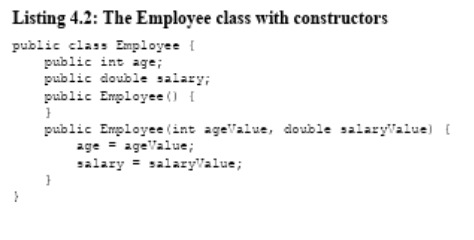
- must have at least one constructor to construct an object
- does not have a return value, even when void
- constructorName (listof Arguments)tab {enter, tab [constructor body] enter}
- must have the same name as class
- can be used to initialize the fields in the object.
- with this constructor, you can assign values to age and position
- new Employee (20, 90000.00)
- with this constructor, you can assign values to age and position
- constructorName (listof Arguments)tab {enter, tab [constructor body] enter}
- does not have a return value, even when void
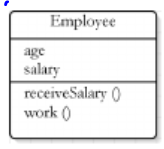
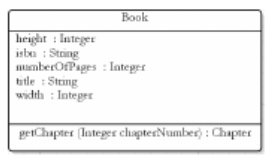
- Class Members- UML allows one to include field types and method signatures
- method's agrument list is in parenthesis and return type is written after a colon
- must have at least one constructor to construct an object
- the field
- Variables that can be primitive or refer to objects.
- Primitive: Age, salary
- Objects: such as Address which represents a street address
- should follow camel naming convention
- Variables that can be primitive or refer to objects.
- the methods
- class className { enter, tab [class body] enter, tab }
- class Employee { int age; double salary; }
- Class definition: must be saved in a file that has the same name as the class name and extension: Employee class must be saved as Employee.java
- in UML diagrams, a class contains three parts: 1. top: class name, 2. middle: fields and 3. bottom: methods
- creating an object from a class
- "new" keyword is followed by the constructor of the class to be instantiated
- new Employee () ;
- Employee employee = new Employee () '
- declares an object reference with the same type as the object.
- employee is an object reference of type Employee
- Employee employee = new Employee () '
- new Employee () ;
- upon creating an object, you call its methods and access it field by:
- objectReference.methodName objectReference.fieldName
- Employee employee = new Employee (} ; employee.age = 24; employee.salary = 50000;
- objectReference.methodName objectReference.fieldName
- null keyword: when reference variable doesnt have a value.
- Book book; // book is null
- Book book = null ;
- test by using":
- if (book == null) { book = new Book () ; } System.out.printIn(book.title);
- "new" keyword is followed by the constructor of the class to be instantiated
- Class name
- Attributes & actions
Naming & Conventions
- Pascal: class names capitilize the initial of each word: Employee, DateUtility,. RegularRateCalculator
- Camel: capiitallize the initia of each word, except for the first one
Imágenes y archivos del mapa
Información
- Descripción
- Mapa Mental sobre COP3502- Objects and Classes, creado por Jeremy Deleon el 19/05/2019.
- Creado por
- Jeremy Deleon
- Visitas
- 0
- Valoración