
Mapa mental
3. Probability
Contenido del mapa
3. Probability
1. Definitions of Statistical Experiment:
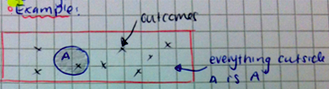
- Sample Space (s): A set of all possible outcomes (eg. Roll a 6 sided die; s= 1, 2, 3, 4, 5, 6)
- Events: Subset of the outcomes (eg. Event A= Outcome is even (2, 4, 6)
2. Probability Scale: For each event A we assign P(A) which is the probability of event A occurring (P(A) is a value b/w 0 and 1)
- If A is impossible, P(A)=0, It A is certain, P(A)=1
3. Equally Likely Outcomes: Sample space (S) has n(s) outcomes, each is equally likely to occur
- Event A is made of n(A) outcomes, then P(A)= n(A)/n(s)
- Eg. Roll 6 sided die and let A= event "outcome is >3". n(s)= 6 and n(A)= 3, t/f P(A)= 3/6 or 1/2
4. Complimentary Events: Event A' = "not A". As A either occurs or does not, then A'= n(s)-n(A)
- Equation: P(A')= n(A')/n(s) or [n(S)-n(A)]/n(S) or 1-[n(A)/n(S)] or 1-P(A)
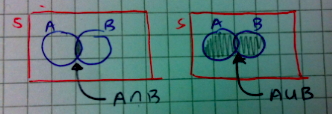
5. Venn Diagrams: Represent S as a rectangle and events A, B, C will be regions within S.
6. Union and Intersection of Events: Suppose A and B are 2 events associated w/ some stat experiment.
- AUB, A or B or A 'union' B is the event where either A occurs, B occurs, or A and B occur.
- N(AUB)= n(A)+n(B)-n(ANB)
- P(AUB)= n(AUB)/n(S)
- ANB, A and B or A 'intersection' B is the event where A and B occur
- AUB, A or B or A 'union' B is the event where either A occurs, B occurs, or A and B occur.
7. Mutually Exclusive Events: If events A and B cant occur together. P(ANB)=0, Hence ONLY FOR MUTUALLY ECLUSIVE!!! P(AUB)=P(A)+P(B)
8. Exhaustive Events: If at least one of event A or B must occur. P(AUB)=1
9. Tree Diagrams: Useful for events occurring in sequence
10. Independence: A and B are independent if they don't influence each other. P(ANB)= P(A)P(B).
- Multiplication Rule: If A, B, C, D are mutually independent of each other, we use this rule. Eg. What is the probability in 4 rolls of a die that we see 4 sixes (bias die w/ P(6)= 0.6 f)? P= 0.6x0.6x0.6x0.6= 0/1296
11. Ordering, Permutations and Combinations:
- Basic Principle of Counting: 2 experiments performed. Exp 1 has m possible outcomes and exp 2 has n outcomes. Total number of outcomes= mXn.
- Combinations: The # of coordinated arrangements of r objects from n objects is n!/[r!(n-r!)] = 'n choose r'. Eg. If n=7, r=5, then 7!/(5!2!)=21
- Orderings: You have n unique objects. # of orderings is n!= nX(n-1) (note both 0! and 1!=1).
- You have n objects of type A and n objects of type b, the # of distinct arrangements= n!/(a!b!).
- Permutations: # of ordered arrangements of r objects out of n distinct objects. nPr = n!/(n-r!).
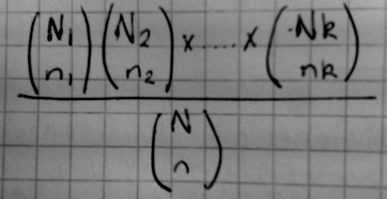
- Sampling w/o Replacement: Box has n items, we choose n items w/o replacement. What is probability we have n1 items of type 1, n2 of type 2, nk of type k. (selection order isnt important).
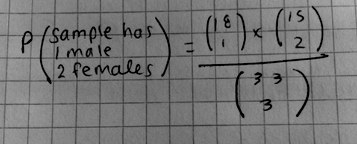
- Eg. N=33 students of k=2 types. We have N1=18 males and N2=15 females and sample n=3 students randomly w/o replacement P (sample has 1 male, 2 females) =18
- Basic Principle of Counting: 2 experiments performed. Exp 1 has m possible outcomes and exp 2 has n outcomes. Total number of outcomes= mXn.
12: Conditional Probability: Probability of B given that A has occured = P(B|A). Conditional probability formula P(B|A)= P(BNA)/P(A) or P(B|A)(PA)=P(BNA). Can be reversed so P(A|B)=P(ANB)/P(B) or P(A|B)P(B)=P(ANB)
13: Statistical Independence: Two events A and B are independent of one another if, knowing one event has occured, doesnt imapct the probability of the other. If A and B are statistically independent then P(ANB)=P(A)P(B), also, P(A|B)=P(A) and P(B|A)=P(B)
Imágenes y archivos del mapa
Información
- Descripción
- Mapa Mental sobre 3. Probability, creado por Jasmine Latimore el 06/01/2015.
- Creado por
- Jasmine Latimore
- Visitas
- 5
- Valoración