
Probability
54 resources created by 45 users
This Probability page on GoConqr gathers community-made quizzes, mind maps, flashcards and notes, from basic concepts and sample spaces to conditional probability, random variables and limit theorems. It's built for school students revising a topic, university students and professional candidates filling gaps, and teachers after ready-made material. There are over 400 resources here, including more than 50 quizzes, over 200 mind maps and more than 100 flashcards, mostly secondary and university level. Pick a starting point, try a quiz to find your gaps, then make your own study sets.
Top Probability resources
-
42 questionsMat II 41. A set of families has the following distribution on number of children: x1, x2 Determine , if it is kno...
-
25 cardsApplying Probability Based on the data in this two-way table, if a flower is picked at random, what is the probability that it's...
-
20 questionsProbability A box contains four coins, of which two coins have heads on both their faces, one coin has tail on both its...
-
Mind map Cálculo Diferencial - Module 1. Probability and statistics. Modulo 1, mini proyecto.
-
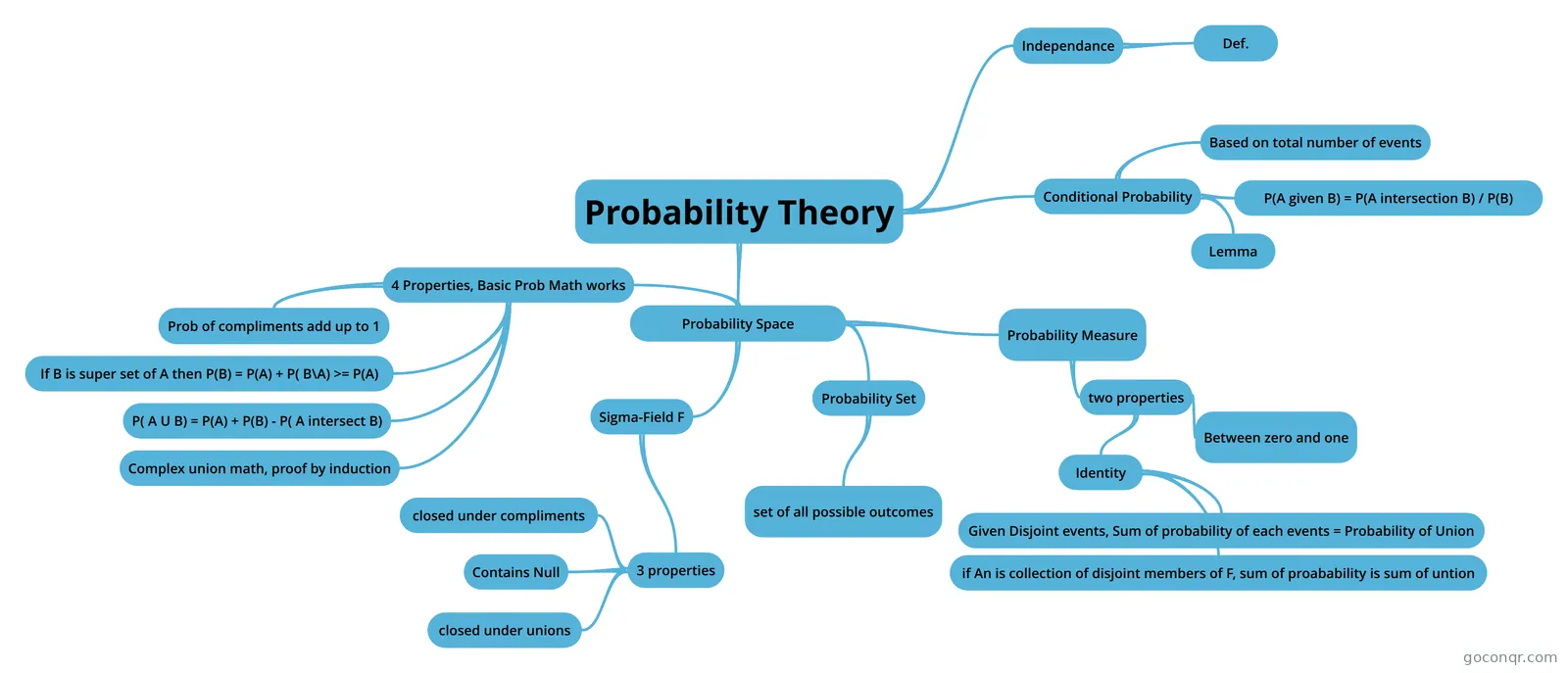 Mind map Probability Theory V1
-
Mind map Probability mind map on the chapter Probability of NCERT textbook class X of CBSE board
-
5 questionsExperimental and Theoretical Probablity A quick resource to examine the differences between theoretical and experimental probability.
-
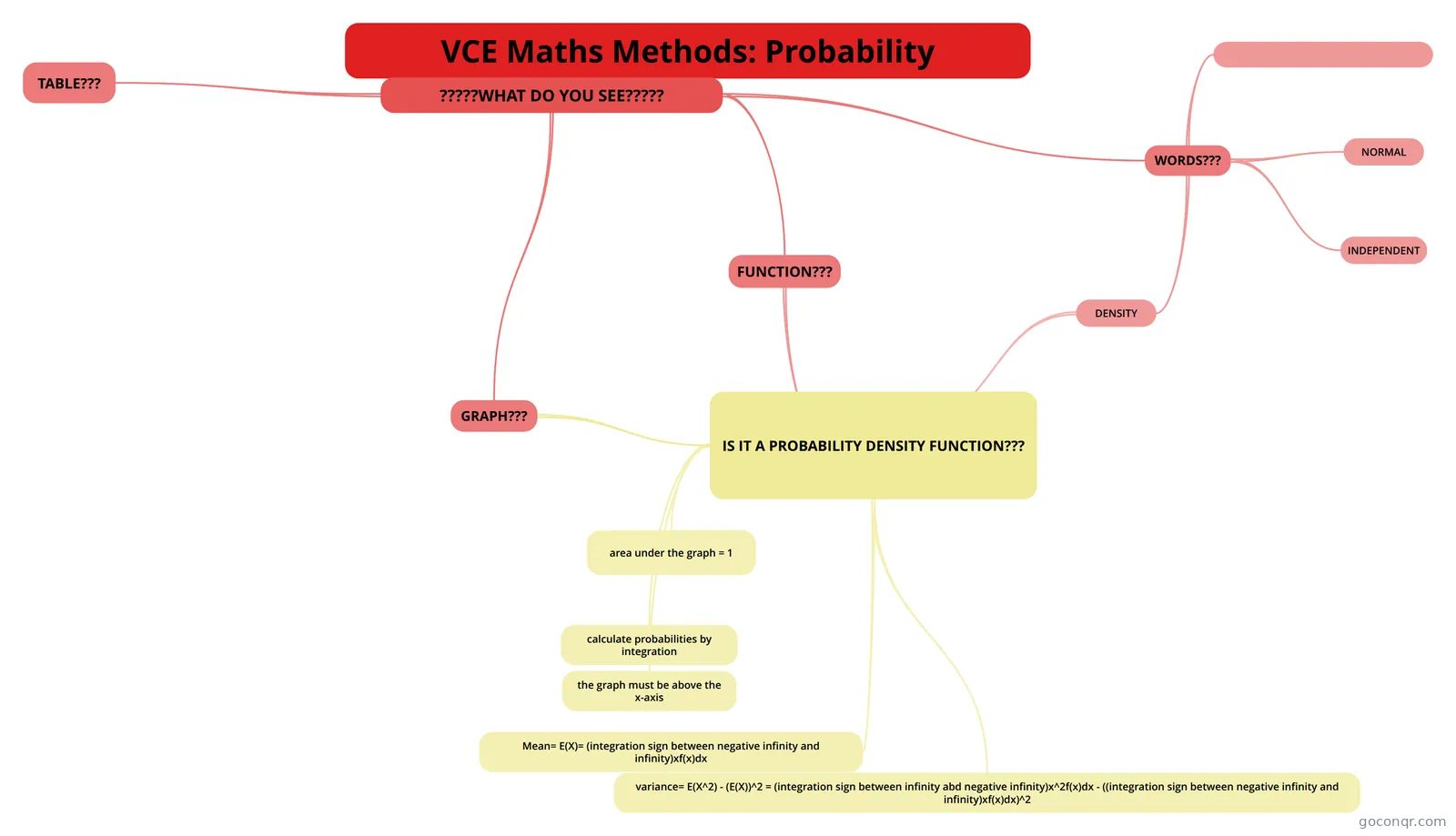 Mind map VCE Maths Methods: Probability I havn't finished this...if anyone sees this and wants me to finish it just leave a comment and I will
Quizzes
-
42 questionsMat II 41. A set of families has the following distribution on number of children: x1, x2 Determine , if it is kno...
-
20 questionsProbability A box contains four coins, of which two coins have heads on both their faces, one coin has tail on both its...
-
5 questionsExperimental and Theoretical Probablity A quick resource to examine the differences between theoretical and experimental probability.
-
4 questionsQuiz 1 In 1995, they introduced blue M&M’s. Before then, the color mix in a bag of plain M&M’s was 30% Brown, 20% ...
-
10 questionsProbability selecting words for statements which word describes this event, you will get heads when you flip a coin.
Mind maps
See all 18 mind maps-
Cálculo Diferencial - Module 1. Probability and statistics. Modulo 1, mini proyecto.
-
Probability Theory V1
-
Probability mind map on the chapter Probability of NCERT textbook class X of CBSE board
-
VCE Maths Methods: Probability I havn't finished this...if anyone sees this and wants me to finish it just leave a comment and I will
-
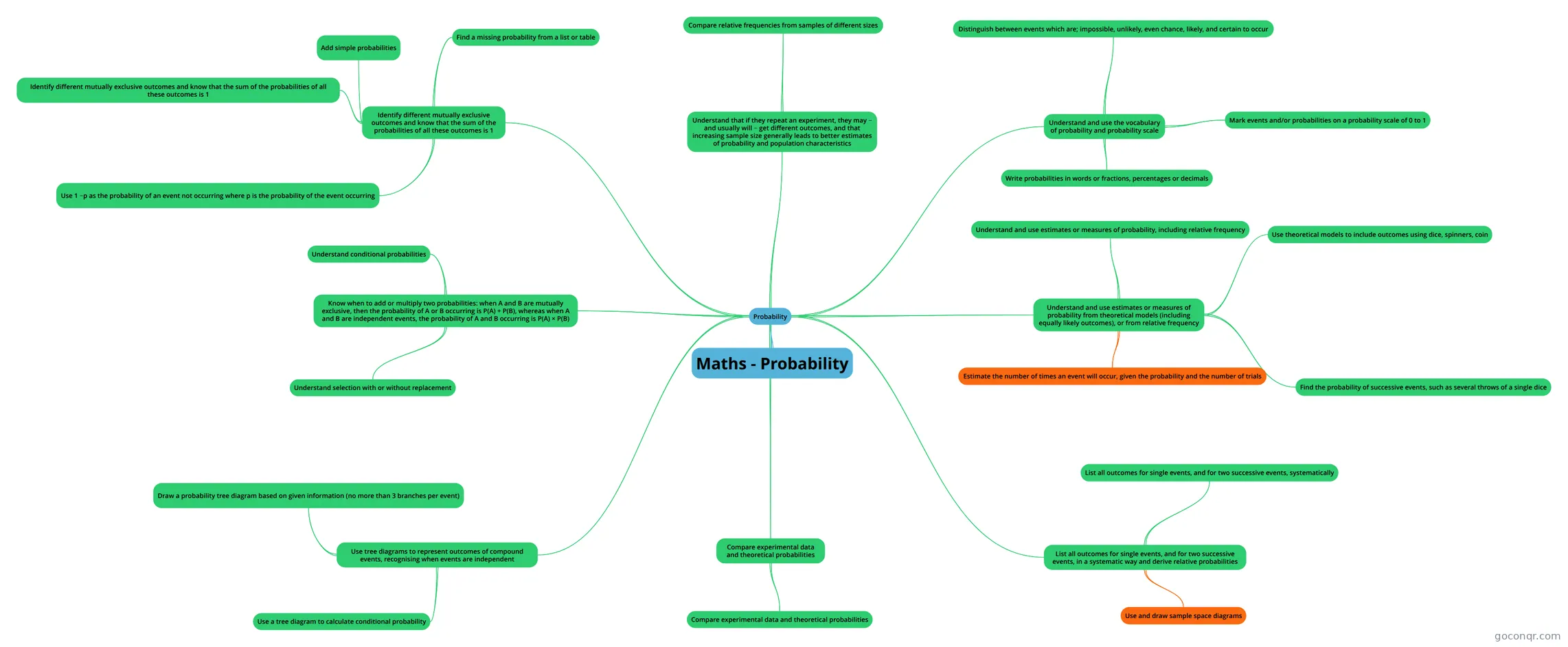 Maths - Probability
-
Math 160 Exam #2 Probability Chapter 4 and 5.
-
Probability experiments
-
Maths Probability
Flashcards
See all 25 flashcards-
25 cardsApplying Probability Based on the data in this two-way table, if a flower is picked at random, what is the probability that it's...
-
42 cardsChapter 1: Probability and Measure
-
31 cards1. General Probability Actuary (Exam P) Flashcards on General Probability, created by hinal vaghela on 07/09/2017.
-
32 cardsRS1 Unit 3 Flashcards 2022-2023
-
35 cardsQua Normal Distribution rule
-
20 cardsChapter 6: Probability Interpretation and Basic rules
-
18 cardsStats 151 - Predicting Outcomes with Probability What is probability?
-
12 cardsCounting and Probability Fundamental Principle of Counting
Flowcharts
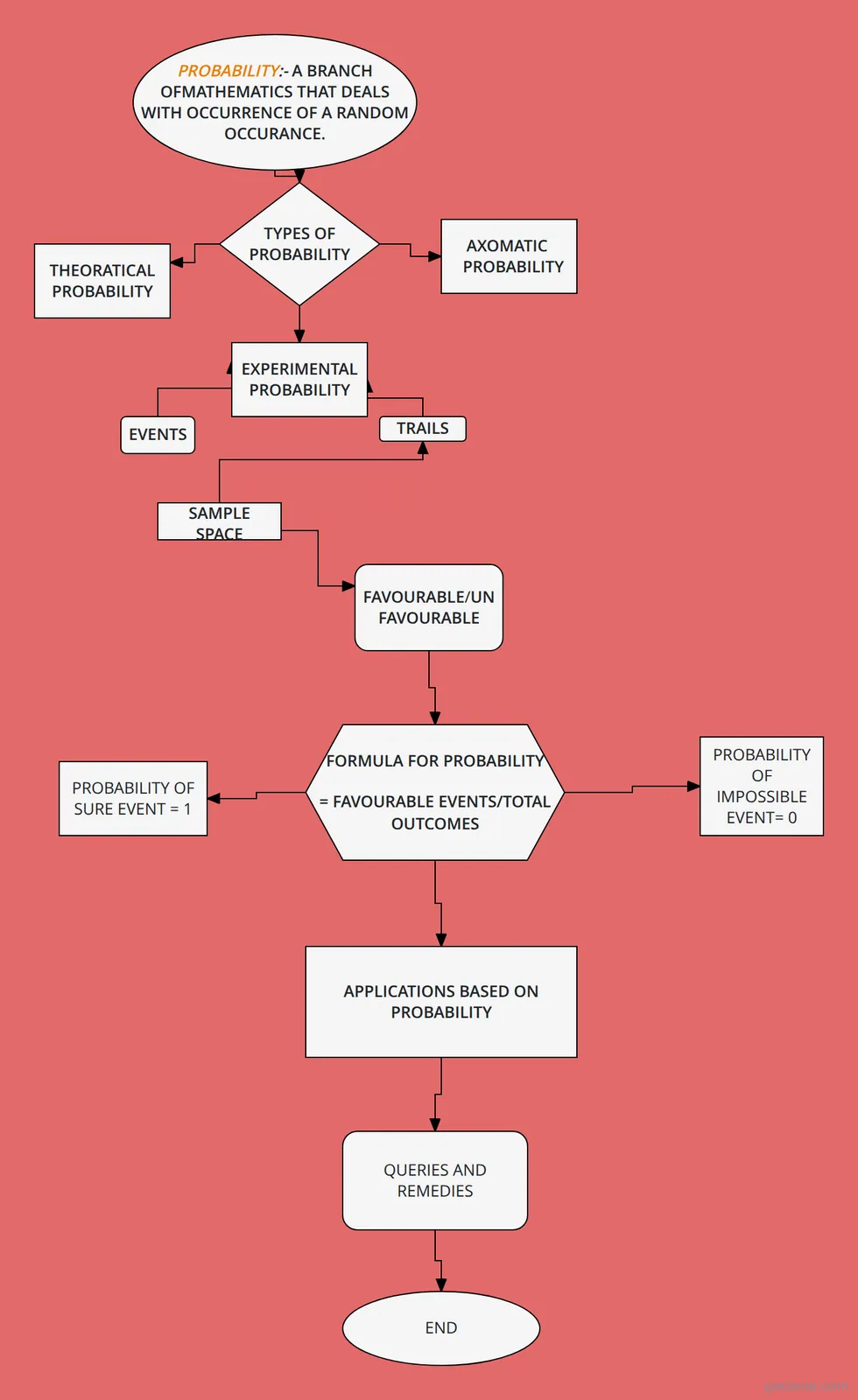
Notes
-
Basic Probability Notes Set Theory Set Theory Cont'd Basic Prob
-
Probability Probability Probability is the branch of mathematics concerning numerical descriptions of how likely an event is to occur, or how likely it is that a proposition is true. The probability of...
-
Mathematics 2.12 Apply probability methods in solving problems Subject content Theoretical Probability Relative Frequency Informal Conditional Probability Multiplicative Principle and Expected Number Tree Diagrams Risk The Standard Normal DistributionInverse Normal
Slides
More Statistics and probability topics
About Probability
GoConqr OriginalWhat the resources cover
The unit opens with mind maps that set out the basics. The mind map titled Probability defines a sure event, an elementary event and a complementary event. Another Probability mind map walks through experiments, outcomes, sample spaces and events. The Probability Theory mind map goes further, with sigma-fields, probability spaces and probability measures.
Flashcard decks stretch from Applying Probability, which uses two-way tables, to Conditional Probability Formula, Bernoulli trials and Chapter 2.2 Classical Limit Theorems. There are also notes, slide sets and flowcharts, including Counting techniques.
Where to start
- Read a basic mind map such as Probability or Probability Concept to get the vocabulary.
- Work through the quiz Experimental and Theoretical Probablity to check the difference between estimating and calculating.
- Move to flashcards on counting, conditional probability and sample spaces.
- Try the harder quizzes, such as the coin-box question in the quiz called Probability or the long Probability Theory final exam quiz.
Using quizzes and maps together
Look at a map first, then take a quiz on the same idea. When an answer is wrong, go back to the branch of the map that covers it. Flashcards are handy for formulas and definitions you want to recall quickly. Some resources are in other languages, such as Probabilidad, and some relate to named exams, including Exam P, AP Statistics, GCSE Maths and A-level Maths.
Where it sits
This unit belongs to the Probability strand of Statistics and probability. It sits alongside material on distributions and random variables that the resources touch on.
Choose one resource that matches your level, give it a go, and then build a map or deck of your own.
Frequently asked questions
Which resource should I open first?
Begin with one of the Probability mind maps. One lays out sure, elementary and complementary events, and another covers experiments, outcomes and sample spaces. Once the terms feel familiar, take the quiz Experimental and Theoretical Probablity to test yourself.
What do the mind maps cover?
They range from basic concepts and events to Probability Theory, which deals with sigma-fields and probability measures. Others cover probability density functions, a survey of probability concepts and the Exam P_1 map, so you can pick the depth you need.
Are the resources free to use?
Yes. Every resource listed here is free to open, study and take, with no account needed. They were made by GoConqr users, not by GoConqr itself. A free account also saves your quiz scores and lets you make your own quizzes, mind maps, flashcards and notes.
Which levels and exams do they suit?
The mix is mostly secondary and university material. Listed resources mention AP Statistics, GCSE Maths, A-level Maths, GMAT and Exam P, so check each title and excerpt to see whether it fits your course.
Is there anything for harder practice?
Yes. The quiz Probability Theory, a final exam with 121 questions, is a demanding option. The 50 Challenging Problems quiz and the MATH 3410 review quizzes also give more advanced practice once you are comfortable with the basics.
What if I can't find the topic I need?
Try searching related words such as counting, conditional probability, Bernoulli trials or random variables, since titles vary. You can also make your own mind map, flashcards or quiz on the missing topic and keep it for revision.