
Mapa mental
VARIATION 3
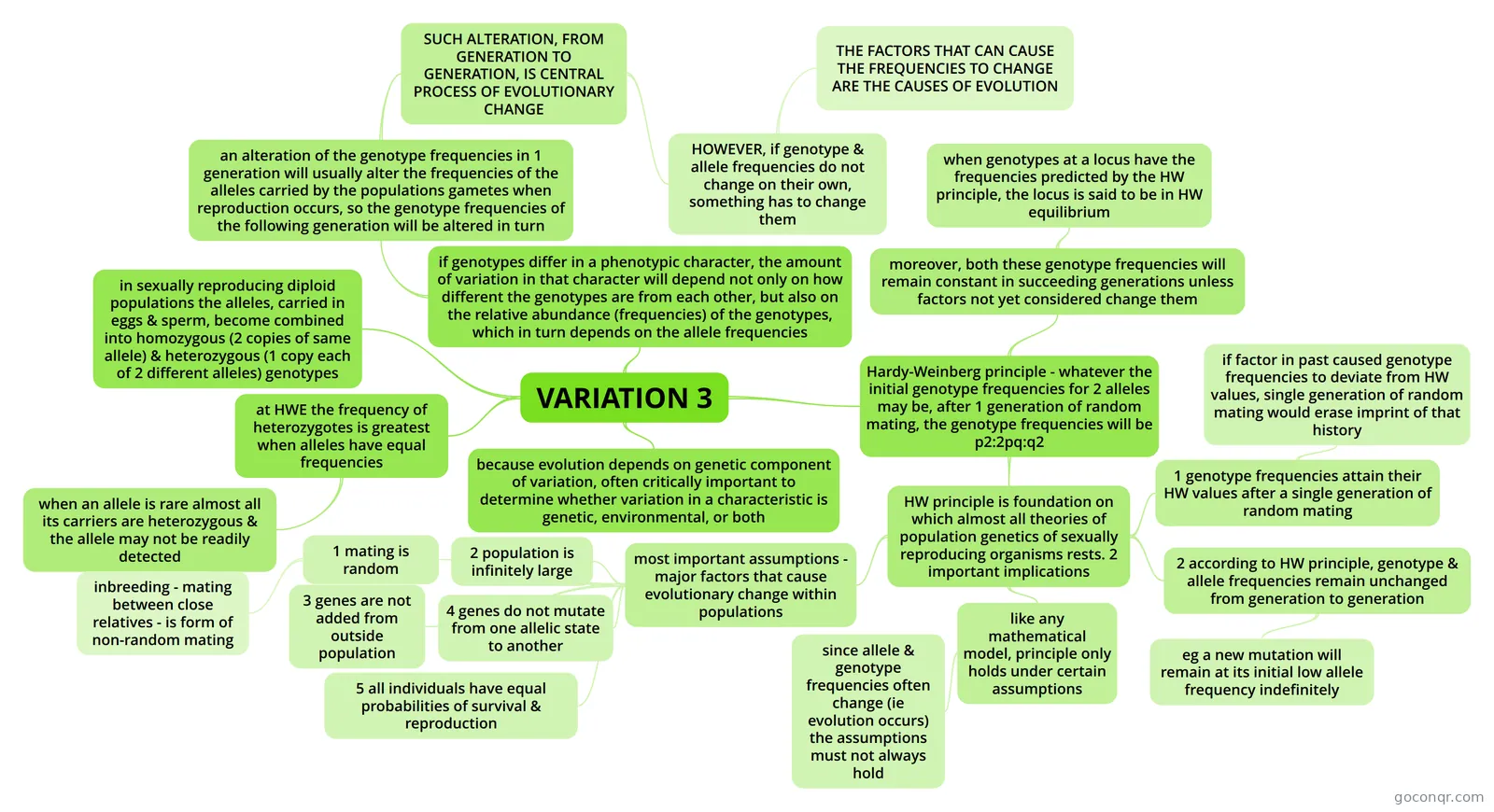
Mind map: Genetic Variation and Hardy-Weinberg Principle
Contenido del mapa
VARIATION 3
because evolution depends on genetic component of variation, often critically important to determine whether variation in a characteristic is genetic, environmental, or both
in sexually reproducing diploid populations the alleles, carried in eggs & sperm, become combined into homozygous (2 copies of same allele) & heterozygous (1 copy each of 2 different alleles) genotypes
if genotypes differ in a phenotypic character, the amount of variation in that character will depend not only on how different the genotypes are from each other, but also on the relative abundance (frequencies) of the genotypes, which in turn depends on the allele frequencies
- an alteration of the genotype frequencies in 1 generation will usually alter the frequencies of the alleles carried by the populations gametes when reproduction occurs, so the genotype frequencies of the following generation will be altered in turn
- SUCH ALTERATION, FROM GENERATION TO GENERATION, IS CENTRAL PROCESS OF EVOLUTIONARY CHANGE
- HOWEVER, if genotype & allele frequencies do not change on their own, something has to change them
- THE FACTORS THAT CAN CAUSE THE FREQUENCIES TO CHANGE ARE THE CAUSES OF EVOLUTION
- HOWEVER, if genotype & allele frequencies do not change on their own, something has to change them
- SUCH ALTERATION, FROM GENERATION TO GENERATION, IS CENTRAL PROCESS OF EVOLUTIONARY CHANGE
- an alteration of the genotype frequencies in 1 generation will usually alter the frequencies of the alleles carried by the populations gametes when reproduction occurs, so the genotype frequencies of the following generation will be altered in turn
Hardy-Weinberg principle - whatever the initial genotype frequencies for 2 alleles may be, after 1 generation of random mating, the genotype frequencies will be p2:2pq:q2
- moreover, both these genotype frequencies will remain constant in succeeding generations unless factors not yet considered change them
- when genotypes at a locus have the frequencies predicted by the HW principle, the locus is said to be in HW equilibrium
- HW principle is foundation on which almost all theories of population genetics of sexually reproducing organisms rests. 2 important implications
- 1 genotype frequencies attain their HW values after a single generation of random mating
- if factor in past caused genotype frequencies to deviate from HW values, single generation of random mating would erase imprint of that history
- 2 according to HW principle, genotype & allele frequencies remain unchanged from generation to generation
- eg a new mutation will remain at its initial low allele frequency indefinitely
- like any mathematical model, principle only holds under certain assumptions
- since allele & genotype frequencies often change (ie evolution occurs) the assumptions must not always hold
- most important assumptions - major factors that cause evolutionary change within populations
- 1 mating is random
- inbreeding - mating between close relatives - is form of non-random mating
- 2 population is infinitely large
- 3 genes are not added from outside population
- 4 genes do not mutate from one allelic state to another
- 5 all individuals have equal probabilities of survival & reproduction
- 1 mating is random
- 1 genotype frequencies attain their HW values after a single generation of random mating
- moreover, both these genotype frequencies will remain constant in succeeding generations unless factors not yet considered change them
at HWE the frequency of heterozygotes is greatest when alleles have equal frequencies
- when an allele is rare almost all its carriers are heterozygous & the allele may not be readily detected
Información
- Descripción
- Mapa Mental sobre VARIATION 3, creado por tomking304 el 06/09/2013.
- Creado por
- tomking304
- Visitas
- 30
- Valoración