
Mapa mental
Planetary Science
Contenido del mapa
Planetary Science
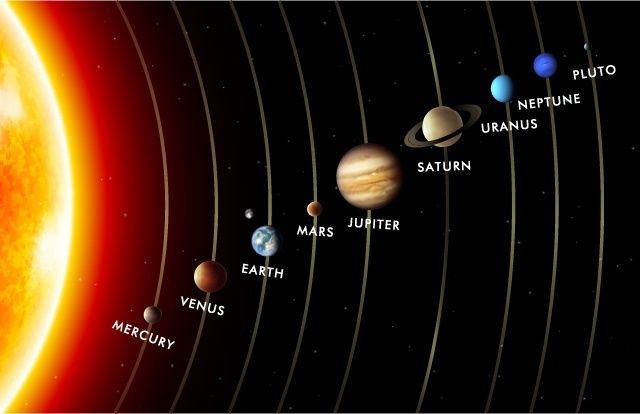
Order (from closest to the Sun)
- Mercury, Venus, Earth, Mars, Jupiter, Saturn, Uranus, Neptune
- https://upcosmos.com/wp-content/uploads/2017/11/Solar-System-Planets-Order.jpg
- Inner Planets: Richer in higher melting point elements
- Mercury
- Atmosphere: No atmosphere (composed primarily of Oxygen and Sodium).
- Surface: Relatively crater-free, plains were formed from lava flows that covered cratered terrain, has planetwide system of cliffs (scarps).
- Interior: High density of planet suggests it has an extensive nickel-iron core, has molten zone, as well as the outer layers may have been lost in collision with another celestial body in history.
- Surface: Relatively crater-free, plains were formed from lava flows that covered cratered terrain, has planetwide system of cliffs (scarps).
- Atmosphere: No atmosphere (composed primarily of Oxygen and Sodium).
- Venus
- Atmosphere: Primarily Carbon Dioxide and Nitrogen gas.Contains thick clouds (which prevents astronomers from directly observing the surface, except for radio wavelengths). Clouds are made of sulfuric acid. This means that the greenhouse effect on Venus is more effective than Earth's.
- Surface: Contains few impact craters (as Venus is fairly young).
- Interior: Theorized that Venus has a liquid metal core that extends halfway to the surface.
- Fact: Radar measurements revealed that Venus has a retrograde rotation (backward spin/clockwise spin). Venus is also the hottest planet in our solar system, despite being the second closest to the Sun!
- Interior: Theorized that Venus has a liquid metal core that extends halfway to the surface.
- Surface: Contains few impact craters (as Venus is fairly young).
- Atmosphere: Primarily Carbon Dioxide and Nitrogen gas.Contains thick clouds (which prevents astronomers from directly observing the surface, except for radio wavelengths). Clouds are made of sulfuric acid. This means that the greenhouse effect on Venus is more effective than Earth's.
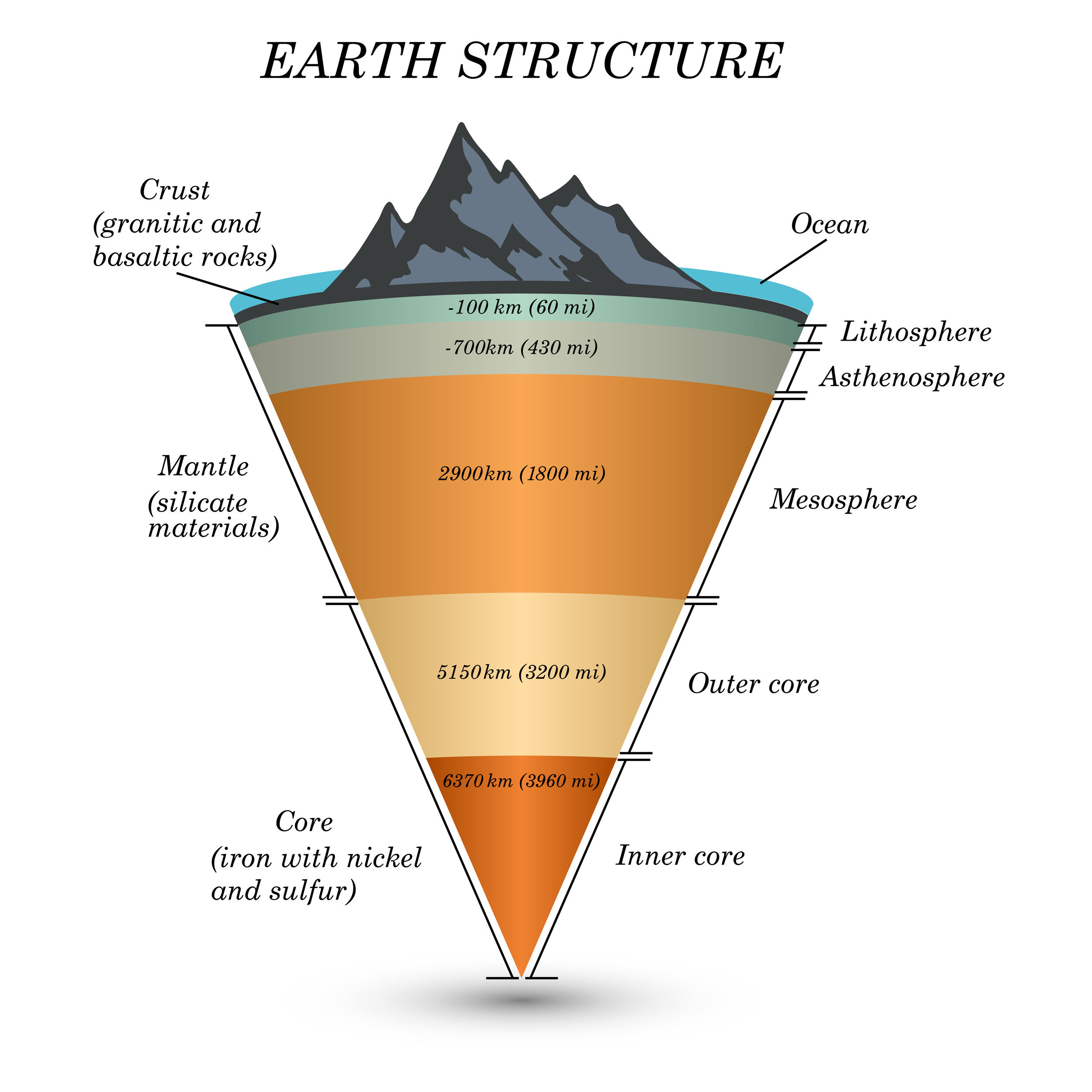
- Earth
- Atmosphere: Moderately dense atmosphere composed of 78% Nitrogen and 21% Oxygen. Earth's mild greenhouse effect supports conditions suitable for life!
- Surface: Contains water, rocks, etc.
- Fact: Its distance from the Sun and its nearly circular orbit allow liquid water to exist on its surface in all three states.
- http://blogs.discovermagazine.com/d-brief/files/2019/01/Earth-Crust.jpg
- Surface: Contains water, rocks, etc.
- Atmosphere: Moderately dense atmosphere composed of 78% Nitrogen and 21% Oxygen. Earth's mild greenhouse effect supports conditions suitable for life!
- Mars
- Atmosphere: Thin atmosphere (lots of dust storms)
- Surface: Southern Hemisphere (heavily cratered, highland region), Northern Hemisphere (dominated by plains that are sparsely cratered, 4 gigantic shield volcanoes)
- Interior: Hypothesis is that the core contains Iron, Nickel, and Sulfur. Since Mars does not have a magnetic field, the core is predicted to be solid.
- Fact: Mars is referred to as the 'red planet' due to its reddish surface colour due to high iron content in the soil.
- Potential water on Mars? Missions have shown that ice caps were found. The ice caps were made of Carbon Dioxide ice and sometimes dry ice.
- Fact: Mars is referred to as the 'red planet' due to its reddish surface colour due to high iron content in the soil.
- Interior: Hypothesis is that the core contains Iron, Nickel, and Sulfur. Since Mars does not have a magnetic field, the core is predicted to be solid.
- Surface: Southern Hemisphere (heavily cratered, highland region), Northern Hemisphere (dominated by plains that are sparsely cratered, 4 gigantic shield volcanoes)
- Atmosphere: Thin atmosphere (lots of dust storms)
- Mercury
- Outer Planets: More volatile, and gases
- Jupiter
- Atmosphere: Mostly composed of Hydrogen and Helium (gas and liquid). Below the liquid Hydrogen is a layer of liquid metallic hydrogen (form of 'H' that has properties of liquid and metal, which can only exist under conditions of very high pressure). Electric currents also exist within the layer of liquid metallic hydrogen which generates Jupiter's magnetic field.
- Rings: Consists of 3 rings, which are probably composed of dust particles.
- Interior: Models suggest that Jupiter might have an Earth-sized solid core which contains heavier elements.
- Appearance & Rotation: Jupiter's rapid rotation distorts the shape of the planet, which causes its clouds to flow rapidly (causes a banded appearance). It creates cloud patterns called Belts (low, warm, dark-coloured zones that sink) and Zones (high, cool, light-coloured clouds that rise)
- Moons: Consists of 60+ moons, which the 4 largest ones are: Io, Europa, Ganymede, Callisto. The ice content is lower in Io and Europa, because they have been squeezed and heated. Io is almost completely molten inside, whereas Europa's ice has melted due to gravitational heating.
- Interior: Models suggest that Jupiter might have an Earth-sized solid core which contains heavier elements.
- Fact: Since Jupiter is a massive planet, it is used in gravity assist (technique used to help propel satellites passing Jupiter).
- Rings: Consists of 3 rings, which are probably composed of dust particles.
- Atmosphere: Mostly composed of Hydrogen and Helium (gas and liquid). Below the liquid Hydrogen is a layer of liquid metallic hydrogen (form of 'H' that has properties of liquid and metal, which can only exist under conditions of very high pressure). Electric currents also exist within the layer of liquid metallic hydrogen which generates Jupiter's magnetic field.
- Saturn
- Atmosphere: Has a layered cloud system., composed of Hydrogen and Helium, with ammonia ice near the cloud tops. Also has a magnetic field.
- Rings: Composed of pieces of ice. Consists of 7 major rings which are each made up of narrower rings (ringlets) and contain many open gaps. Ringlets and gaps are caused by the gravitational effects of Saturn's many moons. The rings are also thin because rotational forces keep orbits of all particles confined to Saturn's equatorial plane.
- Moons: Contains more than 55 satellites. One of the moons, Titan, is larger than planet Mercury. Titan has a dense atmosphere made of Nitrogen gas and Methane (found in solid, liquid, and gas form).
- Rings: Composed of pieces of ice. Consists of 7 major rings which are each made up of narrower rings (ringlets) and contain many open gaps. Ringlets and gaps are caused by the gravitational effects of Saturn's many moons. The rings are also thin because rotational forces keep orbits of all particles confined to Saturn's equatorial plane.
- Atmosphere: Has a layered cloud system., composed of Hydrogen and Helium, with ammonia ice near the cloud tops. Also has a magnetic field.
- Uranus
- Atmosphere: Mainly composed of Hydrogen and Helium (colourless). But, the planet has a blue appearance due to the few clouds that differ in brightness and colour from the surrounding atmosphere. The blue colour is mainly caused my Methane in its atmosphere which reflects light.
- Interior/Composition: Completely fluid, except for a small, solid core.
- Moons & Rings: Contains 27+ moons and a faint ring system.
- Fact: Uranus' rotational axis is tipped so far that the North Pole almost lies in its orbital plane. A hypothesis for this is that Uranus was knocked sideways by a massive collision with a passing object. This results in each pole on Uranus to spend 42 Earth years in darkness (and vice versa in sunlight)!
- Moons & Rings: Contains 27+ moons and a faint ring system.
- Interior/Composition: Completely fluid, except for a small, solid core.
- Atmosphere: Mainly composed of Hydrogen and Helium (colourless). But, the planet has a blue appearance due to the few clouds that differ in brightness and colour from the surrounding atmosphere. The blue colour is mainly caused my Methane in its atmosphere which reflects light.
- Neptune
- Fact: Its existence was predicted before discovery--based on small deviations in motion of Uranus and the application of Newton's Universal Law of Gravitation.
- Moons: Contains 13 moons, Triton is the largest. Triton has a retrograde orbit, thin atmosphere, as well as Nitrogen geysers which are caused by Nitrogen gas below Triton's south polar ice which expands and erupts when heated by the Sun.
- Rings: Contains 6 rings which are composed of microscopic dust particles which do not reflect light well.
- Moons: Contains 13 moons, Triton is the largest. Triton has a retrograde orbit, thin atmosphere, as well as Nitrogen geysers which are caused by Nitrogen gas below Triton's south polar ice which expands and erupts when heated by the Sun.
- Fact: Its existence was predicted before discovery--based on small deviations in motion of Uranus and the application of Newton's Universal Law of Gravitation.
- Jupiter
- Composition of Planets
- Mercury, Venus, Earth, Mars, Jupiter, Saturn, Uranus, Neptune
Formation
- Interstellar Clouds
- What does it consist of?
- Clouds of H and He
- Small amounts of other elements and dust
- Stage 1
- Density of gases is low. The cloud of gas collapses, accelerates, and becomes more dense.
- Centripetal Force (cloud spins faster and contracts), collapses in equatorial plane --> becomes flat
- Looks like rotating disk w/ dense center
- Centripetal Force (cloud spins faster and contracts), collapses in equatorial plane --> becomes flat
- Density of gases is low. The cloud of gas collapses, accelerates, and becomes more dense.
- Stage 2
- Center of rotating disk becomes more dense, Temperature increases and there is enough pressure to fuse hydrogen into helium.
- Gravity and rotation within the nebula form a protosun and thin outer flattened disk.
- Center of rotating disk becomes more dense, Temperature increases and there is enough pressure to fuse hydrogen into helium.
- What does it consist of?
- Planetesmial Formation
- Tiny grains of matter combined and collided, creating planetesmials from small to massive objects.
- Terrestrial Planets
- Formed by merging planetesimals on inner part of the main disk. (e.g. Elements that resisted vapourization)
- Interstellar Clouds
Shape
- Elliptical, Heliocentric
- Asteroid Belt
- Consists of asteroids, debris from other planets which did not get pulled in from its gravitational pull.
Role of Gravity
- Gravity draws matter together
- Asteroids trapped between Jupiter and Mars in the asteroid belt were attracted by Jupiter's gravitational pull.
Interplanetary Debris
- Leftover debris from planet formation (e.g. made of rock and ice). Examples are asteroids and comets.
Sun
- Composition
- Plasma
- Hydrogen and Helium exist in the 4th state of matter. Plasma is a sea of protons and electrons broken from their atoms by intense heat and pressure. (Recall: Sun is mainly composed of 'H' and 'He' gases which are highly ionized and conductive)
- Plasma
- Formation by Fusion
- Process of combining Hydrogen nuclei to form Helium nuclei and energy is released. The mass difference between 4 'H' nuclei which are fused to form 1 'He' nucleus is the energy released. All stars are powered by fusion.
- Atmosphere
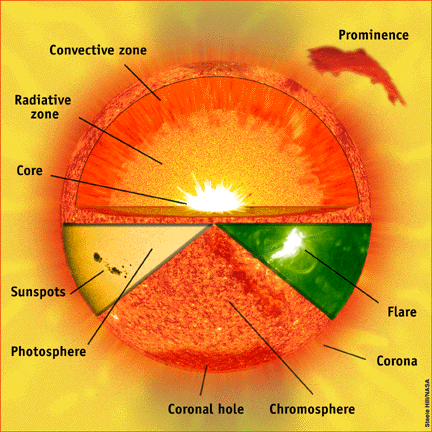
- Photosphere
- Visible surface of the Sun. Where most light is from.
- Chromosphere
- Only visible during a solar eclipse
- Corona
- Outermost layer visible during an eclipse.
- Photosphere
- Solar Wind
- High speed jet of charged particles (protons, electrons) flowing from the Sun.
- Earth's magnetic field deflects most of the solar wind.
- Aurora Borealis is caused when solar wind collides with gases in the atmosphere. When this happens, it releases light.
- High speed jet of charged particles (protons, electrons) flowing from the Sun.
- Features
- Sunspots
- Cooler areas of the photosphere produced when magnetic fields from the Sun's core prevents gases from rising to the surface.
- https://www.thesuntoday.org/wp-content/uploads/2010/05/layers.gif
- Sunspots
- Coronal Hole
- Areas of low gas density over sunspots from which solar wind particles emanate.
- Composition
Moon
- Formation
- 4 different theories: Spin/Fission Theory, Capture Theory, Failed Planet Theory, Giant Impact Theory
- GIT: Caused by impact of Mars-siezed "planetesimal" on Earth where the debris melted together to form the Moon.
- 4 different theories: Spin/Fission Theory, Capture Theory, Failed Planet Theory, Giant Impact Theory
- Features
- Tides
- The gravitational pull of Moon and Sun both contribute to ocean tides on Earth. Since the Moon is closer, it has a greater effect.
- Moon's gravity pulls on Earth and oceans of Earth more strongly than the Sun. The Moon produces a tidal bulge under which the Earth rotates (2 high tides and 2 low tides per day, every 6 hours).
- Neap Tide: Tides are lower than normal.
- Spring Tide: Tides are higher than normal.
- The gravitational pull of Moon and Sun both contribute to ocean tides on Earth. Since the Moon is closer, it has a greater effect.
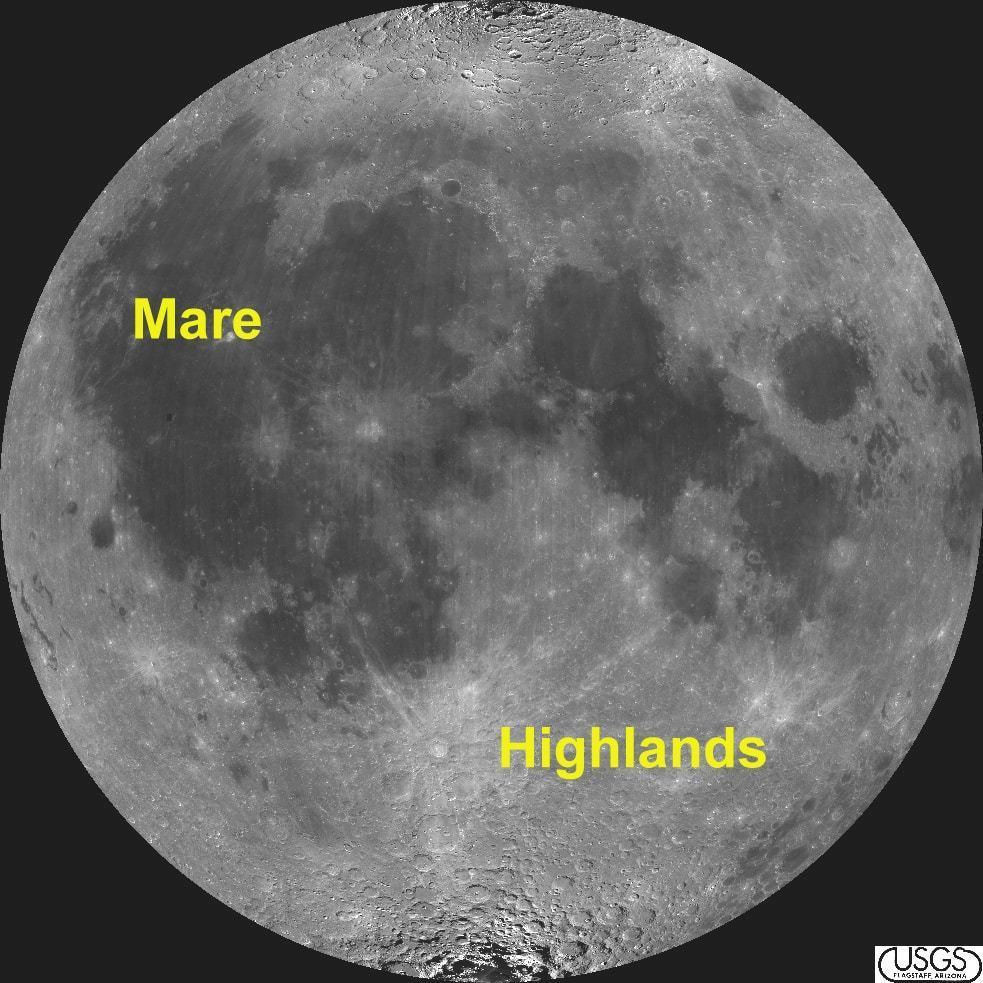
- Highlands
- Light (high albedo) mountainous areas.
- Mare
- Dark (low albedo) smooth plains composed of volcanic rock (likely basalt)
- Rilles: Found in the Maria, and are long, deep ancient lava channels which look like meandering valley-like structures.
- Dark (low albedo) smooth plains composed of volcanic rock (likely basalt)
- https://swh-826d.kxcdn.com/wp-content/uploads/2011/01/moonhires.jpg
- Tides
- Albedo
- Albedo = 0 means all light is absorbed
- Albedo = 1 means all light is reflected
- Property of objects that describes how much light they reflect.
- Earth's only natural satellite
- Surface
- No atmosphere and has extreme temperatures.
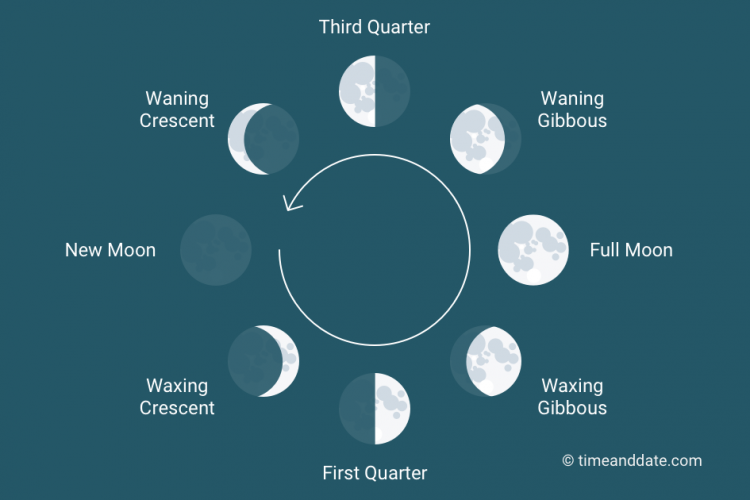
- Phases
- https://c.tadst.com/gfx/750x500/moon-phases-explained.png?1
- Formation
Interaction between Star, Planets, Satellites
- Major satellites of the gas giant planets found farther out than their rings because the gravitational pull of planets prevents particles very close to the planet from sticking together.
Relationship between our Solar System and the Milky Way
- Our solar system consists of the Sun, terrestrial planets, giant gas planets, as well as other interplanetary debris. In relation to the Milky Way, the sun is merely one of the many stars.
Benefits of Space Exploration
- Many technology with special features which have on Earth now have been created due to solve issues that astronauts would encounter in space.
- e.g. Scratch Resistant Lenses: Scratch resistant lenses were invented due the fact that there are dirt and particles in the space environment. NASA needed to create a special coating which would be able to block out such particles , particularly for the astronaut's helmet visors. Now, many glasses and other consumer products have incorporated scratch-resistant coating to their products.
- Many technology with special features which have on Earth now have been created due to solve issues that astronauts would encounter in space.
Effects of Space on Humans
- Protected Body
- Lack of Gravity: The inner ear would not be able to function properly. One would have no sense of "up" and "down", causing motion sickness.
- Body Fluids: Begin to distribute themselves equally , causing bloating. One's blood pressure would change, causing astronauts to pass out when they return to Earth.
- Bones and Muscles: Bones are no longer needed to support the body. Muscles weaken due to the lack of force against them (muscle atrophy)> One may lose 1.5% of bone tissue per month of being in microgravity.
- Skin: Without the atmosphere for protection of the body, the body is exposed to high amounts of solar radiation. This leads to high rates of tissue breakdown and it can lower immunity.
- Sense of Taste: One loses their sense of taste, which may be caused due to excess fluid build-up on the sinus cavities. However, iif you would like to taste something, that would only be possible with moisture (spit on tongue).
- Without a Space Suit
- Gas Excchange: Due to lack of pressure, gas exchange will still occur, but gases would be quickly used up (Oxygen gas).
- After 9-12 seconds, you would pass out.
- Blood and Bodily Fluids: Body fluids can boil due to the extreme loss of pressure. The body may expand to twice its size due to this effect.
- Also, due to the lack of gravity, body fluids distribute evenly.
- Solar Radiation: Intense solar radiation would cause a massive sunburn effect.
- Skin will burn in seconds.
- Body Temperature: Although it is cold in space, it would take some time before your body cooled. In some cases of prolonged exposure, frost can occur on one's limbs.
- Gas Excchange: Due to lack of pressure, gas exchange will still occur, but gases would be quickly used up (Oxygen gas).
- Protected Body
Asteroids, Meteors, Meteeoroid, Meteorite
- Meteor shower: Occurs when Earth intersects a cometary orbit, where the particles from the comet burn up upon entering Earth's upper atmosphere. This produces the bright spheres of light known as meteors.
- Meteoroid: Asteroid fragment/piece of interplanetary material when it enters the earth's atmosphere.
- Meteorite: Part of interplanetary material that survives to strike Earth's surface.
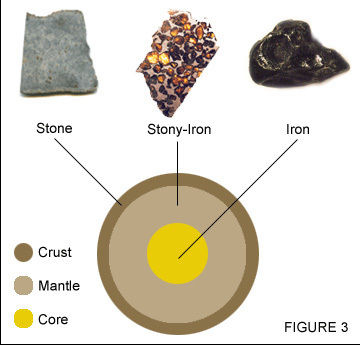
- Stony Meteorites: Mixtures of minerals (e.g. Feldspar, Pyroxene, Olivine) which looks similar to Earth rocks. Makes up 94% of all meteorites found.
- Iron Meteorites: Composed of Iron and Nickel. These meteorites often have fusion crusts and distinctive intergrown Iron-Nickel crystals. Makes up 5% of all meteorites found.
- Stony Iron Meteorites: Composed of Iron and Silicate materials. Makes up less than 1% of all meteorites found.
- https://lh4.ggpht.com/_YZF8hY__8ck/TPp0gSTc0PI/AAAAAAAAKHs/y4k2ABjN8pE/3%20types%20of%20meteorites%20and%20where%20they%20come%20from.jpg?imgmax=800
Solar Eclipse: Occurs when the Moon is between the Earth and Sun.
Lunar Eclipse: Occurs when the Earth casts a shadow on the Moon.
Comets
- Comet orbits, Periodic Comets
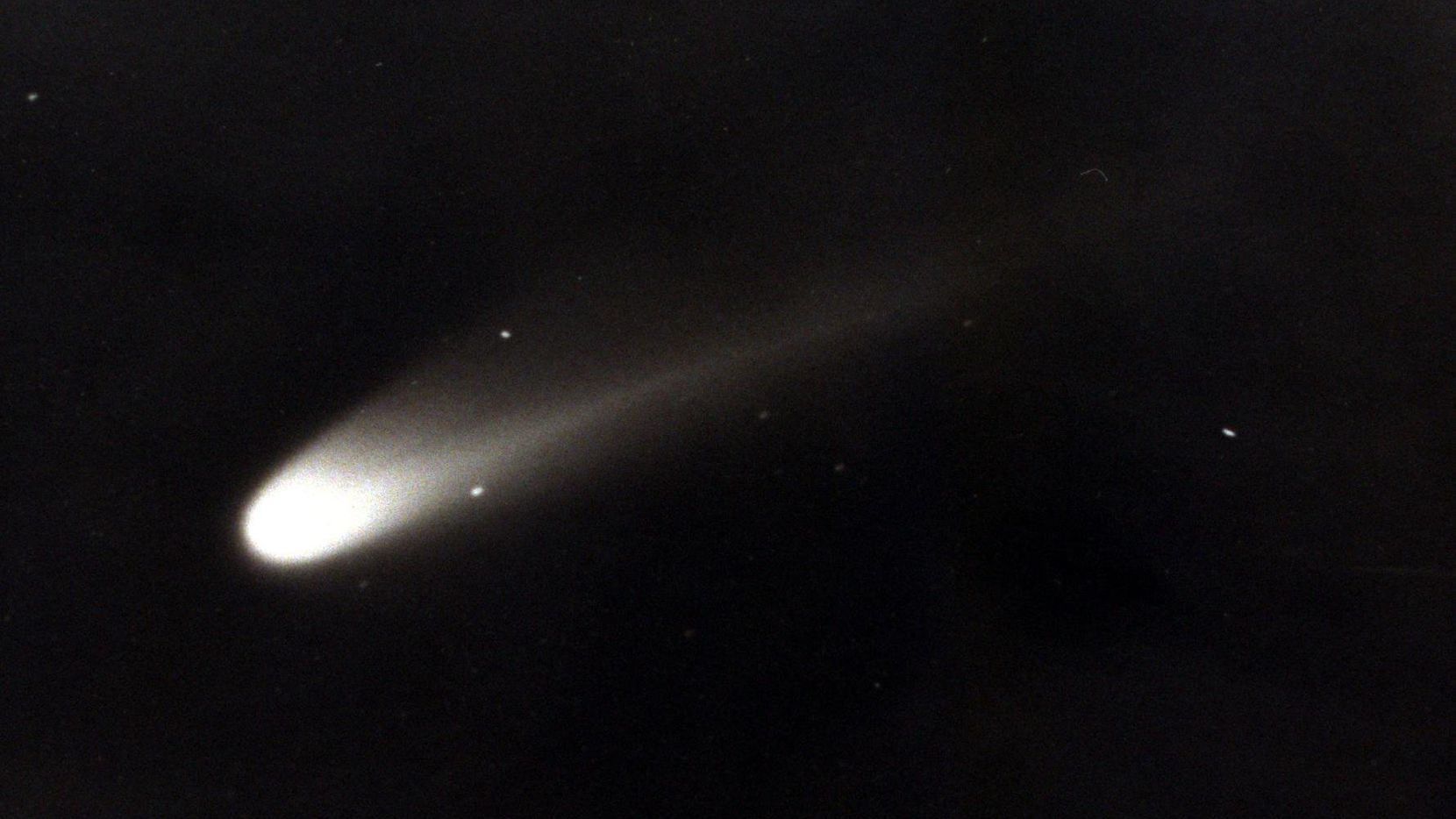
- Periodic Comet: Comet that repeatedly orbits into the inner solar system.
- e.g. Halley's Comet
- https://dmn-dallas-news-prod.cdn.arcpublishing.com/resizer//ciGCRHI5qu4Wy15nH3ydsP1HQ74=/1660x934/smart/filters:no_upscale()/arc-anglerfish-arc2-prod-dmn.s3.amazonaws.com/public/Z7SH6QAFGRD5ROPTGGWNIEF6HM.JPG
- Bright comet that has a period of 76 years.
- e.g. Halley's Comet
- Orbit: Have highly eccentric orbits around the Sun.
- Periodic Comet: Comet that repeatedly orbits into the inner solar system.
- Consists of nucleus of dust in ice, Carbon Dioxide, Methane, and Ammonia. Are visible when they pass close to the Sun.
- Located in 2 clusters/clouds (Kuiper Belt and Oort Cloud).
- Comet orbits, Periodic Comets
Imágenes y archivos del mapa
Información
- Descripción
- Mapa Mental sobre Planetary Science, creado por Samantha So el 23/10/2019.
- Creado por
- Samantha So
- Visitas
- 4
- Valoración