
The Solar System and Its Formation
939 resources created by 786 users
This Solar System and Its Formation page on GoConqr gathers community-made quizzes, mind maps, flashcards, notes and slides, from the nebular theory and the planets to moons, asteroids, comets and the Sun. It's built for school students revising a topic, primary pupils meeting the planets for the first time, and teachers after ready-made material. There are over 700 resources here, including more than 140 quizzes and over 300 mind maps, with a few aimed at university students. Pick a topic, try a quiz to find your gaps, then make your own revision sets.
Top The Solar System and Its Formation resources
-
10 questionsVenus Venus is sometimes referred to as the "evening star" or the "morning star".
-
14 questionsPlanetary Geology What is the correct order of the planets?
-
31 cardsScience Olympiad Solar system flash cards For study use
-
51 questionsAstronomy: The Solar System Units- 19, 21-25, 34-39, and 51-52 In the picture, what type of tides is Earth experiencing?
-
42 questionsASTR 101 ch8-9 Observations show that interstellar clouds can have almost any shape and, if they are rotating at all, thei...
-
10 cardsUNIT 6.4 STARS AND PLANETS List the planets of the solar system, in order moving away from the sun.
-
16 cardsSpace Science U2L2 Quiz Flash cards to use in preparation of the quiz on Space Science.
-
9 questionsThe Galilean Moons What famous astronomer is well-known for discovering four of Jupiter's largest moons?
Quizzes
See all 176 quizzes-
10 questionsVenus Venus is sometimes referred to as the "evening star" or the "morning star".
-
14 questionsPlanetary Geology What is the correct order of the planets?
-
51 questionsAstronomy: The Solar System Units- 19, 21-25, 34-39, and 51-52 In the picture, what type of tides is Earth experiencing?
-
42 questionsASTR 101 ch8-9 Observations show that interstellar clouds can have almost any shape and, if they are rotating at all, thei...
-
9 questionsThe Galilean Moons What famous astronomer is well-known for discovering four of Jupiter's largest moons?
-
9 questionsRocky vs Gas Giants Rocky planets are otherwise known as:
-
10 questionsThe Solar System First Grade The names of the planets in order are:
-
3 questionsScience Test Haileybury How long does it take the earth to revolve around the sun?
Mind maps
See all 435 mind maps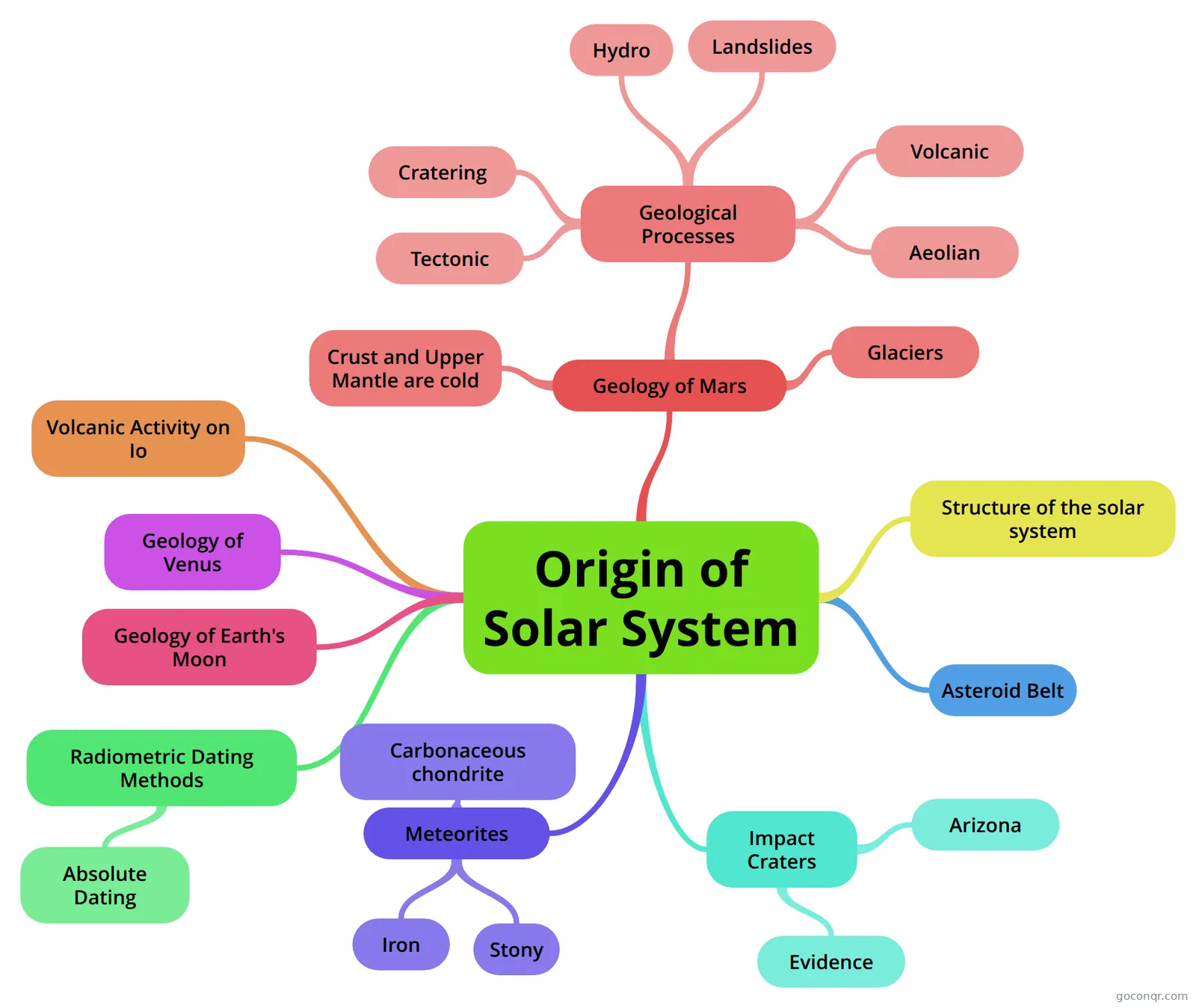
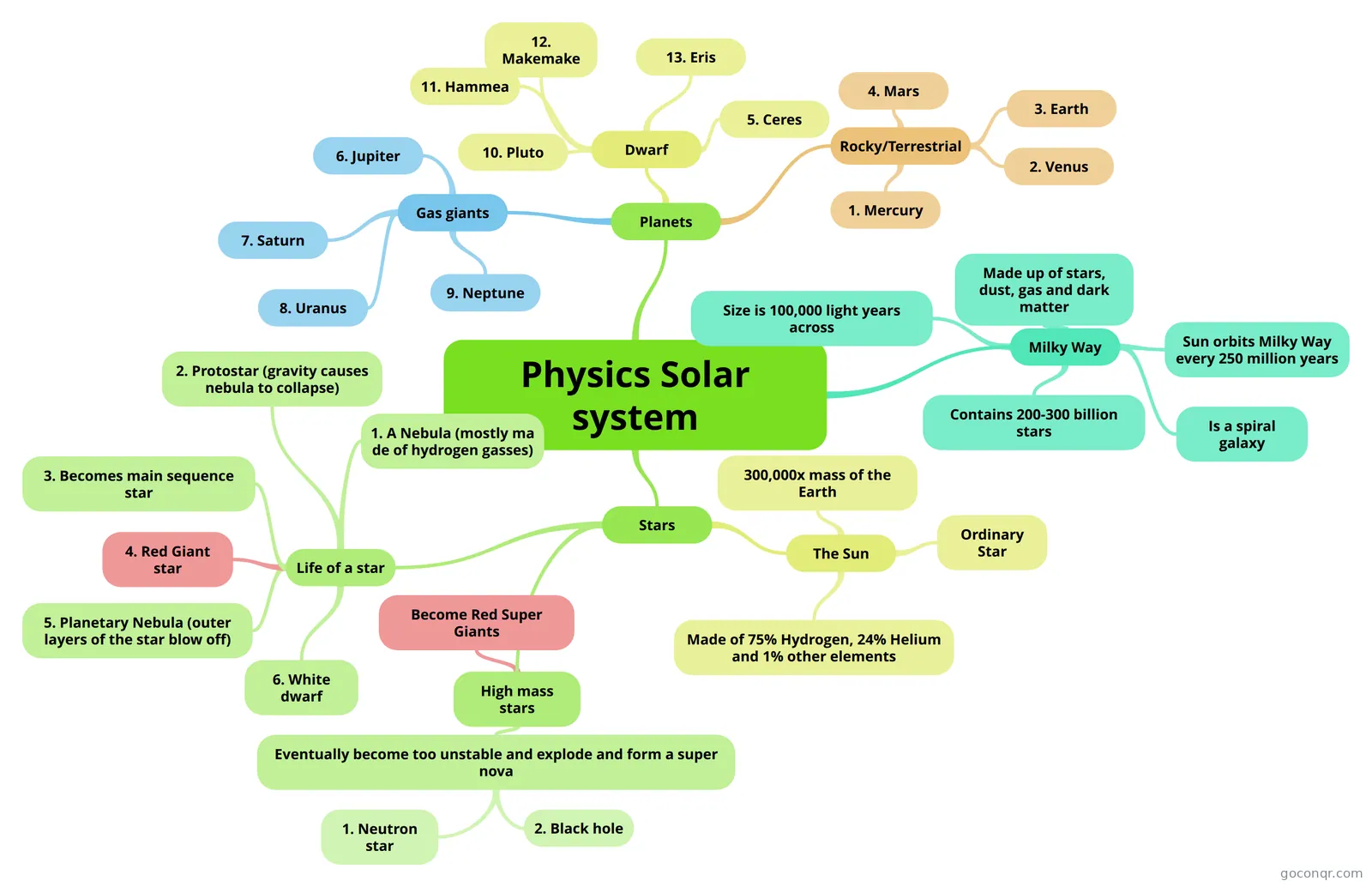
Flashcards
See all 264 flashcards-
31 cardsScience Olympiad Solar system flash cards For study use
-
10 cardsUNIT 6.4 STARS AND PLANETS List the planets of the solar system, in order moving away from the sun.
-
16 cardsSpace Science U2L2 Quiz Flash cards to use in preparation of the quiz on Space Science.
-
28 cardsSolar System Flashcards div b sciolying
-
27 cardsThe Solar System The Solar System includes the Sun,
-
34 cardsSS ID Solar system ID flashcards objects and telescopes and spacecraft
-
7 cardsPlanetary Symbols Each planet has a symbol. Here are a few cards to help you memorize them.
-
9 cardsSolar System- Planets The different planets that conforms solar system.
Flowcharts
See all 22 flowchartsNotes
See all 29 notes-
Untitled Imagine that you are not reading this textbook. Imagine instead that you are lying on your back in some soft grass on a warm summer night, far from city lights, staring into the vast, dark night sky. As you continue t...
-
Untitled Aryabhat Astronomy Quiz Study Material Part 1 The Sun The Sun Our Sun (called Sol by the Romans from which we get the word solar) is a main sequence G2 dwarf star. This means that it is fusing ...
-
Untitled Astronomy notes unit 2 Planets 1 Cassini division - a prominent gap between Saturn’s a and b rings Kuiper belt -A doughnut-shaped ring of space around the Sun beyond the orbit of Pluto that contains manna frozen...
-
The Sun-Earth-Moon System
-
Observing the Solar System Apparent Motion of Heavenly Bodies Apparent motions are motions that something appears to be making. They can be real or they can be imagined. For example, if you whiz pass trees on a bicycle or car, it appears ...
-
Meteorites and Impact Craters Most meteorites come from the Asteroid Belt, a few are thought to come from the Moon and perhaps Mars. Meteorites from the Moon are identified because they have a composition similar to the rock samples brought back f...
-
Astronomy The Solar System: Orbits of planets - elliptical (squashed circles) and Sun is close to centre Gravitational field strength - strength of gravity on planet or moon Planets don’t emit light - non-luminous Planets refle...
-
P.1 The Solar System P.1 The Solar System The Geocentric Model Created by Greek astronomer, Ptolemy Earth in the centre Planets move in small circles as they orbit the Earth Planets orbit Earth in circular fashion Accepted model until 1600s
Slides
See all 13 slidesTopics in The Solar System and Its Formation
More Astronomy topics
About The Solar System and Its Formation
GoConqr OriginalWhat the resources cover
The page opens with the planets and what sets them apart. The Rocky vs Gas Giants quiz asks where each type is found in the solar system. The Venus and Mercury quizzes look at single planets, while Jupiter and Saturn and Outer Solar System Quiz cover the outer worlds. The Galilean Moons quiz asks who discovered Jupiter's four largest moons and which is the biggest.
Formation and the wider system
Several mind maps deal with how it all began, including Nebular Theory, Formation of the Solar System and 5 Billion Yrs Ago. The quiz ASTR 101 ch8-9 picks up the nebular idea that a cloud will rotate as it collapses. Other maps look at the Asteroid Belt, Comets/Meteors, Trans-Neptunian Objects (TNOs) and The Sun. Notes such as How Planets are formed and Meteorites and Impact Craters add detail.
Where to start
- Younger pupils can begin with the Solar System slide set or the Planets of the Solar System flashcards.
- Move on to a mind map such as The Solar System in General to see how the parts connect.
- Test yourself with a planet quiz, then a broader paper such as Astronomy Study Guide.
- Finish with the Science Olympiad Solar system flash cards, which name bodies from Ceres and Triton to Arrokoth and exoplanets such as HD 209458b.
Using quizzes and maps together
Read a map first, then take the matching quiz. Note the questions you miss and go back to that branch of the map. Flashcard decks like Space Science U2L2 Quiz, which covers Kepler's three laws and gravity, suit short, repeated practice. Some resources mention GCSE Physics, for example OCR Gateway P2f, so older school students can find exam-style material too.
Where it fits
This unit sits in the Solar System strand of Astronomy. Everything here was made by GoConqr users, and it is free to open and study. Choose one resource, work through it, and see what you can build from it yourself.
Frequently asked questions
Which resource should I open first?
If the topic is new, try the Solar System slide set or the Planets of the Solar System flashcards for a plain overview. Then open a mind map such as The Solar System in General. Once the basics feel familiar, take the Rocky vs Gas Giants quiz to check what stuck.
What do the mind maps on this page cover?
They range from formation to individual bodies. Nebular Theory and Formation of the Solar System deal with origins. Others cover the Sun, the Asteroid Belt, Comets/Meteors, Trans-Neptunian Objects, Uranus & Neptune, the terrestrial planets and moons and rings. There are over 300 in total.
Are the resources free to use?
Yes. Every resource listed here is free to open, study and take, with no account needed. They were made by GoConqr users rather than by GoConqr itself. A free account also saves your quiz scores and lets you make your own quizzes, mind maps, flashcards and notes.
Which levels and exams do they suit?
Most resources are pitched at secondary school students, and a good share suit primary pupils. A few reach university level. Exam names that appear in the listed resources are GCSE Physics and Science Olympiad, such as the Science Olympiad Solar system flash cards.
Is there anything on Kepler's laws and gravity?
Yes. The flashcard deck Space Science U2L2 Quiz covers gravity, Kepler's first, second and third laws, and asks what keeps a planet in orbit around the Sun. It also asks about the law of universal gravitation, so it works well after a planets quiz.
What if the topic I need is missing?
Look through the related mind maps, notes and flashcard decks first, as the same idea often appears under a different title. If it still isn't there, you can build your own quiz, map or flashcards on the subject with a free account.