
2107625


Engineering Management - Complex
Decision Problems
- Decision Theory
- Fundamentals
Nota:
- • Problem Owner, Decision-maker • Decision task = problem • Tools • Decision logic
- Paradoxes
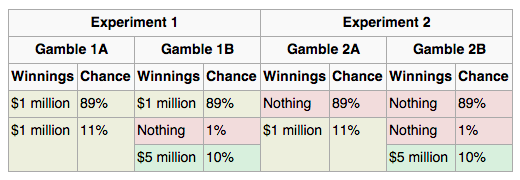
- Allais
Nota:
- The Allais paradox is a choice problem designed by Maurice Allais (1953) to show an inconsistency of actual observed choices with the predictions of expected utility theory.
- St. Petersburg
Nota:
- O problema é o seguinte: suponhamos que Pedro e Paulo concordam em jogar um jogo de cara ou coroa. Se o primeiro lance der cara, Paulo dará duas moeda a Pedro; se o primeiro lance der coroa e o segundo der cara, Paulo dará a Pedro quatro moedas. Se cara só aparece no terceiro lance, Pedro receberá oito moedas. Em resumo, se só aparecer cara no n-ésimo lance, Pedro receberá 2 elevado a n moedas. Então, quanto deve Pedro pagar a Paulo pelo privilégio de jogar tal jogo? O senso comum sugere uma soma finita muito modesta, mas a inacreditável resposta para esta pergunta é que Pedro pode pagar a Paulo qualquer quantia, digamos um milhão de moedas, por cada jogo e ainda esperar sair como vencedor. Em qualquer jogo simples, a probabilidade de Pedro ganhar duas moeda é 1/2, de ganhar 4 moedas é 1/4, de ganhar 8 moedas é 1/8 e assim por diante. Então, o total que Pedro pode esperar ganhar é dado pela série que tem soma infinita. Ou seja, não importa qual quantia (finita) Pedro pague a Paulo por cada jogo, ele sempre ganhará se for realizado um número suficiente de jogos. Para tanto estamos assumindo que o capital de Paulo e o número de jogos que os dois podem jogar são ilimitados. Quando Georges-Louis Leclerc, conde de Buffon fez um teste empírico do caso, achou que em 2084 jogos Paulo teria pago a Pedro 10057 moedas. Isso indica que em qualquer jogo a esperança de Paulo, em vez de ser infinita, na verdade é algo inferior a 5 moedas, já que 5 x 2084 = 10420.
- Allais
- Decision problems in many respects
Nota:
- "Solving" can be interpreted in different ways. It could correspond to choosing the "best" alternative from a set of available alternatives (where "best" can be interpreted as "the most preferred alternative" of a decision maker). Another interpretation of "solving" could be choosing a small set of good alternatives, or grouping alternatives into different preference sets. An extreme interpretation could be to find all "efficient" or "nondominated" alternatives (which we will define shortly). The difficulty of the problem originates from the presence of more than one criterion. There is no longer a unique optimal solution to an MCDM problem that can be obtained without incorporating preference information. The concept of an optimal solution is often replaced by the set of nondominated solutions. A nondominated solution has the property that it is not possible to move away from it to any other solution without sacrificing in at least one criterion. Therefore, it makes sense for the decision maker to choose a solution from the nondominated set. Otherwise, he could do better in terms of some or all of the criteria, and not do worse in any of them. Generally, however, the set of nondominated solutions is too large to be presented to the decision maker for his final choice. Hence we need tools that help the decision maker focus on his preferred solutions (or alternatives). Normally one has to "tradeoff" certain criteria for others.
- Multi-criteria Decision Analysis (MCDA)
Nota:
- MCDA or MCDM is concerned with structuring and solving decision and planning problems involving multiple criteria. The purpose is to support decision makers facing such problems. Typically, there does not exist a unique optimal solution for such problems and it is necessary to use decision maker’s preferences to differentiate between solutions.
- Multi-criteria Decision Making (MCDM)
Nota:
- MCDA or MCDM is concerned with structuring and solving decision and planning problems involving multiple criteria. The purpose is to support decision makers facing such problems. Typically, there does not exist a unique optimal solution for such problems and it is necessary to use decision maker’s preferences to differentiate between solutions.
- Fundamentals
- Simple decision tools
Nota:
- Decision table Decision tree
- Software group tools for decision problems
Nota:
- MSS - Management Support System ES - Expert System pl. MYCIN, DENDRAL DSS/GDSS - (Group) Decision Support System EIS - Executive Information System ESS - Executive Support System Others: e.g. Artificial Intelligence, simulation
- Decision logics
- Allocation
Nota:
- in fix time – race condition – limited resource – OUTPUT: distribution
- Credit
Nota:
- – unlimited time – unlimited piece – requirements – no race condition– OUTPUT: yes / no
- Selection
Nota:
- - in fix time – race condition – viewpoint/respect system – choosing 1 from more alternatives – OUTPUT: winner
- Allocation
- Circumstances of Decisions
- Decision Rules
Nota:
- All rules of the circumstances
- Influencing factors
- Decision Rules
- Decision types
- Under certainty
- With risks
- Under uncertainty
- Under certainty
- Multi-criteria Decision Models
- Analytic Hierarchy Process (AHP)
Nota:
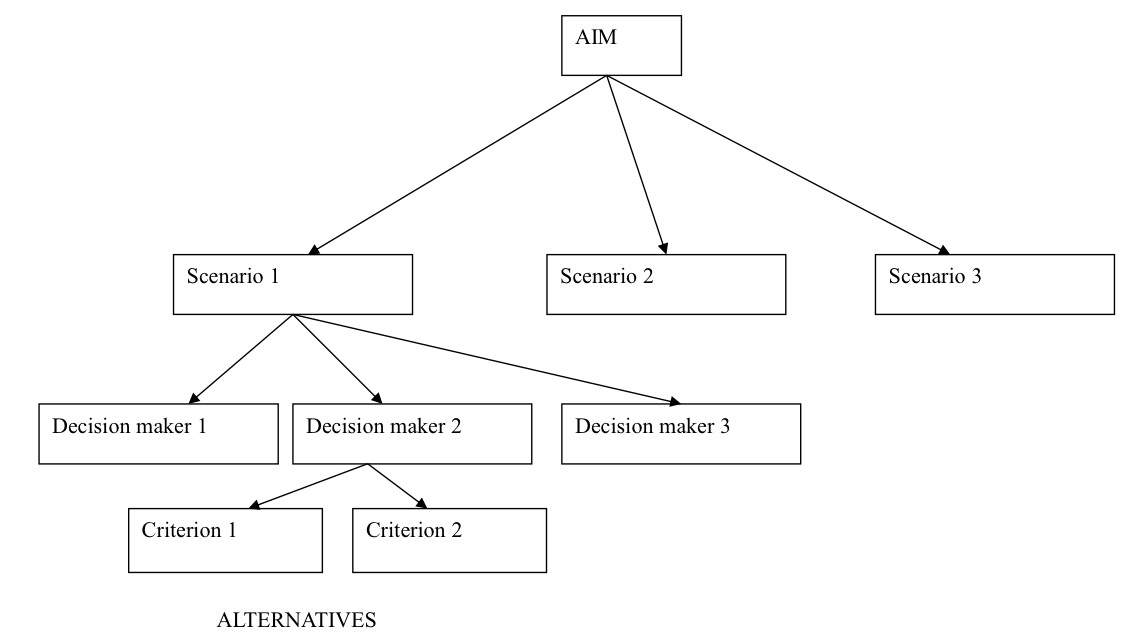
- • Method is based on decomposition and synthesis. • Pair-wise comparison • Quantitative and qualitative variables. • E.g.: Expert Choice software. The procedure for using the AHP can be summarized as: Model the problem as a hierarchy containing the decision goal, the alternatives for reaching it, and the criteria for evaluating the alternatives. Establish priorities among the elements of the hierarchy by making a series of judgments based on pairwise comparisons of the elements. For example, when comparing potential purchases of commercial real estate, the investors might say they prefer location over price and price over timing. Synthesize these judgments to yield a set of overall priorities for the hierarchy. This would combine the investors' judgments about location, price and timing for properties A, B, C, and D into overall priorities for each property. Check the consistency of the judgments.Come to a final decision based on the results of this process
- Criteria: C1,...,Cm Weight: w1,...,wm Pair-wise comparison of criteria: how much times more important criteria Ci than criteria Cj: rij = wi / wj rij values: R matrix. In ideal case: – R*w= m*w – where w = [w1,...,wm] Property of matrix R:– rji = 1 / rij and – rij*rjk = (wi/wj) * (wj/ wk) = wi/wk In case of rij comparisons derived from decision makers: wi’ are the estimated values of wi values. – R’*w’ = w*w’ Solution of eigen value problem (linear algebra) Rank of R is 1, rii=1, consistency can be verified by the difference between m and maximal eigenvalue
- Analytic Network Process (ANP)
Nota:
- The analytic network process (ANP) is a more general form of the analytic hierarchy process (AHP) used in multi-criteria decision analysis. AHP structures a decision problem into a hierarchy with a goal, decision criteria, and alternatives, while the ANP structures it as a network. Both then use a system of pairwise comparisons to measure the weights of the components of the structure, and finally to rank the alternatives in the decision. In the AHP, each element in the hierarchy is considered to be independent of all the others—the decision criteria are considered to be independent of one another, and the alternatives are considered to be independent of the decision criteria and of each other. But in many real-world cases, there is interdependence among the items and the alternatives. ANP does not require independence among elements, so it can be used as an effective tool in these cases.
- ELECTRE (Outranking)
Nota:
- ELECTRE is a family of multi-criteria decision analysis methods that originated in Europe in the mid-1960s. The acronym ELECTRE stands for: ELimination Et Choix Traduisant la REalité (ELimination and Choice Expressing REality). Usually the Electre Methods are used to discard some alternatives to the problem, which are unacceptable. After that we can use another MCDA to select the best one. The Advantage of using the Electre Methods before is that we can apply another MCDA with a restricted set of alternatives saving much time.
- Multi-Attribute Utility Theory (MAUT)
Nota:
- Base on utility functions Decision Procedure: Gathering the alternatives, declaration of viewpoints. Definition of utility functions.Determination of weights of each viewpoint. Valuation of all alternatives in each viewpoint. Summarization of weighted values. Analysis after the assessment, and proposal.
- Group decision support methods
- Brain storm
Nota:
- O brainstorming (literalmente: "tempestade cerebral" em inglês) ou tempestade de ideias, mais que uma técnica de dinâmica de grupo, é uma atividade desenvolvida para explorar a potencialidade criativa de um indivíduo ou de um grupo - criatividade em equipe - colocando-a a serviço de objetivos pré-determinados.
- Delphi Methods
Nota:
- O Método Delphi é baseado no princípio que as previsões por um grupo estruturado de especialistas são mais precisas se comparadas às provenientes de grupos não estruturados ou individuais. Parecida com o brainstorming, a técnica Delphi difere desta somente porque os participantes não se conhecem, mas são especialistas no assunto , e cooperam com idéias, sugestões ou opiniões, o que possibilita a solução dos problemas e a criação de novas estratégias, produtos ou serviços.
- Nominal Group Technique (NGT)
Nota:
- http://en.wikipedia.org/wiki/Nominal_group_technique
- Other Creative Problem Solving Processes
- Synectics
Nota:
- Synectics is a problem solving methodology that stimulates thought processes of which the subject may be unaware. http://en.wikipedia.org/wiki/Synectics
- Decision conference
- Brain storm
- Analytic Hierarchy Process (AHP)
Recursos multimedia adjuntos
¿Quieres crear tus propios Mapas Mentales gratis con GoConqr? Más información.