
Mapa mental
giant covalent structures
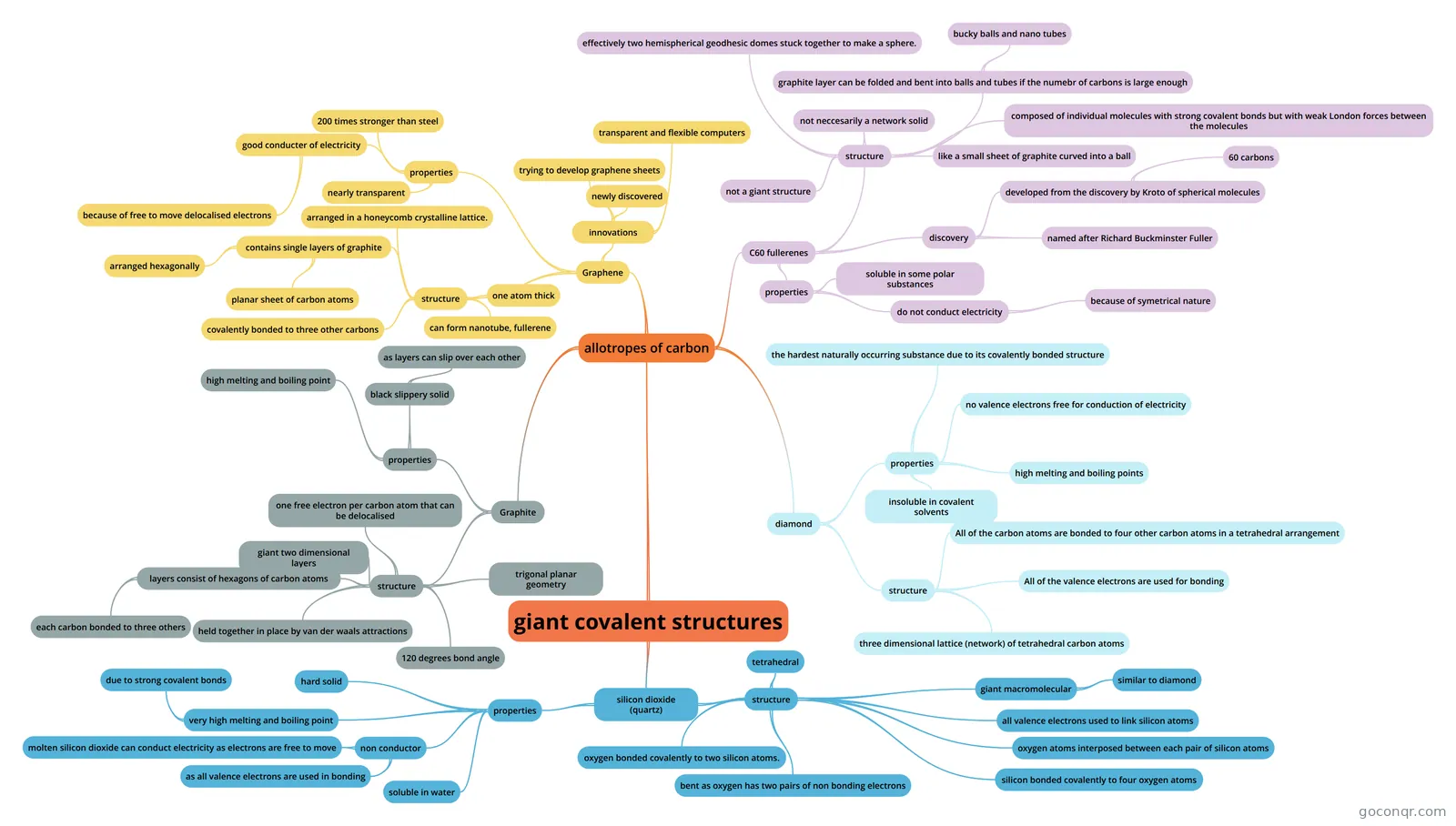
Mind map: giant covalent structures
Contenido del mapa
giant covalent structures
allotropes of carbon
- diamond
- structure
- three dimensional lattice (network) of tetrahedral carbon atoms
- All of the carbon atoms are bonded to four other carbon atoms in a tetrahedral arrangement
- All of the valence electrons are used for bonding
- properties
- no valence electrons free for conduction of electricity
- high melting and boiling points
- the hardest naturally occurring substance due to its covalently bonded structure
- insoluble in covalent solvents
- structure
- Graphite
- structure
- giant two dimensional layers
- held together in place by van der waals attractions
- layers consist of hexagons of carbon atoms
- each carbon bonded to three others
- one free electron per carbon atom that can be delocalised
- trigonal planar geometry
- 120 degrees bond angle
- properties
- black slippery solid
- as layers can slip over each other
- high melting and boiling point
- black slippery solid
- structure
- Graphene
- innovations
- newly discovered
- trying to develop graphene sheets
- transparent and flexible computers
- structure
- contains single layers of graphite
- arranged hexagonally
- planar sheet of carbon atoms
- one atom thick
- arranged in a honeycomb crystalline lattice.
- covalently bonded to three other carbons
- can form nanotube, fullerene
- contains single layers of graphite
- properties
- good conducter of electricity
- because of free to move delocalised electrons
- nearly transparent
- 200 times stronger than steel
- good conducter of electricity
- innovations
- C60 fullerenes
- structure
- graphite layer can be folded and bent into balls and tubes if the numebr of carbons is large enough
- bucky balls and nano tubes
- effectively two hemispherical geodhesic domes stuck together to make a sphere.
- not neccesarily a network solid
- composed of individual molecules with strong covalent bonds but with weak London forces between the molecules
- like a small sheet of graphite curved into a ball
- not a giant structure
- graphite layer can be folded and bent into balls and tubes if the numebr of carbons is large enough
- discovery
- developed from the discovery by Kroto of spherical molecules
- 60 carbons
- named after Richard Buckminster Fuller
- developed from the discovery by Kroto of spherical molecules
- properties
- soluble in some polar substances
- do not conduct electricity
- because of symetrical nature
- structure
- diamond
silicon dioxide (quartz)
- structure
- giant macromolecular
- similar to diamond
- all valence electrons used to link silicon atoms
- tetrahedral
- oxygen atoms interposed between each pair of silicon atoms
- silicon bonded covalently to four oxygen atoms
- oxygen bonded covalently to two silicon atoms.
- bent as oxygen has two pairs of non bonding electrons
- giant macromolecular
- properties
- hard solid
- very high melting and boiling point
- due to strong covalent bonds
- non conductor
- as all valence electrons are used in bonding
- molten silicon dioxide can conduct electricity as electrons are free to move
- soluble in water
- structure
Información
- Descripción
- giant covalent structures for giant males
- Creado por
- Jack Mcilduff
- Visitas
- 9
- Valoración