
Mapa mental
High - Low Level Languages
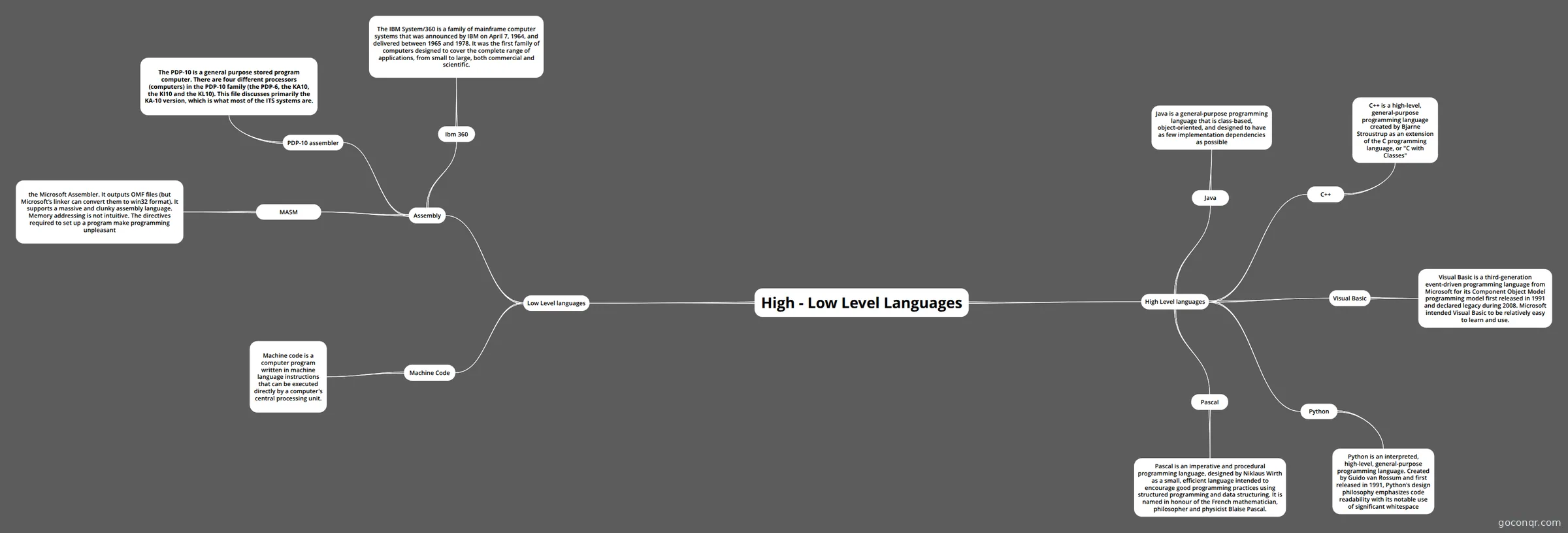
Mind map: High and low level languages
Contenido del mapa
High - Low Level Languages
High Level languages
- Java
- Java is a general-purpose programming language that is class-based, object-oriented, and designed to have as few implementation dependencies as possible
- C++
- C++ is a high-level, general-purpose programming language created by Bjarne Stroustrup as an extension of the C programming language, or "C with Classes"
- Visual Basic
- Visual Basic is a third-generation event-driven programming language from Microsoft for its Component Object Model programming model first released in 1991 and declared legacy during 2008. Microsoft intended Visual Basic to be relatively easy to learn and use.
- Python
- Python is an interpreted, high-level, general-purpose programming language. Created by Guido van Rossum and first released in 1991, Python's design philosophy emphasizes code readability with its notable use of significant whitespace
- Pascal
- Pascal is an imperative and procedural programming language, designed by Niklaus Wirth as a small, efficient language intended to encourage good programming practices using structured programming and data structuring. It is named in honour of the French mathematician, philosopher and physicist Blaise Pascal.
- Java
Low Level languages
- Assembly
- Ibm 360
- The IBM System/360 is a family of mainframe computer systems that was announced by IBM on April 7, 1964, and delivered between 1965 and 1978. It was the first family of computers designed to cover the complete range of applications, from small to large, both commercial and scientific.
- PDP-10 assembler
- The PDP-10 is a general purpose stored program computer. There are four different processors (computers) in the PDP-10 family (the PDP-6, the KA10, the KI10 and the KL10). This file discusses primarily the KA-10 version, which is what most of the ITS systems are.
- MASM
- the Microsoft Assembler. It outputs OMF files (but Microsoft’s linker can convert them to win32 format). It supports a massive and clunky assembly language. Memory addressing is not intuitive. The directives required to set up a program make programming unpleasant
- Ibm 360
- Machine Code
- Machine code is a computer program written in machine language instructions that can be executed directly by a computer's central processing unit.
- Assembly