
Programming Languages, Paradigms and Translators
777 resources created by 615 users
This Programming Languages, Paradigms and Translators page on GoConqr gathers community-made quizzes, mind maps, flashcards, slides and notes, from high and low level languages and compiler stages to Haskell, grammars and computability. It's built for school students, university students and professional candidates revising or filling gaps, and for teachers after ready-made material. There are over 700 resources here, including more than 40 quizzes, over 500 mind maps and 150 flashcards. Pick a topic and try a quiz to spot your gaps.
Select topic
- History of Programming Languages11
- Programming Language Types and Generations106
- Comparing and Choosing Programming Languages13
- Programming Paradigms23
- Variables, Functions and Scope9
- Functional Programming and Haskell38
- Haskell Modules and Libraries48
- Data Types and Typeclasses43
- Compilers, Interpreters and Assemblers81
- Stages of Compilation33
- Integrated Development Environments90
- Formal Languages and Grammars8
- Automata and Computability25
Top Programming Languages, Paradigms and Translators resources
-
22 cardsGenerations of Programming Languages Name the first generation
-
Mind map Formal Languages
-
2 questionsDynamic vs. Static Scoping Using codes to understand the functions of local and static variables and dynamic and static scoping
-
18 cardsFunctional Programming Keywords Functional Programming Paradigm
-
4 questionsBNF Quiz Define a grammar for the empty language, which is a language containing no strings. (There is no valid sent...
-
Mind map Unit 2.5 - Translators and Facilities of Programs My Unit 2.5 OCR Computing Mind Map...
-
 Mind map 2.5 Translators and facilities of languages
-
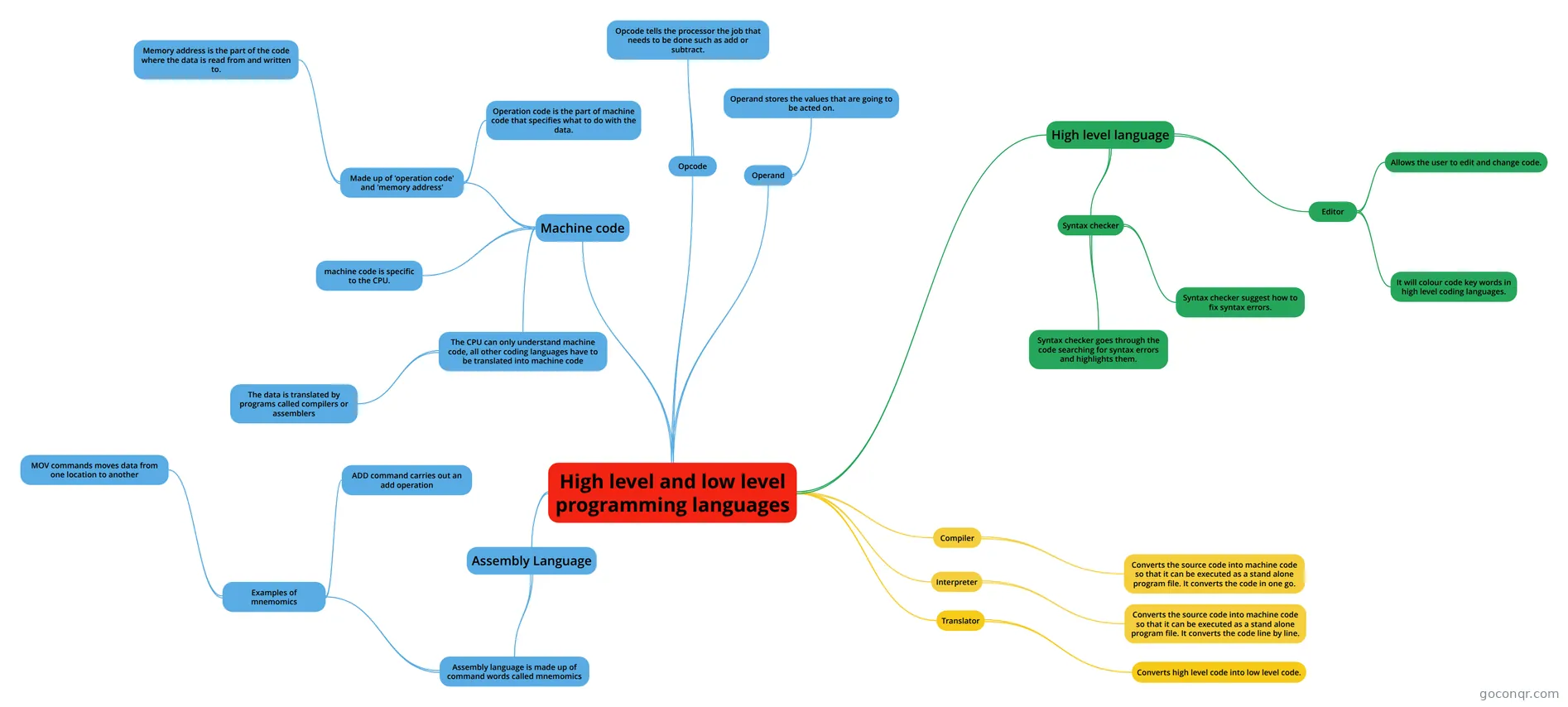 Mind map High level and low level programming languages
Quizzes
See all 47 quizzes-
2 questionsDynamic vs. Static Scoping Using codes to understand the functions of local and static variables and dynamic and static scoping
-
4 questionsBNF Quiz Define a grammar for the empty language, which is a language containing no strings. (There is no valid sent...
-
127 questionsBekomp Submission 1: Do you feel good about Submission 1?
-
111 questionsCS 4337 EXAM 3
-
151 questionsCS4337 Exam 1
-
123 questionsprogramming languages midterm What is a programming language? a notational system for describing computation in human-readable and machin...
-
67 questionsCS 3360 Programming Languages Quiz Questions The Study of programming languages is valuable for a number of important reasons, Including:
-
40 questionspaper final
Mind maps
See all 542 mind mapsFlashcards
See all 152 flashcards-
22 cardsGenerations of Programming Languages Name the first generation
-
18 cardsFunctional Programming Keywords Functional Programming Paradigm
-
22 cardsStages Of Compilation what is meant by a lexicon?
-
117 cardsOOP Langs Test 2 part b
-
133 cards449 midterm
-
94 cardsOrganization of Programming Langs Chapter 12 What are the 3 major language features of OOP Languages?
-
80 cardsSCC 312 - Languages and Compilation what is sentential form in phase grammars?
-
71 cardsOrganization of Programming Languages Chapter 1 Reasons for studying concepts of programming Languages
Flowcharts
Notes
See all 19 notes-
Functional Programming For each of the three Vs: give a system used to work with it. Volume: Distributed Systems Graph Schemas Velocity: Functional Programming Variety: Machine learning Fact-based Models Explain what a higher-or...
-
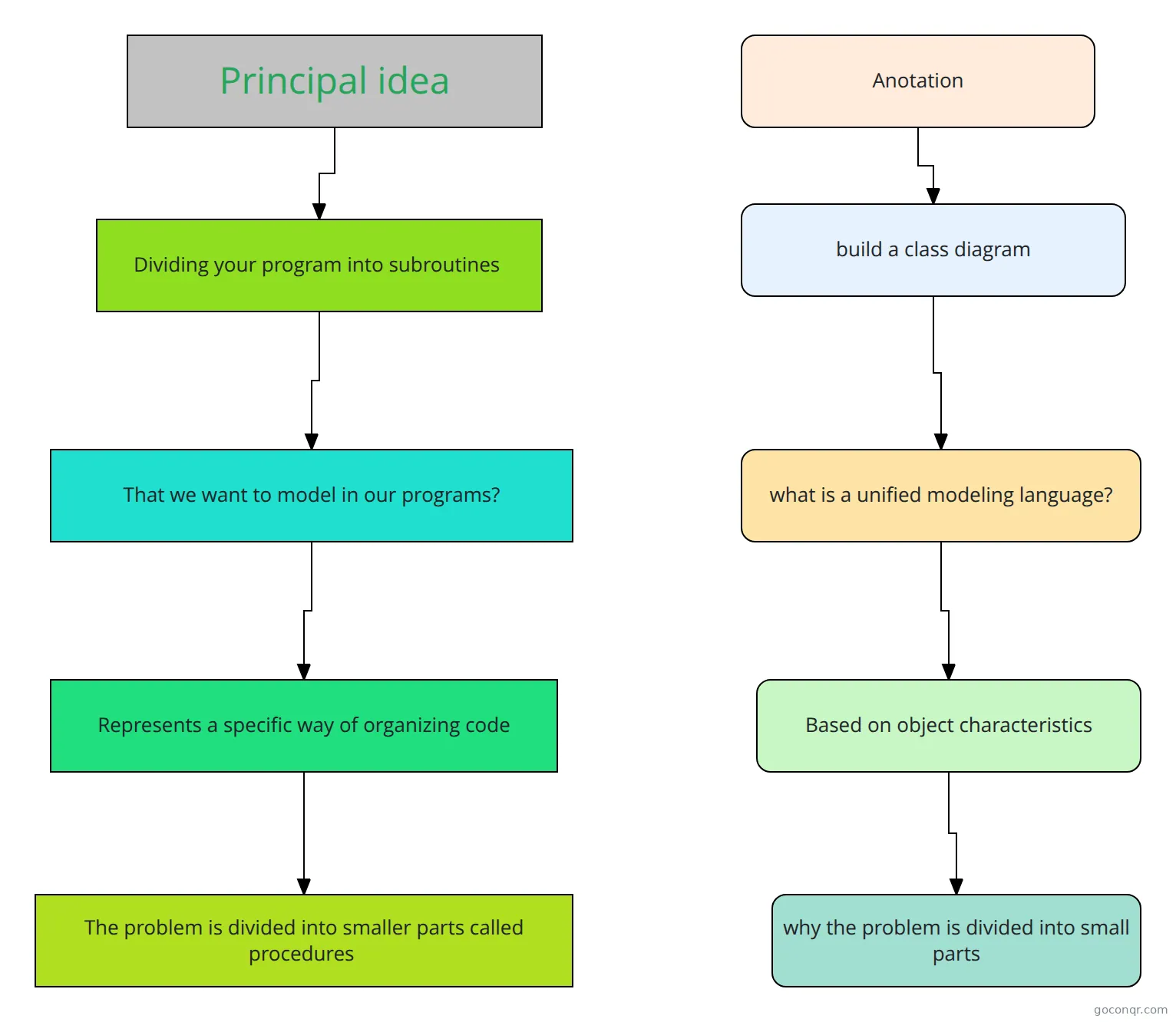
Untitled Procedural programming and Object-Oriented Programming (OOP) are two different approaches to writing computer programs. Procedural programming is a programming paradigm that is based on a step-by-step procedure or rec...
-
Untitled
-
Regular Expressions Language informal language English or French formal language - a series of words whose letters are taken from an alphabet, and are formed according to a set of rules regular language regular language&n...
-
turing machine A Turing Machine is not a real machine. It is an abstract, theoretical concept that represents a computer in its simplest form. A Turing machine consists of: A finite set of states A finite alphabet of symbols (a,b,c,...
-
Language of Computer Programming language A programming language is a formal constructed language designed to communicateinstructions to a machine, particularly a computer. Programming languages can be used to create programs to control t...
-
Turning Machines Turning machines 1. Turning decidable machines- They are the ones who either accepts and halt or reject and halt. Here halting is essential. 2. Turning Recognizable machines- They are the ones who either accepts and h...
-
OOPS Procedural Oriented ProgrammingObject-Oriented Programming In procedural programming, the program is divided into small parts called functions.In object-oriented programming, the program is divided into small par...
Slides
Topics in Programming Languages, Paradigms and Translators
More Computing and ICT (programming, computer science, digital skills, educational technology) topics
About Programming Languages, Paradigms and Translators
GoConqr OriginalWhat the resources cover
The page spans three broad areas. The first is the language itself: Generations of Programming Languages flashcards, the mind map on high level and low level programming languages, and slides titled Programming Languages. The second is translators: compilers, interpreters, stages of compilation, semantic analysis and code generation. The third is theory and paradigms: grammars, automata, regular expressions, functional programming and Haskell.
Where to start
If the topic is new, begin with the mind map 2.5 Translators and facilities of languages. It covers different programming languages, translators and integrated development environments. Then move to the flashcards on Stages Of Compilation to see how source code becomes something a machine can run.
Once those feel comfortable, look at paradigms. Functional Programming Keywords covers ideas such as higher order functions, function composition and first-class objects. The Haskell mind maps and the Standard Prelude Definitions flashcards show those ideas in code.
Going further with theory
University students will find the Formal Languages mind map, which runs from phrase structure grammars and regular languages to finite state acceptors and the pumping lemma. The BNF Quiz asks you to define a grammar for the empty language. The Dynamic vs. Static Scoping quiz uses Perl code to test which value a variable takes at each point.
Using quizzes and maps together
- Read a mind map to get the shape of a topic.
- Take a quiz on the same topic and note what you missed.
- Return to the map or a flashcard deck for those gaps.
- Retry the quiz later.
Resources mention GCSE Computer Science, A-level Computer Science and A-level Computing, so school students can find material aimed at those courses.
Where this fits
This unit sits in the Programming strand of Computing and ICT. Choose one mind map and one quiz today, then add your own flashcards for the terms that keep slipping.
Frequently asked questions
Which resource should I open first?
Start with the mind map 2.5 Translators and facilities of languages. It introduces programming languages, translators and IDEs in one place. After that, try the Generations of Programming Languages flashcards or the quiz of the same name to check what has stuck.
What do the mind maps cover?
There are over 500 mind maps. They cover high and low level languages, generations of languages, translators and compiler phases, functional programming and Haskell, and theory such as formal languages, computability and the pumping lemma.
Are the resources free to use?
Yes. Every resource listed here is free to open, study and take, with no account needed. They were made by GoConqr users, not by GoConqr itself. A free account also saves your quiz scores and lets you make your own quizzes, mind maps, flashcards and notes.
Which levels and exams do these suit?
The mix is roughly half school and half university material. Resources mention GCSE Computer Science, A-level Computer Science and A-level Computing. University students can use the grammar, automata and scoping resources, and professional candidates can use them to fill gaps.
Is there anything on Haskell and functional programming?
Yes. Look at the Haskell mind map, Types and Typeclasses - Haskell, the Standard Prelude Definitions flashcards, the Functional Programming Keywords flashcards and the Functional Programming PT1 quiz. Together they move from vocabulary to writing functions.
What if I cannot find the topic I need?
Try a nearby term, such as compiler, translator, paradigm or grammar, since resources are named differently by different authors. If nothing fits, you can make your own mind map or flashcards, and teachers can build a short quiz for their class.