
Mapa mental
Monopolies
Contenido del mapa
Monopolies
Revenue of a monopoly
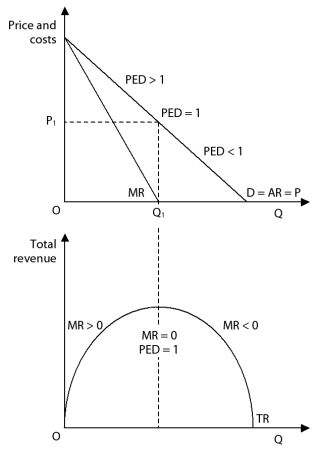
- The D curve is the AR curve in monopolies
- When MR < AR , the average falls, since the monopolist AR falls as output and sales rise MR must be below AR
- MR and AR share the same intercept point on the y-axis
- MR curve is twice a steep as AR=D
- MR is zero on the x-axis, this is the max point on the total revenue
- Where MR is +ve and total revenue is increasing , demand is price elastic
- Where MR is -ve and total revenue decreasing , demand is price inelastic
- When Total revenue is maximised and MR=0 , the elasticity of demand is unitary
A form of market structure in which there is only one seller of a good or service
- Ways monopolies can be developed
- Horizontal Integration
- Vertical Integration
- Statutory monopoly
- Licenses
- Internal Expansion
- Natural Monopoly - occurs in an industry where LRAC fall over a wide range of output levels
- Ways monopolies can be developed
Main Assumptions
- Only one firm
- High Barriers to entry
- No substitutes
- SR Profit Maximiser
Profit Maximisation
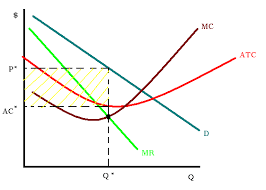
- Achieving the highest possible profit where MC = MR
- Has a downward sloping AR curve
- Price Maker
- MR curve must be below the AR curve
- Equilibrium set at profit max point (MC=MR)
- Price is set at P (where profit max point is cared up to meet the AR Curve)
- A firms profit will continue to rise when MR > MC
- Total Revenue is defined by OPQ on diagram
- Total cost is the area OACQ
- Abnormal Profits = TR-TC
- Abnormal profit can be made in BOTH the SR and LR due to barriers of entry
Price Discrimnation
- What is Price Discrimination?
- Occurs when firm charge different price to different consumers for the same good
- Motive - Reduce consumer welfare and increase profits
- Can't charge higher prices if there is a substitute
- Can't occur in perfect comp markets
- Conditions required for price discrimination
- Different price elasticity of demand
- Higher prices to groups with more price inelastic demand
- Lower prices to groups with more price elastic demand
- Must prevent market seepage - consumers who purchased at lower price reselling it to consumers who would pay higher
- The costs of selling to different sub-groups MUST not be prohibitive
- Monopoly or Monoploy power
- Different price elasticity of demand
- First Degree
- Examples - on-line auctions, car boot sales
- This is where the monopolist charges each customer the MAXIMUM price they're willing to pay
- This extracts all of the consumer surplus
- Second Degree
- Examples - Hotels
- When a firm sells off any excess capacity that it has at a price that is lower than the normal published price
- Third Degree
- Examples - Cinemas/theatres , rail/bus travel
- The most frequently used method
- Involves charging different price for the same products to different groups of consumers who are separated into different parts of the same market known as segments
- Separated by Time, Geography or demographic factors
- Charging different price due to elasticity of demand
- Able to earn more revenue hence more profit
- What is Price Discrimination?
+ves and -ves to monopolies
- Positives
- Dynamic efficiency
- Research & Development
- Reinvestment
- Stops wasteful duplicate
- Natural monopoly
- Competitive advantage internationally
- Dynamic efficiency
- Negatives
- Higher prices
- lowers consumer surplus/welfare
- Reduce output
- Inefficient
- Allocatively
- Productively
- X-efficiency
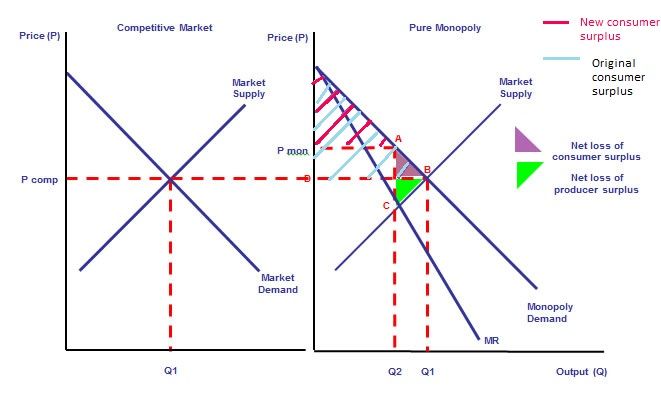
- Deadweight loss
- Limited Choice
- Dynamic efficiency
- No incentive for R&D due to lack of competition
- Higher prices
- Positives
Monopoly Features
- Higher prices and lower output
- Abnormal profit in the SR and LR due to barriers of entry
- A fall in consumer welfare as consumer surplus is decreased causing deadweight welfare loss
- Limited choice for consumers
- Low levels of economic efficiency with productive and allocative efficiency not being achieve
- Enjoy Producer sovereignty rather than consumer sovereignty
- Producer sovereignty - when firms have the power and ability to influence consumer decisions
- Consumer sovereignty- the ability and freedom to choose from a range of products
- X efficiency
- Managerial slack that results from the absence of competitive pressures
- Price Discrimination
- Allows cross-subsidies
- A decision to fund a loss from one product by raising the price of another
- Allows cross-subsidies
Imágenes y archivos del mapa
Información
- Descripción
- Mapa Mental sobre Monopolies , creado por NatalieJayne16 el 16/03/2015.
- Creado por
- NatalieJayne16
- Visitas
- 0
- Valoración