
Mapa mental
Module 2 - Skin
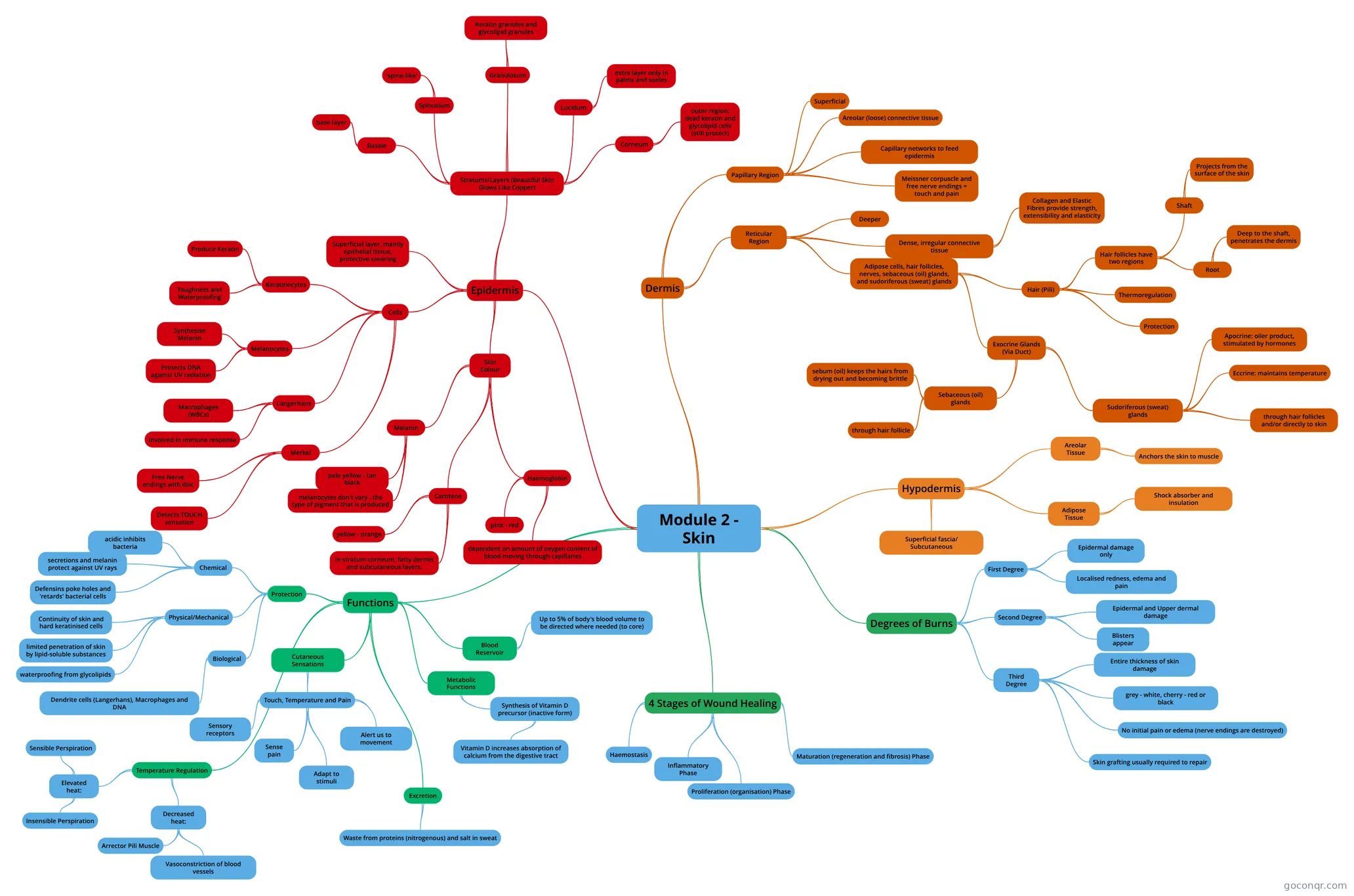
Mind map: Module 2 skin
Contenido del mapa
Module 2 - Skin
Epidermis
- Superficial layer, mainly epithelial tissue, protective covering
- Cells
- Keratinocytes
- Produce Keratin
- Toughness and Waterproofing
- Melanocytes
- Synthesise Melanin
- Protects DNA against UV radiation
- Langerhans
- Macrophages (WBCs)
- Involved in immune response
- Merkel
- Free Nerve endings with disc
- Detects TOUCH sensation
- Keratinocytes
- Skin Colour
- Melanin
- pale yellow - tan black
- melanocytes don't vary , the type of pigment that is produced
- Carotene
- yellow - orange
- in stratum corneum, fatty dermis and subcutaneous layers.
- Haemoglobin
- pink - red
- dependent on amount of oxygen content of blood moving through capillaries
- Melanin
- Stratums/Layers (Beautiful Skin Glows Like Copper)
- Basale
- base layer
- Spinosium
- 'spine-like'
- Granulosum
- Keratin granules and glycolipid granules
- Lucidum
- extra layer only in palms and soeles
- Corneum
- outer region: dead keratin and glycolipid cells (still protect)
- Basale
Dermis
- Papillary Region
- Superficial
- Areolar (loose) connective tissue
- Capillary networks to feed epidermis
- Meissner corpuscle and free nerve endings = touch and pain
- Reticular Region
- Deeper
- Dense, irregular connective tissue
- Collagen and Elastic Fibres provide strength, extensibility and elasticity
- Adipose cells, hair follicles, nerves, sebaceous (oil) glands, and sudoriferous (sweat) glands
- Exocrine Glands (Via Duct)
- Sebaceous (oil) glands
- through hair follicle
- sebum (oil) keeps the hairs from drying out and becoming brittle
- Sudoriferous (sweat) glands
- through hair follicles and/or directly to skin
- Eccrine: maintains temperature
- Apocrine: oiler product, stimulated by hormones
- Sebaceous (oil) glands
- Hair (Pili)
- Protection
- Thermoregulation
- Hair follicles have two regions
- Shaft
- Projects from the surface of the skin
- Root
- Deep to the shaft, penetrates the dermis
- Shaft
- Exocrine Glands (Via Duct)
- Papillary Region
Hypodermis
- Superficial fascia/ Subcutaneous
- Adipose Tissue
- Shock absorber and insulation
- Areolar Tissue
- Anchors the skin to muscle
Functions
- Protection
- Chemical
- acidic inhibits bacteria
- secretions and melanin protect against UV rays
- Defensins poke holes and 'retards' bacterial cells
- Physical/Mechanical
- Continuity of skin and hard keratinised cells
- waterproofing from glycolipids
- limited penetration of skin by lipid-soluble substances
- Biological
- Dendrite cells (Langerhans), Macrophages and DNA
- Chemical
- Cutaneous Sensations
- Touch, Temperature and Pain
- Sensory receptors
- Sense pain
- Adapt to stimuli
- Alert us to movement
- Touch, Temperature and Pain
- Metabolic Functions
- Synthesis of Vitamin D precursor (inactive form)
- Vitamin D increases absorption of calcium from the digestive tract
- Synthesis of Vitamin D precursor (inactive form)
- Blood Reservoir
- Up to 5% of body's blood volume to be directed where needed (to core)
- Excretion
- Waste from proteins (nitrogenous) and salt in sweat
- Temperature Regulation
- Elevated heat:
- Insensible Perspiration
- Sensible Perspiration
- Decreased heat:
- Arrector Pili Muscle
- Vasoconstriction of blood vessels
- Elevated heat:
- Protection
4 Stages of Wound Healing
- Haemostasis
- Inflammatory Phase
- Proliferation (organisation) Phase
- Maturation (regeneration and fibrosis) Phase
Degrees of Burns
- First Degree
- Epidermal damage only
- Localised redness, edema and pain
- Second Degree
- Epidermal and Upper dermal damage
- Blisters appear
- Third Degree
- Entire thickness of skin damage
- grey - white, cherry - red or black
- No initial pain or edema (nerve endings are destroyed)
- Skin grafting usually required to repair
- First Degree
Información
- Descripción
- HAP Mapa Mental sobre Module 2 - Skin, creado por rachlockwood el 23/03/2015.
- Creado por
- rachlockwood
- Visitas
- 0
- Valoración