
Mapa mental
Ocean Acidification
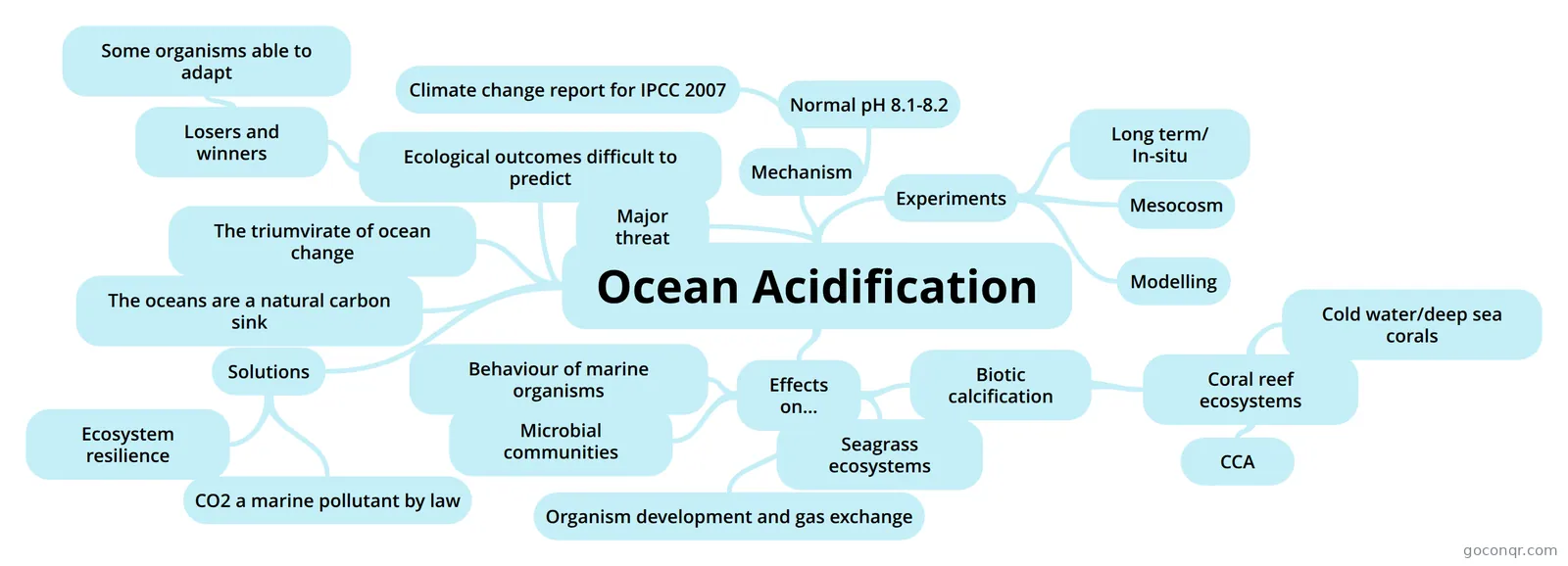
Mind map: Ocean acidification
Contenido del mapa
Ocean Acidification
Mechanism
- In the atmosphere CO2 is a chemically inert gas but when mixed with water it forms carbonic acid (H2CO3). This is a weak acid and thus quickly breaks down to into bicarbonate ions (HCO3-) and hydrogen ions (H+). H+ react with carbonate (CO3 2-) already present in seawater, decreasing it and forming more bicarbonate further reducing the amount of carbonate ions available. This in turn reduces the carbonate saturation state of surface waters hindering biotic calcification of many marine organisms. The excess of hydrogen ions released into solution during this process drives the pH down towards ver lower values. The more hydrogen ions there are in a solution the more acidic it is and anthropogenic CO2 emissions are said to have caused an estimated 30% increase the the concentration of H+ since the early 1900's (Climate change report for IPCC, 2007).
- Once dissolved in seawater, CO2 reacts with water, H2O, to form carbonic acid, H2CO3:CO2 + H2O ↔ H2CO3. Carbonic acid dissolves rapidly to form H+ ions (an acid) and bicarbonate, HCO3-(a base). Seawater is naturally saturated with another base, carbonate ion (CO3−2) that acts like an antacid to neutralize the H+, forming more bicarbonate. The net reaction looks like this: CO2 + H2O + CO3−2→ 2HCO3-
- Climate change report for IPCC 2007
- Anthropogenic actions have caused an increase in H+ concentration in the oceans by 30% since the early 1900's.
- Normal pH 8.1-8.2
- Although this fluctuates naturally. The lowest values are observed in upwelling regions (eg Equatorial Pacific, Arabian Sea) where subsurface waters with lower pH values are brought to the surface. The highest values are observed in regions of high biological production and export. Predicted to decrease to around 7.8 by the end of the century if atmospheric carbon dioxide concentrations increase from 390 to 750ppm, consistent with some scenarios for the end of this century (Fabricius et al. 2011).
Experiments
- Long term/ In-situ
- To attempt to predict what might happen in real ecological communities in situ experiments in habitats naturally high in CO2 such as volcanic seeps, provide a solution. Long term monitoring of carbonate chemistry and seagrass ecosystems.
- Although natural CO2 flux from volcanic vents amounts to < 0.5% of anthropogenic emissions they do alter ocean chemistry and are therefore a good in-situ system for observing changes in community structure under different pH levels.
- Mesocosm
- Difficult to scale up from lab experiments to actual ecological communities as much of the time they only focus on one species or a small component of the ecosystem. Nevertheless they have revealed much about the mechanisms of OA and how it effects organisms growth, development, physiology etc.
- Modelling
- Caldiera & Wickett modelled future projections of decreased pH and predicted that by 2050 the pH of surface waters may be lower than at any other time in the last 25 million years - as this is unprecedented it is very hard to predict future outcomes for ecological communities.
- Long term/ In-situ
Effects on...
- Biotic calcification
- The organisms most at risk from OA are those that biomineralise carbonate (CO3 2 -) and calcium (Ca 2+) to form calcium carbonate (CaCO3) to form their skeletal structures or shells. Carbonate ions are essential for the biotic calcification of marine organisms that construct their shells from calcium carbonate. This is used by marine animals in 2 commonly occuring forms; calcite used by organisms such as coccolithophore and aragonite which is used by pteropods and corals. With reduced carbonate ions available under lower pH conditions the saturation state of both calcite and aragonite is lowered. This leads to the dissolution of organism's shells and skeletons as they are no longer able to maintain there external calcium carbonate structures (Orr et al. 2005)
- Martin et al. (2008) found that the abundance of calcifying organisms was 90% lower at pH 7.7 than at pH 8.2, reducing the overall biodiversity of these important ecosystems.
- Coral reef ecosystems
- In situ experiments in coral reef ecosystems have also shown dramatic changes in community structure potentially having devastating consequences for the biodiversity and ecosystem services of the ecologically and economically important ecosystems.
- Fabricius et al. (2011) conducted an in-situ field study of a tropical coral reef ecosystem at volcanic CO2 seeps in Papua New Guinea. Also looked at the effects of OA on seagrass, sponges etc. at the site - looking at whole ecosystem not just one aspect. Compared ecolgical community along a pH gradient of 8.1 - 7.7. Found that at sites of lower pH the cover of structurally complex corals such as Pocillopora damicornis was reduced 3 fold however overall coral cover was constant between pH 8.1 to around 7.8 although massive Porites corals established dominance over overall structural corals despite lowered rates of calcification in both taxa. This could have implications at higher trophic levels as a reduction in structurally complex corals will lead to fewer niches for organisms to occupy and reduced habitat availability for juvenile fish and invertebrates - impacts biodiversity and ecosystem services. Findings of this study are analogous as to what could occur in the wider ocean environment if atmospheric CO2 emissions continue at a business-as-usual scenario.
- The cover of crustose coralline algae, an important primary reef calcifier and substrate for the settlement of juvenile corals and formation of new reef reduced 7 fold. The cover of fleshy, non-calcareous macro-algae (such as Padina sp.) doubled in reduced pH indicating that increased CO2 levels could induce phase shift from coral to algae dominated ecosystems that are less diverse and do not support ecosystem services that humans and other organisms depend on.
- Cold water/deep sea corals
- Deep sea corals; The saturation level of calcium carbonate decreases with depth and the aragonite saturation state is shouling rapidly under inmcreased CO2 levels, therefore the impact on deep water corals such as Lophelia pertusa could be severe as they will not be able to maintain their skeletal structures. This could have further ecological and economic impacts, for instance Cod (Gadus morhua) a commercially important species uses deep sea coral reefs as a nursery ground and refuge habitat.
- Cold water corals; Because colder ocean waters absorb more CO2 due to it being more soluble in cooler water they naturally have lower carbonate levels than warmer waters. This means that polar waters are more sensitive to the elevated levels of carbon dioxide in the atmosphere caused by man. The recent dramatic decrease in sea ice cover in the Arctic ocean in the summer months also means that there is more surface area of open water each year which is able to absorb more CO2, further exacerbating the problem. This could have serious implications for cold water marine life. Thecosome pteropods (such as Limicina helicina) are pelagic molluscs and play an important role in Arctic marine food webs. Comeau et al. (2009) found that the Arctic pteropod Limicina helicina's calcification rate was 28% less in pH levels predicted for the end of this century. Any decline in their population would cause dramatic changes in the structure, function and services of polar ecosystems.
- CCA
- crustose coralline algae is an important primary reef calcifier and substrate for the settlement of juvenile corals and formation of new reef. Kuffner et al. (2007) ran a mesocosm experiment over a period of seven weeks with seawater manipulated to elevated carbon dioxide concentrations and found that the recruitment rate and growth of CCA was severely inhibited under elevated CO2 conditions. This suggest that ocean acidification due to human activities could cause significant change to benthic community structure in shallow-warm-water carbonate ecosystems. This type of mesocosm study supports the findings of in situ experiments.
- Behaviour of marine organisms
- Another mechanism by which OA impacts coral reef communities is the effect on the behaviour of reef organisms such as fish and invertebrates. Reef fish have been found to regulate their acid-base balance in response to lowered pH which alters the ion gradient across neurons, disrupting neuron transmission pathways. This leads to a reversal of neuron function causing profound changes in sensory preferences and behavior. A study by Nilssonn et al. (2012) concluded that this was caused by the shift in ion gradient across the major neurotransmitter receptor in the vertebrate brain - the gamma-aminobutyric acid (GABA) A receptor. The study found that this shifted olfactory preferences and predator avoidance in larval clownfish Amphiprion percula were altered with fish being attracted the the cue of their predator the rockcod Cephalopholis cyanostigm.
- Another study by Munday et al. (2009) found that larval A. percula were unable to discriminate suitable reef habitat and under pH 7.6 (predicted by 2200) were no longer able to respond to olfactory cues. As chemical cues are the predominant form of communication in the ocean changes in olfactory responses may be particularly detrimental.
- These changes in behaviour and decision making caused by reduced pH driven by ocean acidification are likely to have impacts such as reduced habitat recruitment, population destabilisation and trophic instability and subsequent effects on the wider marine ecosystem.
- Seagrass ecosystems
- Hall-Spencer et al. (2008) found pronounced shifts in biodiversity under lowered pH but some organisms, such as the seagrass Posidonia oceanica, were naturally resilient and able to occupy vent sites with lowered pH. Although this may indicate that this seagrass may thrive under reduced pH conditions the overall biodiversity of the habitat is reduced.
- Seagrass are critically important habitats in many coastal ecosystems providing habitat for a diverse range epibiotic organisms and infauna, many of calcifying organims form a major component of the seagrass biological community. Carbonate ions are essential for the biotic calcification of marine organisms that construct their shells from calcium carbonate. This is used by marine animals in 2 commonly occuring forms; calcite used by organisms such as coccolithophore and aragonite which is used by pteropods and corals. With reduced carbonate ions available under lower pH conditions the saturation state of both calcite and aragonite is lowered. This leads to the dissolution of organism's shells and skeletons as they are no longer able to maintain there external calcium carbonate structures (Orr et al. 2005)
- Although some seagrasses may seem to thrive a literature review by Koch et al. (2013) noted that seagrasses and other macroalgae are taxonomically and metabolically more diverse than terrestrial plants, making generalisations about their response to elevated CO2 even more varied and difficult to predict. Martin et al. (2008) found that the abundance of calcifying organisms was 90% lower at pH 7.7 than at pH 8.2, even though seagrass shoot density itself was higher. So even though seagrass may appear to "win" in an elevated CO2 scenario the overall biodiversity of these important ecosystems is reduced.
- Microbial communities
- Marine biofilms consist of micro-organisms which exist as a community and are surrounded by a matrix formed of extra-cellular polymeric substance (EPS). Biofilms form on natural and manmade surfaces and provide food for grazers such as Patella sp., they are also an essential entry point for metal ions to the trophic food web, which are crucial for the biological function of marine organisms. An alteration in bacterial community structure could reduce grazer consumption of biofilm, causing a decrease in prey for higher trophic predators and leading to shifts in community structure higher up the food chain.
- The impact of OA on microbial communities has not yet been fully established although there is evidence to suggest they do shift under different pH conditions. Taylor et al. (2014) found that intertidal epilithic bacteria diversity changed along the CO2 and pH gradient at a CO2 seep in the bay of a volcanic island (Vulcano, Italy). Diversity and community composition was significantly different between sites of low and high pH. As epilithic bacterial communities are important components of coastal ecosystems shifts in their communities could have impacts at higher trophic levels within the system.
- An increase in pathogens has also been observed under lowered pH conditions, for example Krause et al (2012) found an increase in Campylobacteraceae and Vibrionaceae with potential implications for human and animal health.
- Organism development and gas exchange
- Biotic calcification
The triumvirate of ocean change
- OA, ocean warming and deoxygenation. As ocean waters warm they are less able to absorb CO2 as its solubility is lowered in warmer waters.
- Increase of CO2 in atmosphere also contributes to ocean warming via the greenhouse effect creating a positive feedback loop which accelerates climate change. This has seen global sea surface temperatures rise to 0.74c higher than pre-industrial times (Hoegh-Guldberg et al. 2007).
The oceans are a natural carbon sink
- Absorb around 24 million tons of CO2 per day, making overall marine absorption of CO2 almost as great as terrestrial systems (Field et al. 2009).
Ecological outcomes difficult to predict
- Some species may thrive under eCo2/lowered pH conditions. Often invasive species, shifts in ecological communities with ecosystems generally appearing to become less biodiverse.
- Losers and winners
- Some organisms respond positively while some will be disadvantaged, with probable profound effects on the biodiversity and ecosystem services of the marine environment.
- Some organisms able to adapt
Solutions
- Ecosystem resilience
- CO2 a marine pollutant by law
Major threat
- Anthropogenically driven elevated carbon dioxide (CO2) is a major threat to marine ecosystems on a global scale.
Información
- Descripción
- Mapa Mental sobre Ocean Acidification, creado por amyycartwright el 10/04/2015.
- Creado por
- amyycartwright
- Visitas
- 5
- Valoración
Más sobre Effects of climate change