
Mapa mental
CR - Defences (continued)
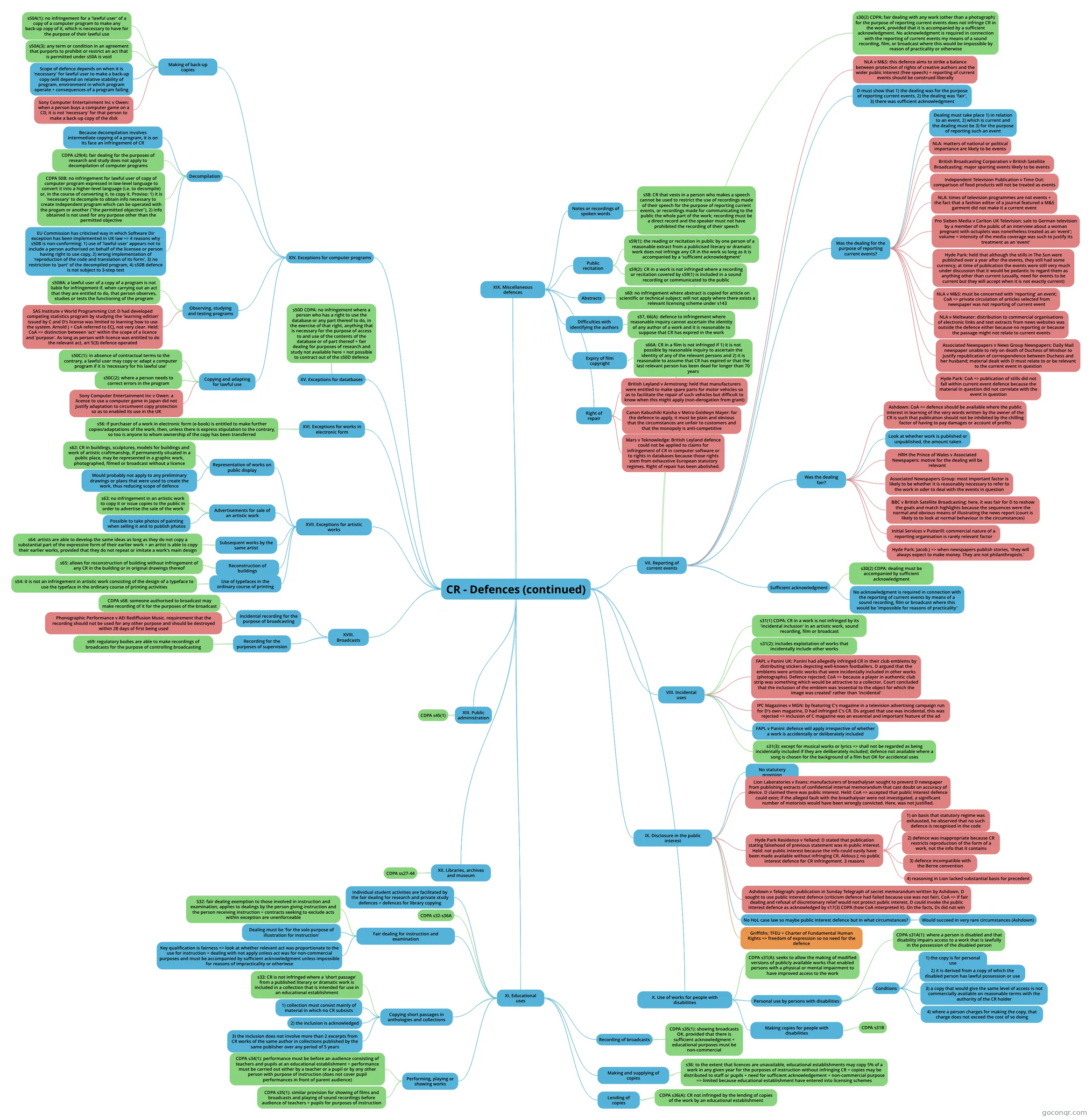
Mind map: CR defences (continued)
Contenido del mapa
CR - Defences (continued)
VII. Reporting of current events
- s30(2) CDPA: fair dealing with any work (other than a photograph) for the purpose of reporting current events does not infringe CR in the work, provided that it is accompanied by a sufficient acknowledgment. No acknowledgment is required in connection with the reporting of current events my means of a sound recording, film, or broadcast where this would be impossible by reason of practicality or otherwise
- NLA v M&S: this defence aims to strike a balance between protection of rights of creative authors and the wider public interest (free speech) + reporting of current events should be construed liberally
- D must show that 1) the dealing was for the purpose of reporting current events, 2) the dealing was 'fair', 3) there was sufficient acknowledgment
- Was the dealing for the purpose of reporting current events?
- Dealing must take place 1) in relation to an event, 2) which is current and the dealing must be 3) for the purpose of reporting such an event
- NLA: matters of national or political importance are likely to be events
- British Broadcasting Corporation v British Satellite Broadcasting: major sporting events likely to be events
- Independent Television Publication v Time Out: comparison of food products will not be treated as events
- NLA: times of television programmes are not events + the fact that a fashion editor of a journal featured a M&S garment did not make it a current event
- Pro Sieben Media v Carlton UK Television: sale to German television by a member of the public of an interview about a woman pregnant with octuplets was nonetheless treated as an 'event'; volume + intensity of the media coverage was such to justify its treatment as an 'event'
- Hyde Park: held that although the stills in The Sun were published over a year after the events, they still had some currency; at time of publication the events were still very much under discussion that it would be pedantic to regard them as anything other than current (usually, need for events to be current but they will accept when it is not exactly current)
- NLA v M&S: must be concerned with 'reporting' an event; CoA => private circulation of articles selected from newspaper was not reporting of current event
- NLA v Meltwater: distribution to commercial organisations of electronic links and text extracts from news websites was outside the defence either because no reporting or because the passage might not relate to current events
- Associated Newspapers v News Group Newspapers: Daily Mail newspaper unable to rely on death of Duchess of Windsor to justify republication of correspondence between Duchess and her husband; material dealt with D must relate to or be relevant to the current event in question
- Hyde Park: CoA => publication of stills did not fall within current event defence because the material in question did not correlate with the event in question
- Was the dealing fair?
- Ashdown: CoA => defence should be available where the public interest in learning of the very words written by the owner of the CR is such that publication should not be inhibited by the chilling factor of having to pay damages or account of profits
- HRH the Prince of Wales v Associated Newspapers: motive for the dealing will be relevant
- Look at whether work is published or unpublished, the amount taken
- Associated Newspapers Group: most important factor is likely to be whether it is reasonably necessary to refer to the work in oder to deal with the events in question
- BBC v British Satellite Broadcasting: here, it was fair for D to reshow the goals and match highlights because the sequences were the normal and obvious means of illustrating the news report (court is likely to to look at normal behaviour in the circumstances)
- Initial Services v Putterill: commercial nature of a reporting organisation is rarely relevant factor
- Hyde Park: Jacob J => when newspapers publish stories, 'they will always expect to make money. They are not philanthropists.'
- Sufficient acknowledgment
- s30(2) CDPA: dealing must be accompanied by sufficient acknowledgment
- No acknowledgment is required in connection with the reporting of current events by means of a sound recording, film or broadcast where this would be 'impossible for reasons of practicality'
VIII. Incidental uses
- s31(1) CDPA: CR in a work is not infringed by its 'incidental inclusion' in an artistic work, sound recording, film or broadcast
- s31(2): includes exploitation of works that incidentally include other works
- FAPL v Panini UK: Panini had allegedly infringed CR in their club emblems by distributing stickers depicting well-known footballers. D argued that the emblems were artistic works that were incidentally included in other works (photographs). Defence rejected; CoA => because a player in authentic club strip was something which would be attractive to a collector, Court concluded that the inclusion of the emblem was 'essential to the object for which the image was created' rather than 'incidental'
- IPC Magazines v MGN: by featuring C's magazine in a television advertising campaign run for D's own magazine, D had infringed C's CR. Ds argued that use was incidental, this was rejected => inclusion of C magazine was an essential and important feature of the ad
- FAPL v Panini: defence will apply irrespective of whether a work is accidentally or deliberately included
- s31(3): except for musical works or lyrics => shall not be regarded as being incidentally included if they are deliberately included; defence not available where a song is chosen for the background of a film but OK for accidental uses
IX. Disclosure in the public interest
- No statutory provision
- Lion Laboratories v Evans: manufacturers of breathalyser sought to prevent D newspaper from publishing extracts of confidential internal memorandum that cast doubt on accuracy of device. D claimed there was public interest. Held: CoA => accepted that public interest defence could exist; if the alleged fault with the breathalyser were not investigated, a significant number of motorists would have been wrongly convicted. Here, was not justified.
- Hyde Park Residence v Yelland: D stated that publication stating falsehood of previous statement was in public interest. Held: not public interest because the info could easily have been made available without infringing CR. Aldous J: no public interest defence for CR infringement. 3 reasons
- 1) on basis that statutory regime was exhausted, he observed that no such defence is recognised in the code
- 2) defence was inappropriate because CR restricts reproduction of the form of a work, not the info that it contains
- 3) defence incompatible with the Berne convention
- 4) reasoning in Lion lacked substantial basis for precedent
- Ashdown v Telegraph: publication in Sunday Telegraph of secret memorandum written by Ashdown. D sought to use public interest defence (criticism defence had failed because use was not fair). CoA => if fair dealing and refusal of discretionary relief would not protect public interest, D could invoke the public interest defence as acknowledged by s17(3) CDPA (how CoA interpreted it). On the facts, Ds did not win
- No HoL case law so maybe public interest defence but in what circumstances?
- Would succeed in very rare circumstances (Ashdown)
- Griffiths: TFEU + Charter of Fundamental Human Rights => freedom of expression so no need for the defence
X. Use of works for people with disabilities
- CDPA s31(A): seeks to allow the making of modified versions of publicly available works that enabled persons with a physical or mental impairment to have improved access to the work
- Personal use by persons with disabilities
- CDPA s31A(1): where a person is disabled and that disability impairs access to a work that is lawfully in the possession of the disabled person
- Condtions
- 1) the copy is for personal use
- 2) it is derived from a copy of which the disabled person has lawful possession or use
- 3) a copy that would give the same level of access is not commercially available on reasonable terms with the authority of the CR holder
- 4) where a person charges for making the copy, that charge does not exceed the cost of so doing
- Making copies for people with disabilities
- CDPA s31B
XI. Educational uses
- Individual student activities are facilitated by the fair dealing for research and private study defences + defences for library copying
- CDPA s32-s36A
- Fair dealing for instruction and examination
- S32: fair dealing exemption to those involved in instruction and examination; applies to dealings by the person giving instruction and the person receiving instruction + contracts seeking to exclude acts within exception are unenforceable
- Dealing must be 'for the sole purpose of illustration for instruction'
- Key qualification is fairness => look at whether relevant act was proportionate to the use for instruction + dealing with not apply unless act was for non-commercial purposes and must be accompanied by sufficient acknowledgment unless impossible for reasons of impracticality or otheriwse
- Copying short passages in anthologies and collections
- s33: CR is not infringed where a 'short passage' from a published literary or dramatic work is included in a collection that is intended for use in an educational establishment
- 1) collection must consist mainly of material in which no CR subsists
- 2) the inclusion is acknowledged
- 3) the inclusion does not involve more than 2 excerpts from CR works of the same author in collections published by the same publisher over any period of 5 years
- Performing, playing or showing works
- CDPA s34(1): performance must be before an audience consisting of teachers and pupils at an educational establishment + performance must be carried out either by a teacher or a pupil or by any other person with purpose of instruction (does not cover pupil performances in front of parent audience)
- CDPA s35(1): similar provision for showing of films and broadcasts and playing of sound recordings before audience of teachers + pupils for purposes of instruction
- Recording of broadcasts
- CDPA s35(1): showing broadcasts OK, provided that there is sufficient acknowledgment + educational purposes must be non-commercial
- Making and supplying of copies
- s36: to the extent that licences are unavailable, educational establishments may copy 5% of a work in any given year for the purposes of instruction without infringing CR + copies may be distributed to staff or pupils + need for sufficient acknowledgement + non-commercial purpose => limited because educational establishment have entered into licensing schemes
- Lending of copies
- CDPA s36(A): CR not infringed by the lending of copies of the work by an educational establishment
XII. Libraries, archives and museum
- CDPA ss27-44
XIII. Public administration
- CDPA s45(1)
XIV. Exceptions for computer programs
- Making of back-up copies
- s50A(1): no infringement for a 'lawful user' of a copy of a computer program to make any back-up copy of it, which is necessary to have for the purpose of their lawful use
- s50A(3): any term or condition in an agreement that purports to prohibit or restrict an act that is permitted under s50A is void
- Scope of defence depends on when it is 'necessary' for lawful user to make a back-up copy (will depend on relative stability of program, environment in which program operate + consequences of a program failing
- Sony Computer Entertainment Inc v Owen: when a person buys a computer game on a CD, it is not 'necessary' for that person to make a back-up copy of the disk
- Decompilation
- Because decompilation involves intermediate copying of a program, it is on its face an infringement of CR
- CDPA 50B: no infringement for lawful user of copy of computer program expressed in low-level language to convert it into a higher-level language (i.e. to decompile) or, in the course of converting it, to copy it. Proviso: 1) it is 'necessary' to decompile to obtain info necessary to create independent program which can be operated with the progam or another ("the permitted objective"), 2) info obtained is not used for any purpose other than the permitted objective
- CDPA s29(4): fair dealing for the purposes of research and study does not apply to decompilation of computer programs
- EU Commission has criticised way in which Software Dir exception has been implemented in UK law => 4 reasons why s50B is non-conforming: 1) use of 'lawful user' appears not to include a person authorised on behalf of the licensee or person having right to use copy, 2) wrong implementation of 'reproduction of the code and translation of its form', 3) no restriction to 'part' of the decompiled program, 4) s50B defence is not subject to 3-step test
- Observing, studying and testing programs
- s50BA: a lawful user of a copy of a program is not liable for infringement if, when carrying out an act that they are entitled to do, that person observes, studies or tests the functioning of the program
- SAS Institute v World Programming Ltd: D had developed competing statistics program by studying the 'learning edition' issued by C and D's license was limited to learning how to use the system. Arnold J + CoA referred to ECJ, not very clear. Held: CoA => distinction between 'act' within the scope of a licence and 'purpose'. As long as person with licence was entitled to do the relevant act, art 5(3) defence operated
- Copying and adapting for lawful use
- s50C(1): in absence of contractual terms to the contrary, a lawful user may copy or adapt a computer program if it is 'necessary for his lawful use'
- s50C(2): where a person needs to correct errors in the program
- Sony Computer Entertainment Inc v Owen: a license to use a computer game in Japan did not justify adaptation to circumvent copy protection so as to enabled its use in the UK
- Making of back-up copies
XV. Exceptions for datatbases
- s50D CDPA: no infringement where a person who has a right to use the database or any part thereof to do, in the exercise of that right, anything that is necessary for the purpose of access to and use of the contents of the database or of part thereof + fair dealing for purposes of research and study not available here + not possible to contract out of the s50D defence
XVI. Exceptions for works in electronic form
- s56: if purchaser of a work in electronic form (e-book) is entitled to make further copies/adaptations of the work, then, unless there is express stipulation to the contrary, so too is anyone to whom ownership of the copy has been transferred
XVII. Exceptions for artistic works
- Representation of works on public display
- s62: CR in buildings, sculptures, models for buildings and work of artistic craftmanship, if permanently situated in a public place, may be represented in a graphic work, photographed, filmed or broadcast without a licence
- Would probably not apply to any preliminary drawings or plans that were used to create the work, thus reducing scope of defence
- Advertisements for sale of an artistic work
- s63: no infringement in an artistic work to copy it or issue copies to the public in order to advertise the sale of the work
- Possible to take photos of painting when selling it and to publish photos
- Subsequent works by the same artist
- s64: artists are able to develop the same ideas as long as they do not copy a substantial part of the expressive form of their earlier work + an artist is able to copy their earlier works, provided that they do not repeat or imitate a work's main design
- Reconstruction of buildings
- s65: allows for reconstruction of building without infringement of any CR in the building or in original drawings thereof
- Use of typefaces in the ordinary course of printing
- s54: it is not an infringement in artistic work consisting of the design of a typeface to use the typeface in the ordinary course of printing activities
- Representation of works on public display
XVIII. Broadcasts
- Incidental recording for the purpose of broadcasting
- CDPA s68: someone authorised to broadcast may make recording of it for the purposes of the broadcast
- Phonographic Performance v AEI Rediffusion Music. requirement that the recording should not be used for any other purpose and should be destroyed within 28 days of first being used
- Recording for the purposes of supervision
- s69: regulatory bodies are able to make recordings of broadcasts for the purpose of controlling broadcasting
- Incidental recording for the purpose of broadcasting
XIX. Miscellaneous defences
- Notes or recordings of spoken words
- s58: CR that vests in a person who makes a speech cannot be used to restrict the use of recordings made of their speech for the purpose of reporting current events, or recordings made for communicating to the public the whole part of the work; recording must be a direct record and the speaker must not have prohibited the recording of their speech
- Public recitation
- s59(1): the reading or recitation in public by one person of a reasonable extract from a publicised literary or dramatic work does not infringe any CR in the work so long as it is accompanied by a 'sufficient acknowledgment'
- s59(2): CR in a work is not infringed where a recording or recitation covered by s59(1) is included in a sound recording or communicated to the public
- Abstracts
- s60: no infringement where abstract is copied for article on scientific or technical subject; will not apply where there exists a relevant licensing scheme under s143
- Difficulties with identifying the authors
- s57, 66(A): defence to infringement where reasonable inquiry cannot ascertain the identity of any author of a work and it is reasonable to suppose that CR has expired in the work
- Expiry of film copyright
- s66A: CR in a film is not infringed if 1) it is not possible by reasonable inquiry to ascertain the identity of any of the relevant persons and 2) it is reasonable to assume that CR has expired or that the last relevant person has been dead for longer than 70 years
- Right of repair
- British Leyland v Armstrong: held that manufacturers were entitled to make spare parts for motor vehicles so as to facilitate the repair of such vehicles but difficult to know when this might apply (non-derogation from grant)
- Canon Kabushiki Kaisha v Metro Goldwyn Mayer: for the defence to apply, it must be plain and obvious that the circumstances are unfair to customers and that the monopoly is anti-competitive
- Mars v Teknowledge: British Leyland defence could not be applied to claims for infringement of CR in computer software or to rights in databases because those rights stem from exhaustive European statutory regimes. Right of repair has been abolished.
- Notes or recordings of spoken words
Información
- Descripción
- Law second year (Copyright - defences) Intellectual property law Mapa Mental sobre CR - Defences (continued), creado por Emilie Schou el 24/04/2015.
- Creado por
- Emilie Schou
- Visitas
- 1
- Valoración
Más sobre Fair use, fair dealing and copyright defences