
Mapa mental
Physics
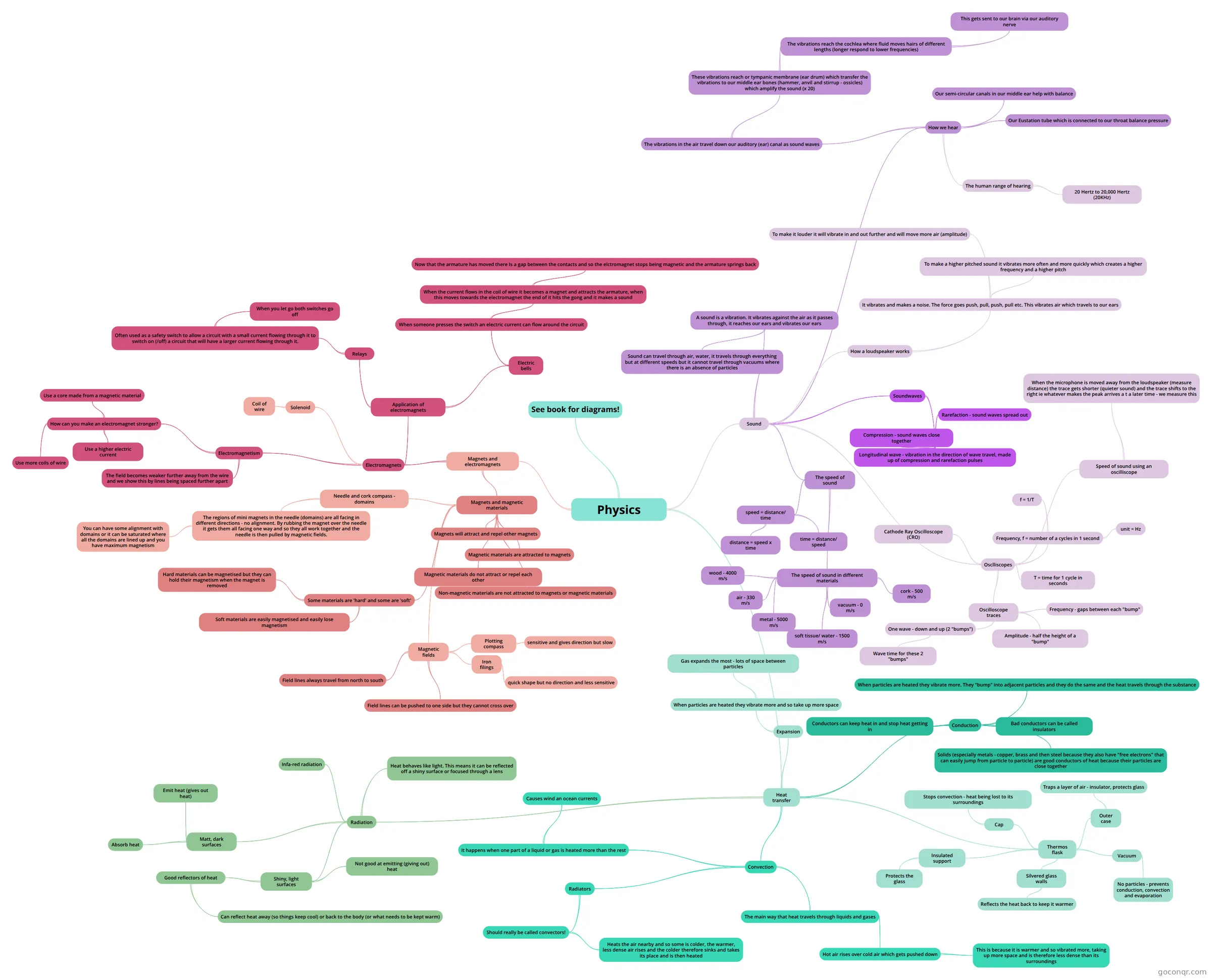
Mind map: Physics
Contenido del mapa
Physics
Magnets and electromagnets
- Magnets and magnetic materials
- Magnets will attract and repel other magnets
- Magnetic materials are attracted to magnets
- Magnetic materials do not attract or repel each other
- Non-magnetic materials are not attracted to magnets or magnetic materials
- Needle and cork compass - domains
- The regions of mini magnets in the needle (domains) are all facing in different directions - no alignment. By rubbing the magnet over the needle it gets them all facing one way and so they all work together and the needle is then pulled by magnetic fields.
- You can have some alignment with domains or it can be saturated where all the domains are lined up and you have maximum magnetism
- The regions of mini magnets in the needle (domains) are all facing in different directions - no alignment. By rubbing the magnet over the needle it gets them all facing one way and so they all work together and the needle is then pulled by magnetic fields.
- Some materials are 'hard' and some are 'soft'
- Hard materials can be magnetised but they can hold their magnetism when the magnet is removed
- Soft materials are easily magnetised and easily lose magnetism
- Magnetic fields
- Plotting compass
- sensitive and gives direction but slow
- Iron filings
- quick shape but no direction and less sensitive
- Field lines can be pushed to one side but they cannot cross over
- Field lines always travel from north to south
- Plotting compass
- Electromagnets
- Solenoid
- Coil of wire
- Electromagnetism
- The field becomes weaker further away from the wire and we show this by lines being spaced further apart
- How can you make an electromagnet stronger?
- Use more coils of wire
- Use a higher electric current
- Use a core made from a magnetic material
- Application of electromagnets
- Relays
- Often used as a safety switch to allow a circuit with a small current flowing through it to switch on (/off) a circuit that will have a larger current flowing through it.
- When you let go both switches go off
- Often used as a safety switch to allow a circuit with a small current flowing through it to switch on (/off) a circuit that will have a larger current flowing through it.
- Electric bells
- When someone presses the switch an electric current can flow around the circuit
- When the current flows in the coil of wire it becomes a magnet and attracts the armature, when this moves towards the electromagnet the end of it hits the gong and it makes a sound
- Now that the armature has moved there Is a gap between the contacts and so the elctromagnet stops being magnetic and the armature springs back
- When the current flows in the coil of wire it becomes a magnet and attracts the armature, when this moves towards the electromagnet the end of it hits the gong and it makes a sound
- When someone presses the switch an electric current can flow around the circuit
- Relays
- Solenoid
- Magnets and magnetic materials
See book for diagrams!
Sound
- A sound is a vibration. It vibrates against the air as it passes through, it reaches our ears and vibrates our ears
- Sound can travel through air, water, it travels through everything but at different speeds but it cannot travel through vacuums where there is an absence of particles
- How a loudspeaker works
- It vibrates and makes a noise. The force goes push, pull, push, pull etc. This vibrates air which travels to our ears
- To make it louder it will vibrate in and out further and will move more air (amplitude)
- To make a higher pitched sound it vibrates more often and more quickly which creates a higher frequency and a higher pitch
- It vibrates and makes a noise. The force goes push, pull, push, pull etc. This vibrates air which travels to our ears
- Soundwaves
- Longitudinal wave - vibration in the direction of wave travel, made up of compression and rarefaction pulses
- Rarefaction - sound waves spread out
- Compression - sound waves close together
- Longitudinal wave - vibration in the direction of wave travel, made up of compression and rarefaction pulses
- The speed of sound
- speed = distance/ time
- distance = speed x time
- time = distance/ speed
- The speed of sound in different materials
- wood - 4000 m/s
- air - 330 m/s
- metal - 5000 m/s
- soft tissue/ water - 1500 m/s
- vacuum - 0 m/s
- cork - 500 m/s
- speed = distance/ time
- Osclliscopes
- Frequency, f = number of a cycles in 1 second
- unit = Hz
- f = 1/T
- T = time for 1 cycle in seconds
- Oscilloscope traces
- Frequency - gaps between each "bump"
- Amplitude - half the height of a "bump"
- One wave - down and up (2 "bumps")
- Wave time for these 2 "bumps"
- Speed of sound using an oscilliscope
- When the microphone is moved away from the loudspeaker (measure distance) the trace gets shorter (quieter sound) and the trace shifts to the right ie whatever makes the peak arrives a t a later time - we measure this
- Cathode Ray Oscilloscope (CRO)
- Frequency, f = number of a cycles in 1 second
- How we hear
- The vibrations in the air travel down our auditory (ear) canal as sound waves
- These vibrations reach or tympanic membrane (ear drum) which transfer the vibrations to our middle ear bones (hammer, anvil and stirrup - ossicles) which amplify the sound (x 20)
- The vibrations reach the cochlea where fluid moves hairs of different lengths (longer respond to lower frequencies)
- This gets sent to our brain via our auditory nerve
- The vibrations reach the cochlea where fluid moves hairs of different lengths (longer respond to lower frequencies)
- These vibrations reach or tympanic membrane (ear drum) which transfer the vibrations to our middle ear bones (hammer, anvil and stirrup - ossicles) which amplify the sound (x 20)
- Our semi-circular canals in our middle ear help with balance
- Our Eustation tube which is connected to our throat balance pressure
- The human range of hearing
- 20 Hertz to 20,000 Hertz (20KHz)
- The vibrations in the air travel down our auditory (ear) canal as sound waves
- A sound is a vibration. It vibrates against the air as it passes through, it reaches our ears and vibrates our ears
Heat transfer
- Conduction
- When particles are heated they vibrate more. They "bump" into adjacent particles and they do the same and the heat travels through the substance
- Solids (especially metals - copper, brass and then steel because they also have "free electrons" that can easily jump from particle to particle) are good conductors of heat because their particles are close together
- Bad conductors can be called insulators
- Conductors can keep heat in and stop heat getting in
- Convection
- The main way that heat travels through liquids and gases
- Hot air rises over cold air which gets pushed down
- This is because it is warmer and so vibrated more, taking up more space and is therefore less dense than its surroundings
- Hot air rises over cold air which gets pushed down
- It happens when one part of a liquid or gas is heated more than the rest
- Causes wind an ocean currents
- Radiators
- Should really be called convectors!
- Heats the air nearby and so some is colder, the warmer, less dense air rises and the colder therefore sinks and takes its place and is then heated
- Should really be called convectors!
- The main way that heat travels through liquids and gases
- Radiation
- Infa-red radiation
- Heat behaves like light. This means it can be reflected off a shiny surface or focused through a lens
- Matt, dark surfaces
- Emit heat (gives out heat)
- Absorb heat
- Shiny, light surfaces
- Good reflectors of heat
- Can reflect heat away (so things keep cool) or back to the body (or what needs to be kept warm)
- Not good at emitting (giving out) heat
- Good reflectors of heat
- Expansion
- When particles are heated they vibrate more and so take up more space
- Gas expands the most - lots of space between particles
- When particles are heated they vibrate more and so take up more space
- Thermos flask
- Cap
- Stops convection - heat being lost to its surroundings
- Outer case
- Traps a layer of air - insulator, protects glass
- Vacuum
- No particles - prevents conduction, convection and evaporation
- Silvered glass walls
- Reflects the heat back to keep it warmer
- Insulated support
- Protects the glass
- Cap
- Conduction
Información
- Descripción
- Year 8 (Physics) Year 8 Mapa Mental sobre Physics, creado por Emily H el 27/04/2015.
- Creado por
- Emily H
- Visitas
- 0
- Valoración
Más sobre Electromagnets and Magnetic Fields of Currents